
präsentiert von

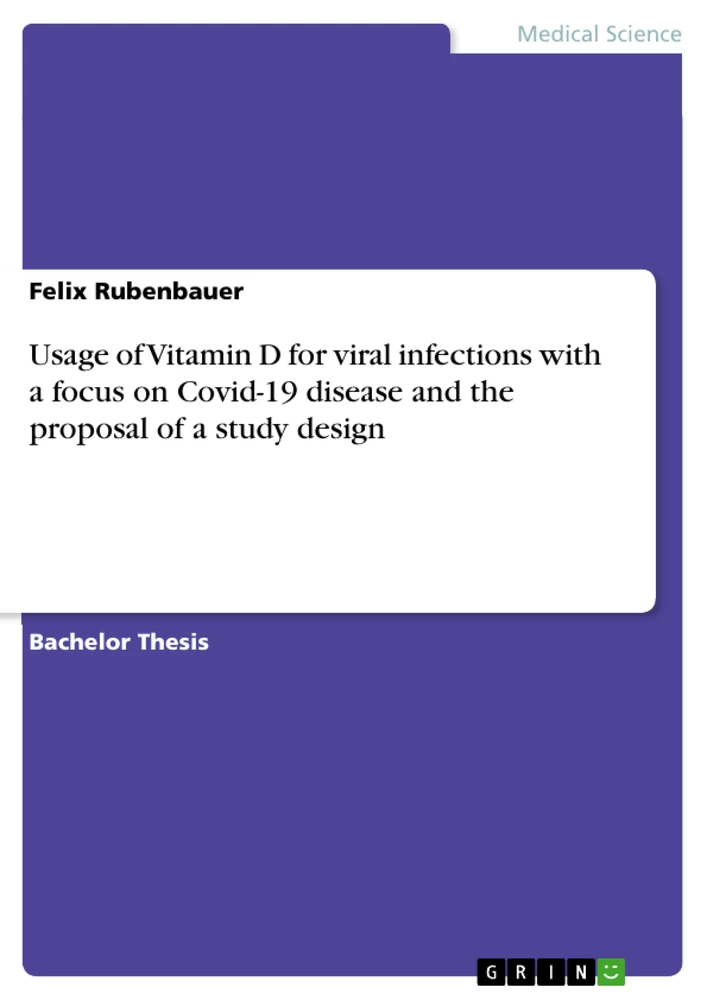
Table of Contents
1. Abstract
2. Introduction
3. Vitamin D
3.1 Physiology
3.2 Effects on the Immune System
4. Vitamin D and Viral Infections
4.1 Vitamin D in upper respiratory tract infections
4.2 Vitamin D and Influenza
4.3 Vitamin D and Herpesviruses
4.4 Vitamin D and HIV
4.5 Vitamin D and Viral Hepatitis
5. Vitamin D and the Covid-19 Disease
5.1 Covid-19
5.2 Covid-19 Pathophysiology
5.3 Treatment of the Covid-19 Disease
5.4 Prevention of the Covid-19 Disease
5.5 Long Covid and Post-Covid
5.6 Covid-19 and Vitamin D
6. Study Synopsis
6.1 Background
6.2 Methods
6.2.1 Aims
6.2.2 Design
6.2.3 Low-Dose Intervention Group
6.2.4 High-Dose Intervention Group
6.2.5 Eligibility criteria
6.2.6 Control group
6.2.7 Recruitment process
6.2.8 Assessment
6.2.9 Analyses
6.2.10 Ethical considerations
7. Conclusions
Research Objectives & Core Themes
The primary objective of this thesis is to evaluate the therapeutic and preventive potential of Vitamin D supplementation regarding common viral infections, with a specific focus on its application and study design necessity in the context of the Covid-19 pandemic and associated hospitalization rates.
- Immunomodulatory properties of Vitamin D in respiratory and viral infections.
- Clinical correlation between Vitamin D serum levels and the severity of Covid-19.
- Comparison of high-dose vs. low-dose Vitamin D supplementation strategies.
- Proposal for a multicenter randomized clinical trial to assess hospitalization reduction.
- Potential role of Vitamin D as a supportive treatment option alongside vaccination.
Excerpt from the Book
Effects on the Immune System
Vitamin D, specifically 1,25(OH)2D, can bind to the vitamin D receptor that is prevalent in activated B and T lymphocytes, which leads to a decrease in cell activity and the reduced production of IgG and IgM (11). This indicates that vitamin D can actively downregulate an inflammatory immune response towards an anti-inflammatory state by inhibiting the production of pro-inflammatory cytokines such as IL-17 and IL-21 and increasing the production of anti-inflammatory cytokine IL-10. Almerigihi et al. found during an in vitro study that monocytes that are stimulated with CD40 ligands produce fewer interleukins IL-1, IL-6, IL-8, IL-12 and TNFɲ. Furthermore, they found fewer apoptotic monocytes and, therefore, the decreased release of interleukins into the bloodstream (12). This provokes the hypothesis that vitamin D can be used as a supportive immunomodulator in patients who need immunomodulatory therapy.
Besides B and T lymphocyte interaction, there is also direct interaction with monocytes. Laghishetty et al. found that vitamin D can interact with the CYP27B1 enzyme in monocytes via toll-like receptors, which leads to responses of the innate immunity to exogenous pathogens (13). Other researchers have uncovered evidence that vitamin D can upregulate gene expression in monocytes to increase the secretion of the antibiotic cathelicidin (14). This correlation can even be seen in general monocyte activity outside of infection states: in patients who are vitamin D deficient, levels of cathelicidin are lower than in patients who have sufficient vitamin D levels; the supplementation of vitamin D elevated the patients’ cathelicidin levels significantly (15). This implies that higher levels of vitamin D can influence faster innate responses to pathogens and lead to less severe disease courses or even the prevention of symptomatic infection.
Summary of Chapters
Abstract: Presents an overview of the role of Vitamin D in viral infections, the existing correlation with Covid-19 severity, and the author's proposal for a clinical trial.
Introduction: Outlines the physiological importance of Vitamin D and the rationale for investigating its impact on immune response and viral illness outcomes.
Vitamin D: Reviews the biochemical pathways of Vitamin D synthesis and its specific regulatory functions within the immune system.
Vitamin D and Viral Infections: Examines evidence for the efficacy of Vitamin D supplementation across specific viruses, including respiratory infections, Influenza, Herpesviruses, HIV, and Viral Hepatitis.
Vitamin D and the Covid-19 Disease: Details the pathophysiology of SARS-CoV-2 and analyzes existing literature on how Vitamin D status affects infection susceptibility and disease progression.
Study Synopsis: Describes the methodology for a proposed randomized control trial, defining the intervention groups, outcome measures, and ethical framework.
Conclusions: Synthesizes findings to suggest that Vitamin D could be a valuable, cost-effective supportive treatment for high-risk populations, warranting further clinical research.
Keywords
Vitamin D, Covid-19, SARS-CoV-2, Immunomodulation, Viral Infections, Supplementation, Hospitalization, Clinical Trial, Cholecalciferol, Innate Immunity, Respiratory Infections, Cytokine Storm, Pathophysiology, Methodology, Randomized Control Trial
Frequently Asked Questions
What is the core focus of this bachelor thesis?
The thesis investigates the immunomodulatory effects of Vitamin D and evaluates its potential as a preventive and therapeutic agent against viral infections, with a specific focus on improving clinical outcomes in Covid-19 patients.
What are the central thematic areas covered?
The paper covers the physiology of Vitamin D, its interaction with the immune system, its effects on various viral infections, the pathophysiology of Covid-19, and the design of a potential clinical trial.
What is the specific research goal or study design proposed?
The primary aim is to test whether specific dosages of Vitamin D supplementation can significantly reduce hospitalization rates in mild to moderate Covid-19 cases. The proposal details a randomized control trial comparing two intervention groups against a control group.
Which scientific methods are employed throughout the text?
The thesis utilizes a literature review of existing clinical trials and systematic reviews to establish a hypothesis, followed by the development of a multicenter randomized control trial design for future validation.
What issues are addressed in the main chapters regarding Covid-19?
The main chapters address how Vitamin D potentially mitigates the "cytokine storm" caused by SARS-CoV-2, the correlation between vitamin deficiency and symptom severity, and how supplementation might lower viral replication.
Which specific keywords define this study?
Key terms include Vitamin D, Covid-19, SARS-CoV-2, Immunomodulation, Viral Infections, and Clinical Trial design, representing the intersection of nutritional medicine and infectious disease research.
How does the proposed trial handle the difference between intervention groups?
The trial proposes assigning cohorts to either a low-dose group (receiving 1,000 IU/d) or a high-dose group (receiving 5,000 IU/d) to observe significant differences in serum levels and hospitalization outcomes over a 28-day period.
Why is the recruitment process specific to nursing homes and residential care?
The recruitment strategy focuses on these environments because they are "ward-based" settings, allowing researchers to study cohorts within the same geographical location and environment, which helps eliminate variance in virus strains and exposure patterns.
Ende der Leseprobe aus 27 Seiten
- nach oben
- Arbeit zitieren
- Felix Rubenbauer (Autor:in), 2021, Usage of Vitamin D for viral infections with a focus on Covid-19 disease and the proposal of a study design, München, Page::Imprint:: GRINVerlagOHG, https://www.diplomarbeiten24.de/document/1281745

neugierig - aktuell - relevant
Entdecken Sie hilfreiche Tipps und Tricks rund ums Studium!

Entdecken Sie hilfreiche Tipps und Tricks rund ums Studium!
Ihre Hausarbeit / Abschlussarbeit:

- - Publikation als E-Book und Buch
- - Hohes Honorar auf die Verkäufe
- - Für Sie komplett kostenlos - mit ISBN
- - Es dauert nur 5 Minuten
- - Jede Arbeit findet Leser

- © GRIN Publishing GmbH.
- Alle Inhalte urheberrechtlich geschützt. Kopieren und verbreiten untersagt.
- info@grin.com
- AGB
- Open Publishing
Der GRIN Verlag hat sich seit 1998 auf die Veröffentlichung akademischer eBooks und Bücher spezialisiert. Der GRIN Verlag steht damit als erstes Unternehmen für User Generated Quality Content. Die Verlagsseiten GRIN.com, Hausarbeiten.de und Diplomarbeiten24 bieten für Hochschullehrer, Absolventen und Studenten die ideale Plattform, wissenschaftliche Texte wie Hausarbeiten, Referate, Bachelorarbeiten, Masterarbeiten, Diplomarbeiten, Dissertationen und wissenschaftliche Aufsätze einem breiten Publikum zu präsentieren.
Kostenfreie Veröffentlichung: Hausarbeit, Bachelorarbeit, Diplomarbeit, Dissertation, Masterarbeit, Interpretation oder Referat jetzt veröffentlichen!
Folgen Sie GRIN auf


- GRIN Verlag GmbH
-
- Nymphenburger Str. 86
- 80636
- Munich, Deutschland
- +49 89-550559-0
- +49 89-550559-10
- info@grin.com
-
