
präsentiert von

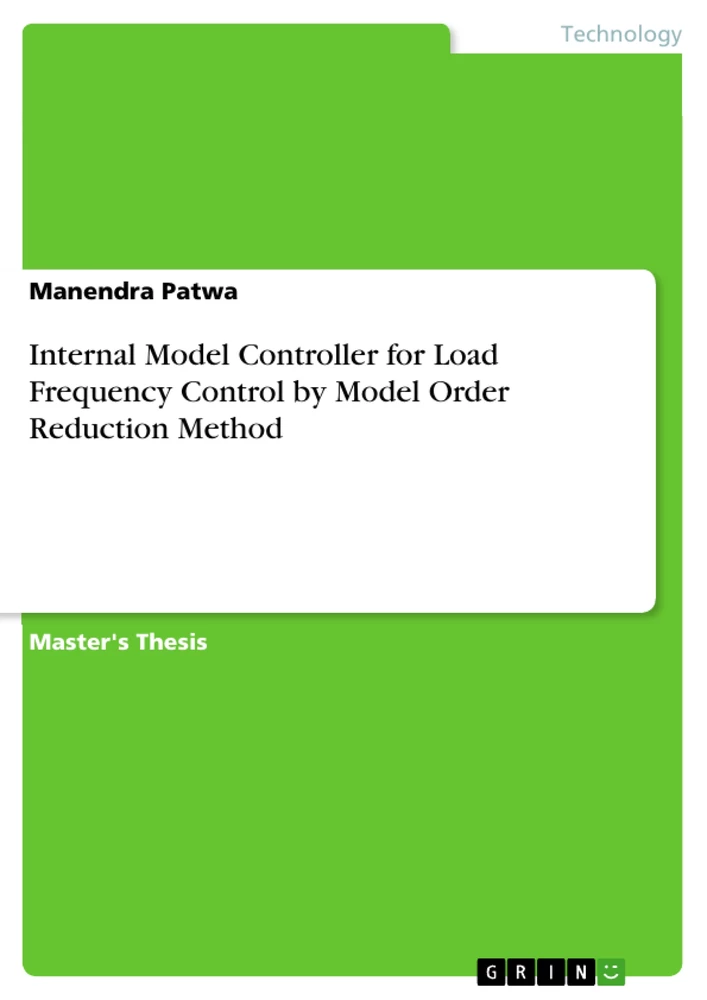
Table of Contents
CHAPTER-1
INTRODUCTION
PURPOSE OF THESIS
CHAPTER-2
LITRATURE REVIEW
CHAPTER-3
3.1 MODEL ORDER REDUCTION
3.2 PADE APPROXIMATION METHOD
CHAPTER-4
4.1 LOAD FREQUENCY CONTROL
4.2 DESCRIPTION OF PLANT
4.3 TWO DEGREE FREEDOM - INTERNAL MODEL CONTROL
PADE APPROXIMATION MODELING
ROUTH APPROXIMATION MODELING
4.4 NUMERICAL MODEL OF LFC
CHAPTER-5
PROGRAM & SIMULATION
RESULT & DISCUSSION
CHAPTER-6
CONCLUSION
FUTURE SCOPE
Objectives and Topics
This thesis investigates the implementation of a Two-Degree-of-Freedom Internal Model Controller (TDF-IMC) for Load Frequency Control (LFC) in power systems. The core research objective is to utilize model order reduction (MOR) techniques, specifically Pade and Routh approximations, to simplify high-order plant models, thereby facilitating the design and implementation of efficient and robust controllers.
- Load Frequency Control (LFC) in power systems
- Model Order Reduction (MOR) techniques
- Pade and Routh approximation methods
- Two-Degree-of-Freedom Internal Model Control (TDF-IMC) design
- MATLAB-based simulation and performance analysis
Excerpt from the Book
3.2 PADE APPROXIMATION METHOD
The approach is discussed in the theory of Pade. In order to understand the algorithm used for Pade approximation, we consider the following definition of frequency domain system as: f(s) = sum n=0 cn s^n (3.1) Where n element W (all whole numbers) f(s) = c0 + c1s + c2s^2 + c3s^3 + c4s^4 + ... (3.2) And a rational function Um(s)/Vn(s), where Vn(s) and Um(s) are nth and mth order polynomials respectively, and m <= n. The rational function Um(s)/Vn(s) is said to be a Pade approximant of f(s).
If the expansion of f(s) and Um(s)/Vn(s) are identical in terms of first m + n terms of the power series.
From Eqn. (3.2) the function f(s) is approximated, then Pade approximant will be following as Um(s)/Vn(s) = a0 + a1s + a2s^2 + ... + ams^m / b0 + b1s + b2s^2 + ... + bns^n (3.3)
Or Eqn. (3.3) can be modified as Um(s)/Vn(s) = a0 + a1s + a2s^2 + ... + ans^n / b0 + b1s + b2s^2 + ... + bn+1s^n+1 (3.4)
If the first (m + n) terms of Eqns. (3.2) and (3.4) are equal, then follows that the following set of relations exists.
Summary of Chapters
CHAPTER-1: Discusses the complexity of modern power systems and introduces the necessity of Load Frequency Control (LFC) and Model Order Reduction (MOR) to ensure system stability.
CHAPTER-2: Provides a comprehensive survey of existing literature regarding various MOR strategies and their applications in control engineering and power system regulation.
CHAPTER-3: Details the theoretical foundation of frequency domain and time domain model order reduction techniques, with a specific focus on the Pade approximation algorithm.
CHAPTER-4: Explains the modeling of LFC for a power plant and derives the TDF-IMC control structure while applying Pade and Routh approximations to simplify the system dynamics.
CHAPTER-5: Presents the technical implementation of the proposed models using MATLAB programming and provides a comparative analysis of the simulation results.
CHAPTER-6: Concludes the thesis by summarizing the findings regarding the effectiveness of the optimized TDF-IMC controller and suggests future research directions.
Keywords
Load Frequency Control, Model Order Reduction, Internal Model Control, Two Degree Freedom, Pade Approximation, Routh Approximation, Power System, MATLAB, Simulation, Control System, Controller Design, System Dynamics, Optimization, Genetic Algorithm, Transfer Function.
Frequently Asked Questions
What is the fundamental focus of this dissertation?
The dissertation focuses on addressing load frequency issues in large-scale power systems by designing an effective Two-Degree-of-Freedom Internal Model Controller (TDF-IMC).
Which central topics are explored regarding controller design?
The study explores model order reduction (MOR) strategies, specifically utilizing Pade and Routh approximations to simplify complex, high-order power plant models for easier controller implementation.
What is the primary objective of using model order reduction?
The primary goal is to reduce computational complexity, size, and cost while retaining the dominant system characteristics, thereby simplifying the design of the LFC regulator.
Which scientific methodology is primarily employed?
The author employs mathematical modeling followed by validation and comparison of plant behavior using MATLAB programming and simulation.
What does the main body of the work encompass?
The main body covers the theoretical background of LFC, the derivation of Pade and Routh approximation models, the architecture of the TDF-IMC scheme, and the translation of these concepts into MATLAB code.
Which keywords define this work?
Key terms include Load Frequency Control (LFC), Internal Model Control (IMC), Model Order Reduction (MOR), Pade Approximation, and Routh Approximation.
How does the author handle plant and model mismatch?
The TDF-IMC structure uses an internal model (predictive model of the plant) and a feedback loop to calculate an error signal, which specifically indicates and helps mitigate plant/model mismatches.
Why are Pade and Routh approximations utilized specifically?
They are utilized as frequency domain model reduction techniques to lower the transfer functions of high-order power systems, making them computationally manageable for real-time regulation.
Ende der Leseprobe aus 42 Seiten
- nach oben
- Arbeit zitieren
- Manendra Patwa (Autor:in), 2022, Internal Model Controller for Load Frequency Control by Model Order Reduction Method, München, Page::Imprint:: GRINVerlagOHG, https://www.diplomarbeiten24.de/document/1284786

neugierig - aktuell - relevant
Entdecken Sie hilfreiche Tipps und Tricks rund ums Studium!

Entdecken Sie hilfreiche Tipps und Tricks rund ums Studium!
Ihre Hausarbeit / Abschlussarbeit:

- - Publikation als E-Book und Buch
- - Hohes Honorar auf die Verkäufe
- - Für Sie komplett kostenlos - mit ISBN
- - Es dauert nur 5 Minuten
- - Jede Arbeit findet Leser

- © GRIN Publishing GmbH.
- Alle Inhalte urheberrechtlich geschützt. Kopieren und verbreiten untersagt.
- info@grin.com
- AGB
- Open Publishing
Der GRIN Verlag hat sich seit 1998 auf die Veröffentlichung akademischer eBooks und Bücher spezialisiert. Der GRIN Verlag steht damit als erstes Unternehmen für User Generated Quality Content. Die Verlagsseiten GRIN.com, Hausarbeiten.de und Diplomarbeiten24 bieten für Hochschullehrer, Absolventen und Studenten die ideale Plattform, wissenschaftliche Texte wie Hausarbeiten, Referate, Bachelorarbeiten, Masterarbeiten, Diplomarbeiten, Dissertationen und wissenschaftliche Aufsätze einem breiten Publikum zu präsentieren.
Kostenfreie Veröffentlichung: Hausarbeit, Bachelorarbeit, Diplomarbeit, Dissertation, Masterarbeit, Interpretation oder Referat jetzt veröffentlichen!
Folgen Sie GRIN auf


- GRIN Verlag GmbH
-
- Nymphenburger Str. 86
- 80636
- Munich, Deutschland
- +49 89-550559-0
- +49 89-550559-10
- info@grin.com
-
