
präsentiert von

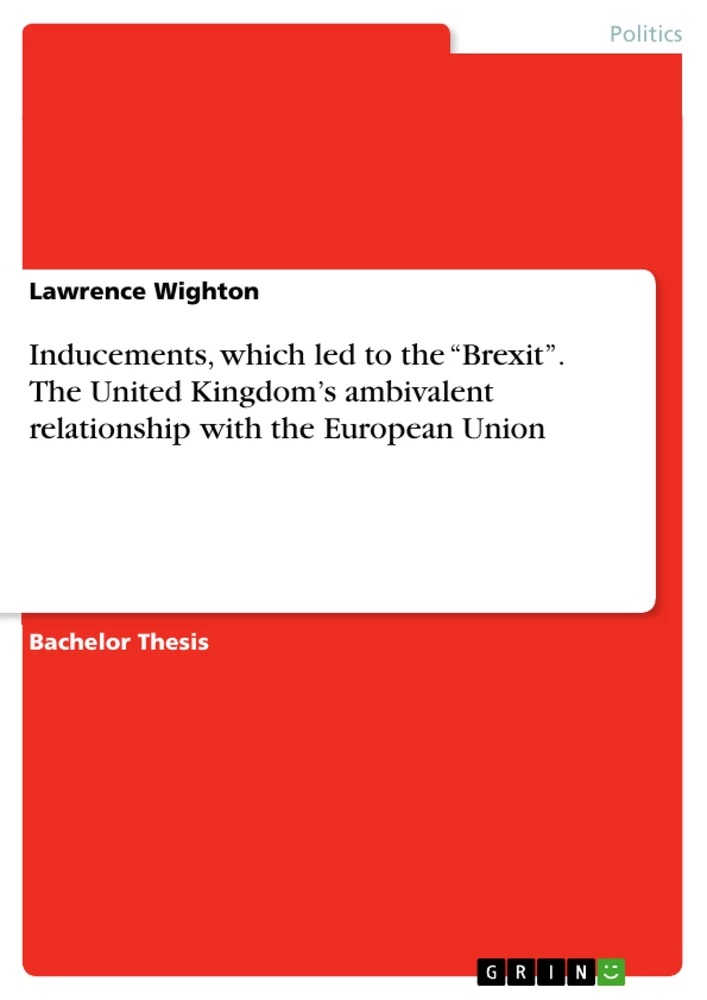
Table of Contents
I. Introduction
II. Definition and Clarification of Key Terms
III. Theoretical Foundations
1. The Theory of Kenneth Waltz’s Neorealism in International Relations
1.1. The Implications and Assumptions of Waltz’s Theory
1.2. The ‘Balance of Power’ Theory within Waltz’ Neorealism
1.3. The Hypotheses Derived from Kenneth Waltz’s Neorealism
2. Andrew Moravcsik’s Liberal Theory of International Relations
2.1. Implications and Assumptions of Moravcsik’s Liberal Theory
2.1.1. The Role of Societal Actors
2.1.2. The Role of Institutions
2.2. The Hypotheses Derived from Andrew Moravcsik’s Liberal Theory
IV. Research Design
V. Empirical Analysis
1. How can the United Kingdom’s Referendum Decision be Explained?
1.1. Analysis from a Neorealist Perspective
1.1.1. The Anarchic International System as a Relevant Factor
1.1.2. The ‘Desire’ to Survive in the International System through Security Maximisation
1.2. Analysis from a Liberal Perspective
1.2.1. The Role of Societal Actors in the Referendum Decision
1.2.2. The Role of Institutions in the Referendum Decision
VI. Conclusions and Outlook
Research Objective & Key Topics
This thesis examines the driving forces behind the United Kingdom's decision to hold a referendum on its European Union membership, utilizing a comparative theoretical framework based on neorealism and liberal international relations theory to assess whether systemic security concerns or domestic political and societal dynamics formed the primary catalyst for this choice.
- Theoretical evaluation of Kenneth Waltz’s neorealism vs. Andrew Moravcsik’s liberal theory.
- Analysis of UK national security strategies and the role of international anarchy.
- Investigation of internal balancing (military expenditure) and strategic alliances.
- Evaluation of domestic societal actors, specifically business groups (CBI) and trade unions (Unite).
- Examination of political actor influence, backbench pressure, and legislative institutional frameworks like the European Union Referendum Act 2015.
Excerpt from the Book
The Anarchic International System as a Relevant Factor
In his theory of neorealism, Waltz’s implies the existence of an anarchic structure in the international system, creating a level of insecurity and causing states to act in certain ways (cf. Schörnig 2010, p. 73). This would suggest that the UK’s perception of the insecurity in the international system, caused by anarchy, played a significant role in the referendum decision in some way. The subsequent analysis will attempt to find evidence that could indicate that the UK wanted to leave the EU due to the threats of an anarchic system, examining the national defence strategies of 2010 and 2015 as they present a “whole government” approach (The National Security Strategy 2010, p. 10).
Analysis of The United Kingdom’s 2010 National Security Strategy
According to the 2010 strategy, one of the UK’s main objectives was the preservation of national security (cf. ibid., 9). In order to attain this important objective, the 2010 strategy states that the UK will employ all of its “(…) national capabilities to build Britain’s prosperity (…)”, increasing its “(…) influence in the world and strengthen our security” (ibid.) and use its power to “(…) help shape a stable word” (ibid., p. 10). This coincides with the neorealist assumption that states want to pursue maximum security in the international system, acknowledging the anarchic and insecure structure. However, this does not imply any intentions of the UK wanting to hold a referendum on its EU-membership. In fact, the strategy states the “(…) vital partnership in the European Union” (ibid., p.10), is a key component to achieving this objective.
Summary of Chapters
I. Introduction: Outlines the significance of the 2016 Brexit referendum and establishes the core research question regarding the theoretical drivers of this political event.
II. Definition and Clarification of Key Terms: Provides essential definitions for terms such as 'Brexit', 'referendum', and 'referendum decision' to maintain consistency throughout the analysis.
III. Theoretical Foundations: Discusses the core tenets of Kenneth Waltz’s neorealism and Andrew Moravcsik’s liberal theory, deriving testable hypotheses for each framework.
IV. Research Design: Details the methodology (qualitative content analysis) and the case selection justification, including the observational period from 2013 to 2016.
V. Empirical Analysis: Conducts a detailed evaluation of the referendum decision by applying the previously defined theoretical frameworks to primary sources and political developments.
VI. Conclusions and Outlook: Synthesizes the finding that liberal theory offers greater explanatory power than neorealism, while acknowledging the potential for future research into identity and constructivist approaches.
Keywords
Brexit, European Union, Referendum, Neorealism, Kenneth Waltz, Liberalism, Andrew Moravcsik, National Security, International System, Domestic Institutions, Societal Actors, Confederation of British Industry, Unite, David Cameron, UKIP
Frequently Asked Questions
What is the primary focus of this dissertation?
The paper focuses on identifying the underlying reasons for the UK’s decision to call a referendum on EU membership, testing whether these were driven by external systemic insecurities or internal domestic political factors.
Which theoretical frameworks are utilized?
The dissertation compares Kenneth Waltz’s neorealism, which focuses on international structure and security, and Andrew Moravcsik’s liberal theory, which focuses on domestic societal and institutional influences.
What is the central research question?
The study asks to what extent the theoretical implications of Waltz’s neorealism and Moravcsik’s liberal theory can explain the UK’s decision to initiate a referendum on EU membership.
What methodology is applied for the analysis?
The research employs an adapted version of Mayring’s qualitative content analysis to interpret primary, text-based sources such as white papers, government strategies, and party manifestos.
What are the main thematic pillars?
The themes include institutional analysis, security and defense strategy (NATO vs. EU), the role of interest groups (CBI, Unite), and the influence of political actors (Conservative Party, UKIP, David Cameron).
Which keywords define the research?
The work is characterized by terms like Brexit, referendum, neorealism, liberal theory, national security, domestic policy, and intergovernmental cooperation.
Did neorealist theory successfully explain the referendum decision?
No, the analysis found that neorealist variables, such as external systemic threats, did not provide a compelling explanation for the referendum decision, as the UK’s security cooperation remained focused on NATO rather than exiting the EU.
How important were domestic institutions in the decision process?
Domestic institutional frameworks and the pressure from conservative backbenchers played a significant role, demonstrating that liberal theory is more effective in explaining the political impetus for the referendum than neorealism.
Ende der Leseprobe aus 63 Seiten
- nach oben
- Arbeit zitieren
- Lawrence Wighton (Autor:in), 2020, Inducements, which led to the “Brexit”. The United Kingdom’s ambivalent relationship with the European Union, München, Page::Imprint:: GRINVerlagOHG, https://www.diplomarbeiten24.de/document/1316751

neugierig - aktuell - relevant
Entdecken Sie hilfreiche Tipps und Tricks rund ums Studium!

Entdecken Sie hilfreiche Tipps und Tricks rund ums Studium!
Ihre Hausarbeit / Abschlussarbeit:

- - Publikation als E-Book und Buch
- - Hohes Honorar auf die Verkäufe
- - Für Sie komplett kostenlos - mit ISBN
- - Es dauert nur 5 Minuten
- - Jede Arbeit findet Leser

- © GRIN Publishing GmbH.
- Alle Inhalte urheberrechtlich geschützt. Kopieren und verbreiten untersagt.
- info@grin.com
- AGB
- Open Publishing
Der GRIN Verlag hat sich seit 1998 auf die Veröffentlichung akademischer eBooks und Bücher spezialisiert. Der GRIN Verlag steht damit als erstes Unternehmen für User Generated Quality Content. Die Verlagsseiten GRIN.com, Hausarbeiten.de und Diplomarbeiten24 bieten für Hochschullehrer, Absolventen und Studenten die ideale Plattform, wissenschaftliche Texte wie Hausarbeiten, Referate, Bachelorarbeiten, Masterarbeiten, Diplomarbeiten, Dissertationen und wissenschaftliche Aufsätze einem breiten Publikum zu präsentieren.
Kostenfreie Veröffentlichung: Hausarbeit, Bachelorarbeit, Diplomarbeit, Dissertation, Masterarbeit, Interpretation oder Referat jetzt veröffentlichen!
Folgen Sie GRIN auf


- GRIN Verlag GmbH
-
- Nymphenburger Str. 86
- 80636
- Munich, Deutschland
- +49 89-550559-0
- +49 89-550559-10
- info@grin.com
-
