
präsentiert von

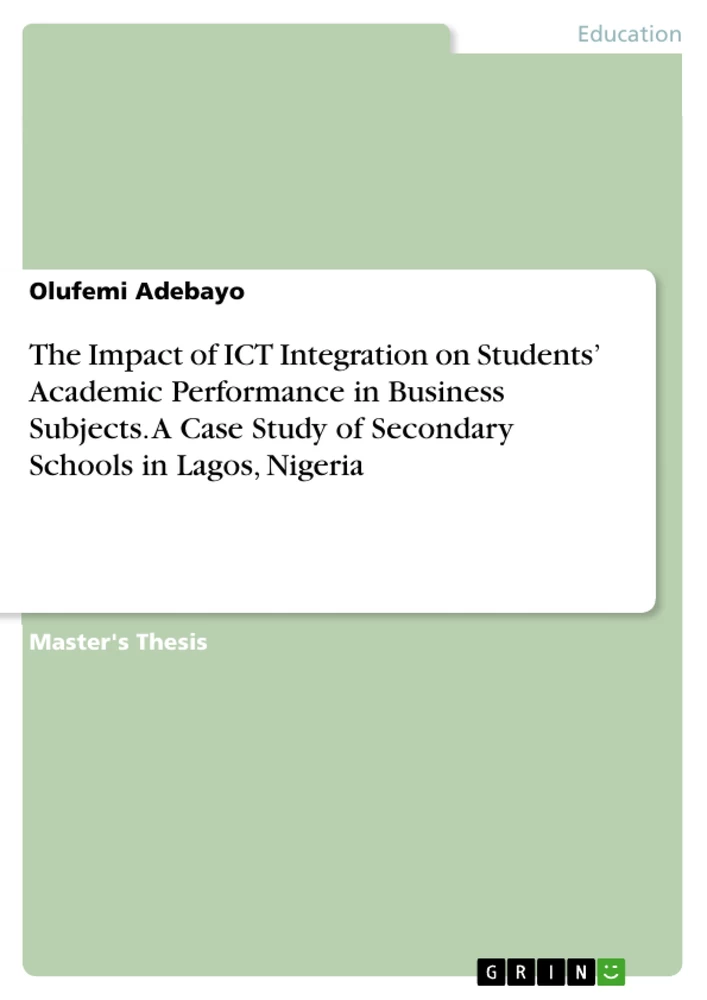
Table of Contents
1. INTRODUCTION
1.1 Research Background
1.2 Statement of the problem
1.3 Purpose of the Study
1.4 Objectives of the study
1.5 Research Questions
1.6 Significance of the Study
1.7 Scope of the Study
1.8 Definition of key terminologies
2. LITERATURE REVIEW
2.1 Introduction
2.2 Role of ICT in Education
2.3 The Nigerian ICT Policy
2.4 Computer Literacy Course and Students
2.5 The Status of Technology in the Educational System
2.6 Effects of Technology Integration on Teachers and Students’ Attitude
2.6.1 Teachers’ Attitude
2.6.2 Students’ Attitude
2.7 Assessing Problems Facing ICT Integration in Education
2.8 Academic Performance of Students
2.9 Factors Affecting Students’ Academic Performance
2.10 Appraisal of literature reviewed
3. RESEARCH METHODOLOGY
3.1 Introduction
3.2 Study Area
3.3 Survey Population and Sampling
3.3.1 Survey Population
3.3.2 Sampling technique
3.4 Research Design
3.5 Research Instrument and Method
3.5.1 Data collection instrument
3.5.2 Data collection Procedure
3.6 Statistical Tool for Data Analysis
3.7 Validity and Reliability
3.8 Ethical consideration
4. DATA PRESENTATION AND ANALYSIS
4.1 Introduction
4.2 Socio-demographic characteristics of respondents
4.3 Level of availability of ICT facilities in secondary schools in Lagos State
4.4 Attitudes of respondents towards ICT application
4.5 Relationship between student’s academic performance and ICT Use
4.6 Challenges faced in the use of ICT in secondary schools
5. DISUSSION
5.1 Overview of participants’ characteristics
5.2 Use of ICT and its impact on academic performance of students
5.3 Challenges faced by students and teachers in the integration of ICT
5.4 Limitations
6. CONCLUSION, RECOMMENDATION AND REFERENCES
6.1 CONCLUSION
6.2 RECOMMENDATIONS
Objectives and Research Themes
This study aims to determine the impact of Information and Communication Technology (ICT) integration on the academic performance of students in business subjects within secondary schools in Lagos State, Nigeria. It further investigates the availability, utilization, and challenges associated with ICT deployment in these educational settings.
- The role of ICT policy and computer literacy in Nigerian education.
- Methods of technology integration and their effect on teacher and student attitudes.
- An assessment of current ICT infrastructure and facility availability in local schools.
- Statistical correlation between ICT utilization levels and historical academic performance trends.
- Common barriers to effective ICT implementation, including power supply and training needs.
Excerpt from the Book
1.1 Research Background
Information and communication technology (ICT) has become so influential in current society that it infiltrates every aspect of life. (Thierer, 2000) pointed out that the role of technology in teaching and learning is rapidly becoming one of the most important and widely discussed issues in contemporary education policy.Its importance has been recognized by educational institutions worldwide (Watson, 2001). As one of the most important needs for the well-being of individuals and communities at large, education in union with ICT prepares one to take on present day tasks and challenges even better. It is opined that ICTs are the building blocks for today’s society, (UNESCO, 2002) as they are seen to have changed and still changing many aspects of people’s ways of life.
When one dives into fields as medicine, tourism, business, law, travel, engineering, architecture and banking, there is a great deal of appreciation on the influence of ICT especially in the past two to three decades. (Collis, 2002) Times have truly changed; ICT is indispensable in the contemporary world. Therefore, culture and society have to be adjusted to meet the challenges of the information age. If one looks at education sector, there seems to be little impact of ICT utilization and far less change, than other fields have experienced. However, education is a powerful instrument of social, political, and economic progress, without which neither an individual nor a society can attain professional growth. (Collis, 2002).
Summary of Chapters
CHAPTER 1 INTRODUCTION: Outlines the significance of ICT in modern society and its role in education, while defining the problem of limited integration and the specific objectives of this study.
CHAPTER 2 LITERATURE REVIEW: Examines existing academic sources regarding the role of ICT in schools, national policy, and factors affecting students' academic achievement.
CHAPTER 3 RESEARCH METHODOLOGY: Details the descriptive survey design, sampling techniques, and data collection tools used to investigate secondary schools in Lagos State.
CHAPTER 4 DATA PRESENTATION AND ANALYSIS: Provides an empirical analysis of survey responses, including statistical comparisons of ICT usage, attitudes, and student performance data.
CHAPTER 5 DISUSSION: Interprets the research findings in the context of existing studies and reflects on the observed limitations of the current ICT implementation.
CHAPTER 6 CONCLUSION, RECOMMENDATION AND REFERENCES: Summarizes the study’s findings and offers targeted recommendations for improving ICT integration for educational stakeholders.
Keywords
ICT, Integration, Academic performance, Secondary schools, Lagos, Nigeria, Business subjects, Educational technology, Teaching, Students, Teachers, Computer literacy, Infrastructure, Challenges, Policy.
Frequently Asked Questions
What is the core focus of this research?
The study investigates the impact of Information and Communication Technology (ICT) integration on the academic performance of students in business subjects within secondary schools in Lagos State, Nigeria.
What are the primary themes discussed?
The central themes include the availability of ICT facilities, the attitudes of teachers and students toward technology, challenges to ICT implementation, and the correlation between technology usage and academic results.
What is the main research objective?
The primary goal is to determine whether a statistical relationship exists between the level of ICT utilization in secondary schools and the academic performance of students in business subjects.
What research methodology was employed?
The study utilized a mixed-method approach, combining descriptive survey questionnaires administered to students and teachers with in-depth, semi-structured interviews.
What is covered in the main body of the work?
The main body details the historical and local context of ICT in Nigerian education, presents findings through various tables (t-tests, mean scores), and analyzes specific challenges such as electricity supply and infrastructure.
What keywords characterize the study?
Core keywords include ICT, Academic performance, Integration, Secondary schools, and Business subjects.
What were the major challenges identified for ICT in schools?
Participants highlighted obstacles such as a lack of access to the internet, insufficient ICT training, the inadequacy of computer hardware, and the unavailability of reliable electricity supply.
Did the study confirm a link between ICT usage and improved performance?
No, the findings indicated there was no statistically significant relationship between the observed level of ICT utilization and students' academic performance scores.
How were the teachers' attitudes evaluated?
Teachers’ attitudes were measured using a five-point Likert scale (Strongly Agree to Strongly Disagree) regarding the perceived benefits and complications of integrating technology in their classrooms.
What is the final conclusion of the author?
The author concludes that while ICT has broad potential, its current impact in the studied schools is minimal, largely due to systemic constraints and low levels of effective classroom utilization.
Ende der Leseprobe aus 67 Seiten
- nach oben
- Arbeit zitieren
- Olufemi Adebayo (Autor:in), 2021, The Impact of ICT Integration on Students’ Academic Performance in Business Subjects. A Case Study of Secondary Schools in Lagos, Nigeria, München, Page::Imprint:: GRINVerlagOHG, https://www.diplomarbeiten24.de/document/1322316

neugierig - aktuell - relevant
Entdecken Sie hilfreiche Tipps und Tricks rund ums Studium!

Entdecken Sie hilfreiche Tipps und Tricks rund ums Studium!
Ihre Hausarbeit / Abschlussarbeit:

- - Publikation als E-Book und Buch
- - Hohes Honorar auf die Verkäufe
- - Für Sie komplett kostenlos - mit ISBN
- - Es dauert nur 5 Minuten
- - Jede Arbeit findet Leser

- © GRIN Publishing GmbH.
- Alle Inhalte urheberrechtlich geschützt. Kopieren und verbreiten untersagt.
- info@grin.com
- AGB
- Open Publishing
Der GRIN Verlag hat sich seit 1998 auf die Veröffentlichung akademischer eBooks und Bücher spezialisiert. Der GRIN Verlag steht damit als erstes Unternehmen für User Generated Quality Content. Die Verlagsseiten GRIN.com, Hausarbeiten.de und Diplomarbeiten24 bieten für Hochschullehrer, Absolventen und Studenten die ideale Plattform, wissenschaftliche Texte wie Hausarbeiten, Referate, Bachelorarbeiten, Masterarbeiten, Diplomarbeiten, Dissertationen und wissenschaftliche Aufsätze einem breiten Publikum zu präsentieren.
Kostenfreie Veröffentlichung: Hausarbeit, Bachelorarbeit, Diplomarbeit, Dissertation, Masterarbeit, Interpretation oder Referat jetzt veröffentlichen!
Folgen Sie GRIN auf


- GRIN Verlag GmbH
-
- Nymphenburger Str. 86
- 80636
- Munich, Deutschland
- +49 89-550559-0
- +49 89-550559-10
- info@grin.com
-
