
präsentiert von

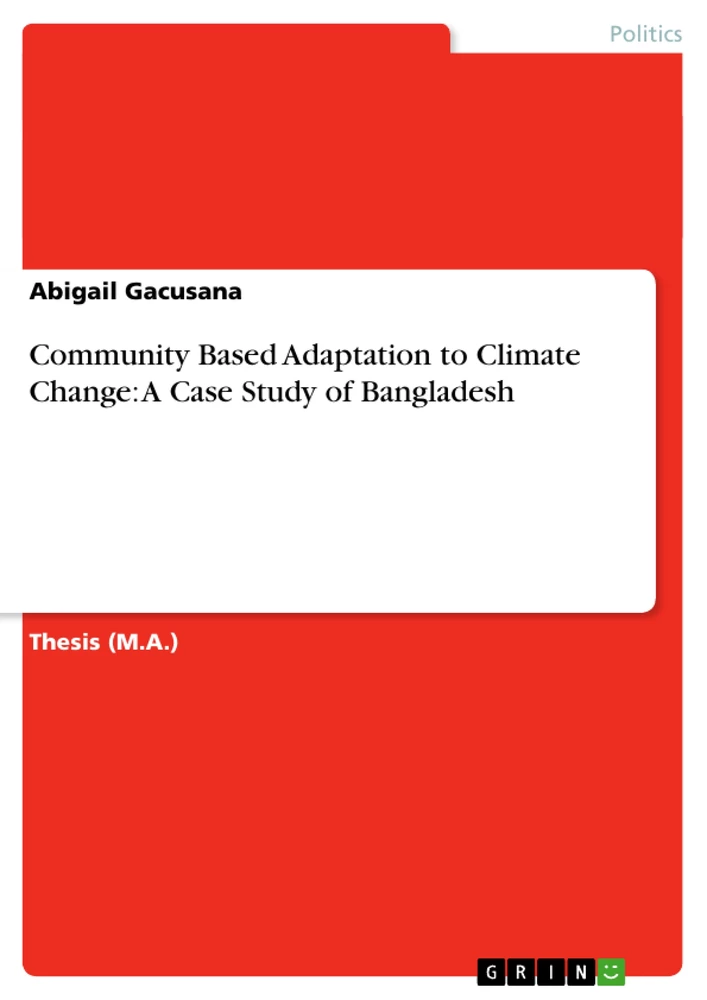
Table of Contents
Chapter One
Introduction
1.1 Research Objectives
1.2 Research Questions
1.3 Structure of the Dissertation
Chapter Two
Background to the Study
2.1 Bangladesh
2.2 Climate Change Vulnerability: Bangladesh Context
2.3 National Responses
2.4 Adaptation
Chapter Three
Literature Review
3.1 Adaptation to Climate Change
3.2 Adaptation at Global, National and Local Levels
3.3 Adaptation, Climate Change and Development
3.4 Facilitating Adaptation: International and Institutional Policies
3.5 Adaptation and Vulnerability to Climate Change
3.6 Livelihoods and Climate Change Adaptation
Chapter Four
Methodology
4.1 Analytical Approach
4.2 Methodological Approach
4.2.1 Research Areas
4.2.2 Methodology Limitations
Chapter Five
Policy Findings
5.1 Role of Public Institutions: Advisory and Capacity Building
5.2 Role of NGOs and Donor Agencies: Community Based Adaptation
5.3 Towards a National Climate Change Policy
5.4 Limitation to Climate Change Adaptation in Bangladesh
Chapter Six
Household and Community Level Findings
6.1 Climate Change and its Impacts on Rural Livelihoods
6.2 Women and Climate Change
6.3 Indigenous and Physical Coping Mechanisms
6.4 Dependence on Aid and Role of the Government
Chapter Seven
Conclusions and Recommendations
Research Objectives and Themes
This dissertation examines the impacts of climate change on poor, rural communities in Bangladesh, using a case study approach to assess how community-based adaptation strategies can increase resiliency and be integrated into broader national development policy.
- Impacts of climate change on rural livelihoods and socio-economic vulnerability.
- Effectiveness of Community Based Adaptation (CBA) in securing local livelihoods.
- Evaluation of existing national climate policies and government institutional capacity.
- Role of NGOs and donor agencies in supporting local coping mechanisms.
- Integration of local knowledge and stakeholder participation into climate adaptation frameworks.
Excerpt from the Book
6.3 Indigenous and Physical Coping Mechanisms
As noted in chapter three, societies worldwide have been adapting to changes in climate for centuries. The people of Bangladesh exemplify this and they are known to be resilient to natural environmental stresses such as flooding as this have been part of their history and lifestyle, in relation to its physiographic conditions. In such context, spontaneous or reactive adaptation is common in Bangladesh, with households and communities applying indigenous and physical coping mechanisms in response to climate stresses.
Based on the field visit to the communities at the Gaibandha district of Bangladesh, the indigenous and physical coping mechanisms observed by households and communities in relation to climate variability can be divided into livelihoods adjustments and community mobilization and/or support networks. Livelihoods adjustments involve actions in relation to protection of properties such as land and houses, and main sources of livelihoods such as livestock, crops and vegetables. As identified by the respondents, the most common and applied means of protecting assets include raising the plinths and homesteads, heightened land, planting Kolni, to protect the soil from river erosion, using concrete pillars for housing, building structures against the water current, and the use of natural straw instead of CI sheets for roofing and walls.
Summary of Chapters
Chapter One: Provides an introduction to the research, outlining the problem, objectives, and the structured approach of the dissertation.
Chapter Two: Describes the background of Bangladesh, focusing on its vulnerability to climate change, current national responses, and the general concept of adaptation.
Chapter Three: Reviews existing literature on climate change adaptation, linking global, national, and local perspectives with development goals and sustainable livelihoods.
Chapter Four: Details the methodology, including the analytical and field-based approaches used to gather primary data from policy actors and rural households in Gaibandha.
Chapter Five: Presents findings on policy, analyzing the roles of public institutions, NGOs, and the government in formulating and implementing adaptation strategies.
Chapter Six: Discusses household and community level findings, highlighting the impact of climate change on livelihoods, gender-specific vulnerabilities, and indigenous coping mechanisms.
Chapter Seven: Concludes the dissertation by summarizing research findings and offering policy recommendations for more effective, integrated climate adaptation.
Keywords
Bangladesh, Climate Change, Adaptation, Community Based Adaptation, Livelihoods, Vulnerability, Resilience, Rural Communities, Policy Formulation, NGOs, Disaster Preparedness, Sustainable Development, Coping Mechanisms, Institutional Capacity, Gaibandha.
Frequently Asked Questions
What is the core focus of this research?
The research focuses on the impacts of climate change on poor, rural communities in Bangladesh and evaluates the effectiveness of community-based adaptation (CBA) strategies in increasing resiliency.
What are the primary thematic areas covered?
The dissertation covers socio-economic vulnerability, livelihood security, the role of government and NGOs in policy implementation, and the significance of local indigenous coping strategies.
What is the primary objective of this dissertation?
The objective is to identify the impacts of CBA on livelihood security, explore existing policies in Bangladesh, and propose how these can be better linked to national development goals.
Which scientific methodology was employed?
The study uses a qualitative approach, including semi-structured interviews with policy experts and development practitioners, as well as participant observation, focus group discussions, and interviews with community members in the Gaibandha district.
What topics are discussed in the main body of the work?
The main body examines climate vulnerability in the context of Bangladesh, reviews global adaptation literature, analyzes policy-level findings, and presents empirical data on household-level coping mechanisms and gender-specific impacts.
Which keywords best characterize this work?
Key terms include Climate Change, Bangladesh, Community Based Adaptation, Livelihoods, Vulnerability, Resilience, and Sustainable Development.
How does the research define the role of NGOs in Gaibandha?
NGOs are identified as essential actors that bridge the gap left by weak government institutions, providing sustainable livelihood support and community-level adaptation projects that are often more accessible to the poor.
What is the significance of the "chars" mentioned in the fieldwork?
The "chars" are riverine islands in the Gaibandha district that are highly susceptible to climate-induced environmental changes, serving as critical sites for understanding local adaptation and survival strategies.
Ende der Leseprobe aus 61 Seiten
- nach oben
- Arbeit zitieren
- Msc Abigail Gacusana (Autor:in), 2008, Community Based Adaptation to Climate Change: A Case Study of Bangladesh, München, Page::Imprint:: GRINVerlagOHG, https://www.diplomarbeiten24.de/document/133166

neugierig - aktuell - relevant
Entdecken Sie hilfreiche Tipps und Tricks rund ums Studium!

Entdecken Sie hilfreiche Tipps und Tricks rund ums Studium!
Ihre Hausarbeit / Abschlussarbeit:

- - Publikation als E-Book und Buch
- - Hohes Honorar auf die Verkäufe
- - Für Sie komplett kostenlos - mit ISBN
- - Es dauert nur 5 Minuten
- - Jede Arbeit findet Leser

- © GRIN Publishing GmbH.
- Alle Inhalte urheberrechtlich geschützt. Kopieren und verbreiten untersagt.
- info@grin.com
- AGB
- Open Publishing
Der GRIN Verlag hat sich seit 1998 auf die Veröffentlichung akademischer eBooks und Bücher spezialisiert. Der GRIN Verlag steht damit als erstes Unternehmen für User Generated Quality Content. Die Verlagsseiten GRIN.com, Hausarbeiten.de und Diplomarbeiten24 bieten für Hochschullehrer, Absolventen und Studenten die ideale Plattform, wissenschaftliche Texte wie Hausarbeiten, Referate, Bachelorarbeiten, Masterarbeiten, Diplomarbeiten, Dissertationen und wissenschaftliche Aufsätze einem breiten Publikum zu präsentieren.
Kostenfreie Veröffentlichung: Hausarbeit, Bachelorarbeit, Diplomarbeit, Dissertation, Masterarbeit, Interpretation oder Referat jetzt veröffentlichen!
Folgen Sie GRIN auf


- GRIN Verlag GmbH
-
- Nymphenburger Str. 86
- 80636
- Munich, Deutschland
- +49 89-550559-0
- +49 89-550559-10
- info@grin.com
-
