
präsentiert von

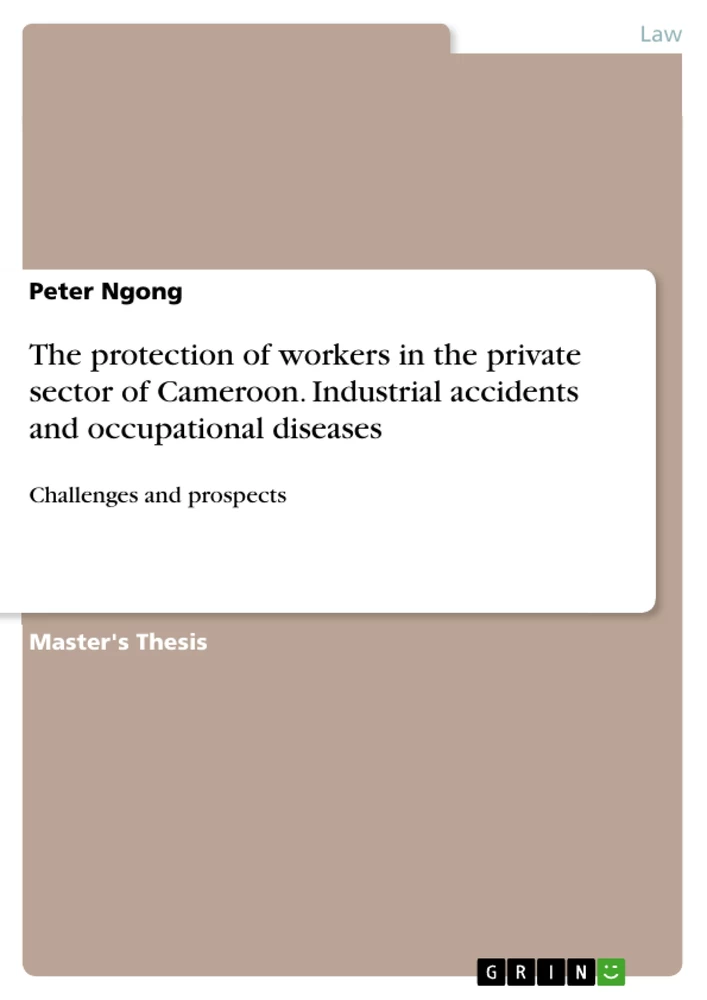
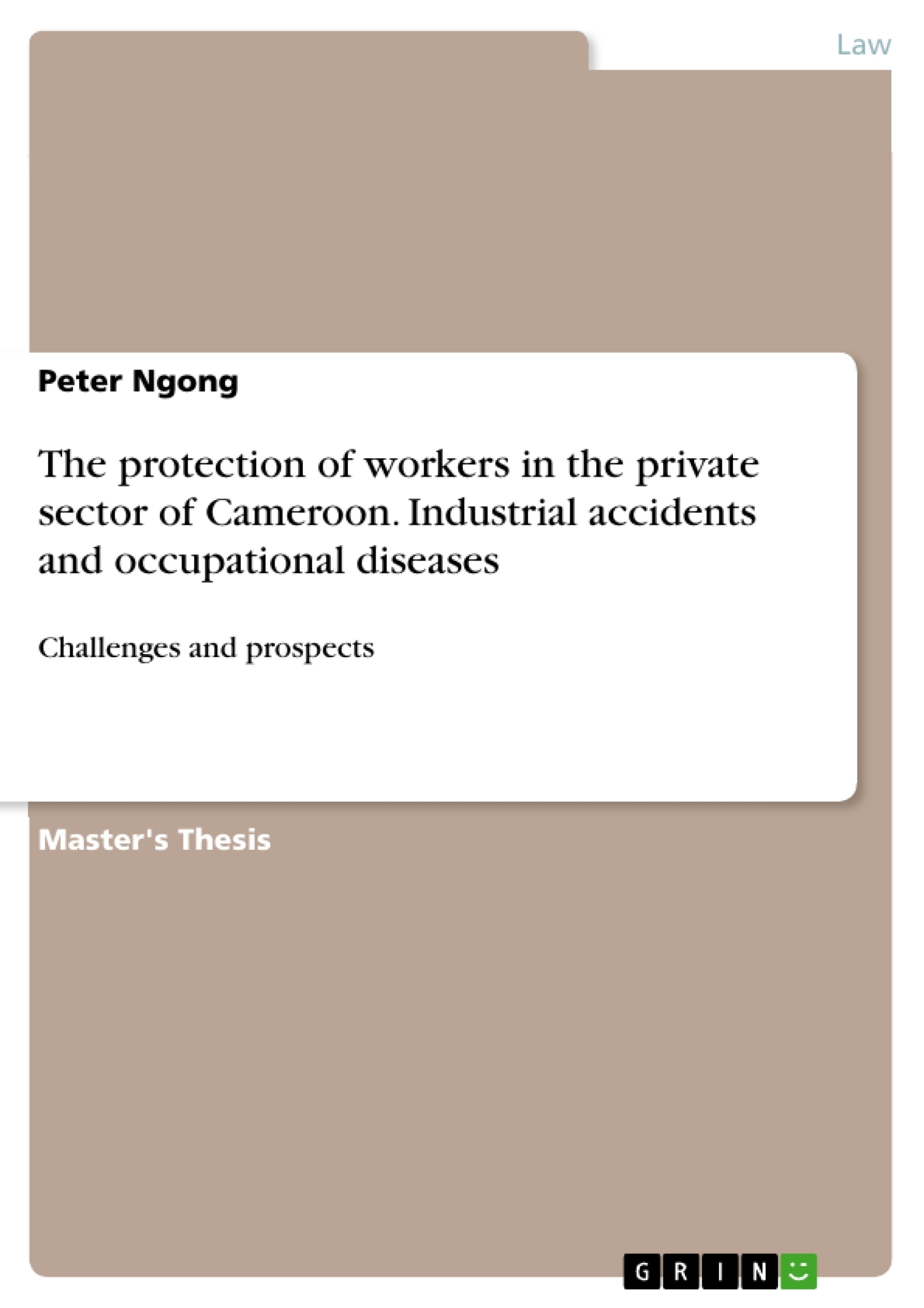
Table of Contents
CHAPTER ONE
GENERAL INTRODUCTION
1.0 Introduction
1.1. Research Problem
1.2. Research Questions
1.3. Objectives
1.4. Research Methodology
1.5. Literature Review
1.6. Theoretical and Conceptual Framework
1.7. Significance of the Research
1.8. Justification of the Research
1.9. Area/Scope of Study
1.10. Limitations
1.11. Conceptual Definition of Key Terms
CHAPTER TWO
THE NATURE AND CONSEQUENCES OF WORKERS’ PROTECTION FROM WORK-RELATED ACCIDENTS AND DISEASES
2.1. Health and Safety at Work
2.1.1. Health and Safety at Work under Statutory Law
2.1.2. Health and Safety at Work at Common Law
2.2. Conceptualisation of Industrial Accidents
2.3. Conceptualisation of Occupational Diseases
2.4. Personal Injury
2.5.0. Why Protect Workers from Work-Related Accidents and Diseases
2.5.1. Interruption with Earnings and Standard of Living
2.5.2. Interruption with Career Prospects
2.5.3. Decrease in Productive Capacity and Possible Dismissal
2.5.4. Increase Expenditure
2.5.5. Possibility of Legal Actions and the Inherent Effects
2.5.6. Damage on Corporate Reputation
2.5.7. Societal Implications
CHAPTER THREE
ACCEPTANCE OF WORK AND/OR ACCEPTANCE OF THE RISKS INHERENT TO WORK
3.1. A Genealogy of Employers’ Common Law Defenses
3.2. The Defence of Common Employment or the Fellow Servant Rule
3.3. The Doctrine of Contributory Negligence
3.4. The Assumption of Risk Defence
3.4.1. Consent to Personal Injury and/or Legal Injury
3.5. Worker’s Assumption of Risk versus the Employer’s Duty of Safety at Work
3.6. Assumption of Risk and the Other Employers’ Legal Doctrines
3.7. Proof of Negligence
3.8.0. Arguments against Adjudging Workers Liable to the Risks Inherent With Their Jobs
3.8.1. Statutory Nature of Work
3.8.2. Parties to the Employment Contract
3.8.3. Threat to Workers’ Career
3.8.4. Workers’ Right to Social Security
CHAPTER FOUR
LEGAL REDRESS FOR WORK-RELATED ACCIDENTS AND/OR DISEASES
4.1. Compensation or Damages
4.1.1. The Statutory Workers’ Compensation System
4.1.1.1. The Workers’ Compensation System in Cameroon
4.1.1.2. Procedure for Claiming Compensation for Work-Related Hazards
4.1.2. The Nature and Extent of Compensable Work-Related Hazards
4.1.2.1. The Nature
4.1.2.2. The Extent of Compensation
4.1.3. Benefits under the Statutory Compensation Scheme
4.1.3.(a). Benefits (Indemnities) for Temporary Incapacity
4.1.3.(b). Benefits for Permanent Incapacity
4.1.3.(c). Benefits Payable in Case of Death of the Victim-Worker
4.2. Damages at Common Law
4.2.1. Procedure for Claiming Damages for Work-Related Hazards
4.2.1.(a). Pre-Litigation Procedure and Challenges
4.2.1.(b). Litigation Proper
4.2.2. The Award of Damages at Common Law
4.2.2.(a). Special Damages
4.2.2.(b). General damages
4.2.3. An Assessment of the Statutory Workers’ Compensation System
4.2.4. An Assessment of the Common Law Compensation System
4.2.4.1. Relationship between the Statutory and the Common Law System of Damages
4.3. Reinstatement or Re-engagement of Dismissed Workers Consequent on a Work-Related Hazard
CHAPTER FIVE
FINDINGS, CONCLUSION AND RECOMMENDATIONS
5.0. Findings
5.1. Conclusion
5.2. Recommendations
Research Objectives and Themes
The primary research objective is to critically examine the legal and institutional efforts in Cameroon intended to protect private sector workers from the inherent risks of industrial accidents and occupational diseases. The thesis investigates the efficacy of these protections through both statutory frameworks and common law doctrines, while addressing the challenge of employer liability and the practical realities workers face when pursuing legal redress.
- Legal protection of workers against industrial accidents and occupational diseases.
- Common law principles of employer liability versus worker assumption of risk.
- Disparities between statutory worker compensation schemes and the practical reality of access to justice.
- The impact of profit-maximization paradigms in the private sector on workplace safety standards.
- The necessity for administrative reforms to improve enforcement of occupational health and safety regulations.
Excerpt from the Book
1.11.4. Industrial Accidents:
Statutorily, the Labour Code has not provided a definition of an industrial accident. However, section 2 of Law No. 77-11of 13 July 1977 as amended defines an industrial accident as an accident in which a worker is involved regardless of its cause and that such situations include those things resulting from work or during work, during travel to and from work and from the worker’s principal residence or secondary residence which gives a certain character of permanence.
On its part, the Black’s Law Dictionary defines an accident as an unintended and unforeseen injurious occurrence; something that does not occur in the usual course of events or that could not be reasonable anticipated.
Lord Macnghten in English case of Fenton v Thorley & Co Ltd opined that the word ‘accident’ as used in its popular and ordinary sense denotes “an unlooked for mishap or an untoward event which is not expected or designed.” While Lord Shand holds that the word “denotes or includes any unexpected personal injury resulting to the workman from any unlooked for mishap or occurrence.”
In this research, an industrial accident is construed as an abrupt and unforeseen event which causes personal harm to the person of the worker in the course of his employment. It therefore excludes as an industrial accident which results solely in damage to the property of the victim.
Summary of Chapters
CHAPTER ONE: Provides an overview of the research, introducing the problem of workplace safety in Cameroon, defining key concepts, and outlining the research objectives, significance, and methodology.
CHAPTER TWO: Explores the nature of industrial accidents and occupational diseases, discussing why worker protection is a necessary socio-economic obligation despite the economic costs to employers.
CHAPTER THREE: Examines the legal doctrines of employer defenses at common law, specifically focusing on the debate surrounding workers' assumption of risk and the employer's duty of care.
CHAPTER FOUR: Critically analyzes the legal redress mechanisms available to injured workers under both statutory compensation schemes and common law, including procedures for damages and reinstatement.
CHAPTER FIVE: Reviews the research findings, offers a conclusion on the adequacy of current regulations, and provides specific policy recommendations to improve worker protection in Cameroon.
Keywords
workers, workers’ protection, industrial accidents, occupational diseases, labour code, statutory compensation, common law, employer liability, negligence, personal injury, workplace safety, social security, Cameroon, employment contract, tort law
Frequently Asked Questions
What is the primary motivation behind this research?
The research is motivated by the persistent risks of work-related hazards in the Cameroonian private sector and the apparent inadequacy of existing statutory and common law protections in ensuring social justice for injured workers.
What are the core thematic fields covered?
The study centers on Labour Law, Human Rights, and Social Security, specifically in the context of the private sector in the Anglophone regions of Cameroon.
Does the research define a specific research question?
Yes, the central research question explores the paradoxical gap between established legal obligations for safety and the actual, often palliative results of protection for workers in hazardous jobs.
Which legal frameworks does the author analyze?
The author evaluates both the Cameroon Labour Code (statutory law) and English common law principles, which historically influenced the legal system in the Anglophone regions.
How is the research data gathered?
The work utilizes an in-depth content analysis of primary sources—such as international treaties, national statutes, and court case law—as well as secondary sources and interviews with key stakeholders in the National Social Insurance Fund and labour unions.
Key attributes of the study mentioned?
The study is characterized by its interdisciplinary approach, linking the reality of industrial hazards to socio-economic theories like capitalism and the role of social security models.
How is "occupational disease" distinguished from an "industrial accident"?
The research emphasizes that an accident is typically an abrupt, unforeseen event with bodily injury, whereas an occupational disease is characterized by a gradual process of development over a significant period, often requiring distinct medical validation.
How does the author view the "assumption of risk" defense?
The author argues that the application of "volenti non fit injuria" within the employer-employee relationship is often misused; it should not automatically shield employers from liability when they have failed in their primary duty to provide a safe system of work.
Is "reinstatement" considered a viable remedy?
The author considers reinstatement a critical equitable remedy for dismissed, injured workers but acknowledges the legal and practical judicial reluctance to enforce it, citing the perspective that it might be equivalent to forcing a personal relationship.
Ende der Leseprobe aus 193 Seiten
- nach oben
- Arbeit zitieren
- Peter Ngong (Autor:in), 2015, The protection of workers in the private sector of Cameroon. Industrial accidents and occupational diseases, München, Page::Imprint:: GRINVerlagOHG, https://www.diplomarbeiten24.de/document/1334013

neugierig - aktuell - relevant
Entdecken Sie hilfreiche Tipps und Tricks rund ums Studium!

Entdecken Sie hilfreiche Tipps und Tricks rund ums Studium!
Ihre Hausarbeit / Abschlussarbeit:

- - Publikation als E-Book und Buch
- - Hohes Honorar auf die Verkäufe
- - Für Sie komplett kostenlos - mit ISBN
- - Es dauert nur 5 Minuten
- - Jede Arbeit findet Leser

- © GRIN Publishing GmbH.
- Alle Inhalte urheberrechtlich geschützt. Kopieren und verbreiten untersagt.
- info@grin.com
- AGB
- Open Publishing
Der GRIN Verlag hat sich seit 1998 auf die Veröffentlichung akademischer eBooks und Bücher spezialisiert. Der GRIN Verlag steht damit als erstes Unternehmen für User Generated Quality Content. Die Verlagsseiten GRIN.com, Hausarbeiten.de und Diplomarbeiten24 bieten für Hochschullehrer, Absolventen und Studenten die ideale Plattform, wissenschaftliche Texte wie Hausarbeiten, Referate, Bachelorarbeiten, Masterarbeiten, Diplomarbeiten, Dissertationen und wissenschaftliche Aufsätze einem breiten Publikum zu präsentieren.
Kostenfreie Veröffentlichung: Hausarbeit, Bachelorarbeit, Diplomarbeit, Dissertation, Masterarbeit, Interpretation oder Referat jetzt veröffentlichen!
Folgen Sie GRIN auf


- GRIN Verlag GmbH
-
- Nymphenburger Str. 86
- 80636
- Munich, Deutschland
- +49 89-550559-0
- +49 89-550559-10
- info@grin.com
-
