
präsentiert von

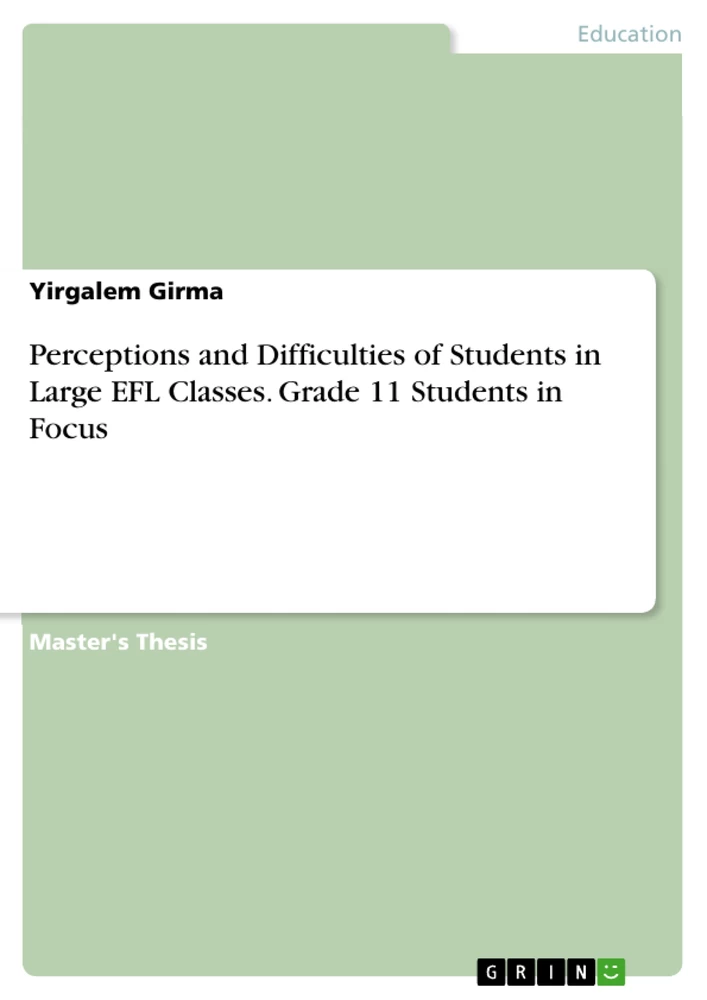
Table of Contents
Chapter One: Introduction
1.1. Background of the Study
1.2. Statement of the Problem
1.3. Objectives of the Study
1.3.1. General 0bjective
1.3.2. Specific Objectives
1.4. Significance of the Study
1.5. Scope of the Study
1.6. Limitations of the Study
1.7. Organization of the Study
Chapter Two: Review of Related Literature
2.1. Definition and Nature of Large Class
2.2. The Class Size Debate
2.3. Problems of Large Class Size
2.3.1. Problems of Students’ Active Involvement in Large Class
2.3.2. Assessment and Feedback Problems in Large Class
2.3.3. Problems of Large Class Management
2.3.4. Affective Challenges in Large Class
2.3.5. Resource Related Constraints
2.4. The Impacts of Large Class Size
2.4.1. Impact of Large Class on Teachers
2.5. Students View in Large Class
2.6. Local studies on large class size
2.7. Some Strategies to Cope up with Large Class
2.7.1. Instructional Strategies for Improving Problems of Large class
2.7.2. Use of Good Rapport in Large Class
2.7.3. Solving Management Problems in Large Class
2.8. Group Work and Large Class
2.9. Motivation for Learning and Large Class
2.10. The Physical Classroom Environment
2.11. Benefits of Large Class
Chapter Three: Research Methodology
3.1. Research Design
3.2. Description of the Study Setting
3.3. Data Type and Source
3.4. Sampling
3.4.1. Sampling Frame and Size
3.4.2. Sampling Techniques
3.4.3. Sampling Procedure
3.5. Data Gathering Instruments
3.5.1. The Questionnaire
3.5.2. Interview
3.6. Data Collection Procedure
3.6.1. Pilot Testing
3.6.2. Main Study
3.7. Methods of Data Analysis
Chapter Four: Data Presentations, Analysis and Discussions
4.1. Background Information
4.2. Participants Response to Class Size
4.3. Analysis of Teachers Questionnaire
4.4. Analysis of Students Questionnaires
4.5. Brief Discussions on Results of the Students Questionnaire
4.6. Analysis of Students Interview
4.7. Discussions on the Results of the Interview
Chapter Five: Summary, Conclusions and Recommendations
5.1. Summary of the Key Findings
5.2. Conclusions
5.3. Recommendations
Research Objectives and Themes
This study aims to assess students' perceptions of large EFL classes across instructional, psychological, and social dimensions, while identifying the major challenges that hinder their learning experience. By focusing on grade eleven students, the research seeks to provide evidence-based insights to help teachers adapt their pedagogical approaches in overcrowded settings.
- Analysis of instructional challenges (e.g., student participation, assessment constraints).
- Evaluation of the psychological impact of large class sizes on student motivation and stress levels.
- Examination of social dynamics and student-teacher interactions in crowded environments.
- Investigation of potential strategies and coping mechanisms to improve learning efficacy in large EFL classes.
Auszug aus dem Buch
1.1. Background of the Study
It is obvious that, in the actual classroom context, there exist some situational variables related to the school system that influence the teaching-learning process. Among the various classroom-based variables that influence teachers’ classroom practices, large class size is the significant one because there is a widely held view signifying that teachers of overcrowded classes come across many overwhelming challenges. In connection with this, teachers’ class room practices in general; their instructional time and classroom management in particular are influenced by overcrowded classes Wilson (2006).
As compared to smaller classes, large classes also impede teachers’ choice and use of various methods. Regarding this, Harmer (1995) says that recent trends in second language or foreign language pedagogy lay greater emphasis on learners and shifting authority away from the teacher and handing it to the students that encourages active students’ involvement in the teaching and learning process; however, Harmer (1991), for example, stated that teachers cannot carry out practical activities, problem solving or other learner-centered approaches to overcrowded classes; moreover, Tudor (1996) confirmed that class size will inevitably have an influence on the form of interaction between teachers and students upon which learner-centered teaching is based; it is hardly viable to directly interact with everyone in classes having large number of students squeezed together.
Some home research findings also indicated that large class size is one of the significant classroom-based variables that influence English language instruction. In line with this, Berhanu (1999), for instance, has showed that the quality of English language instruction suffers mainly from overcrowded classes, in appropriate methodology, lack of sufficient materials and lack of proficient teachers and facilities. Besides, Haimanot (1996) stated that large class was the most serious obstacle for the English teachers posing many constraints that imped their teaching effectiveness.
Summary of Chapters
Chapter One: Introduction: This chapter introduces the study's background, the problem statement regarding large EFL classes, and the Research objectives and significance.
Chapter Two: Review of Related Literature: This section covers theoretical frameworks, including definitions of large classes, the impact on instructional and social aspects, and common coping strategies.
Chapter Three: Research Methodology: This chapter details the descriptive research design, participants, and instruments (questionnaires and interviews) used to gather data from students and teachers.
Chapter Four: Data Presentations, Analysis and Discussions: This chapter presents the statistical results and qualitative interview analysis regarding teachers' and students' perspectives on class size.
Chapter Five: Summary, Conclusions and Recommendations: This final chapter synthesizes the key findings, draws conclusions, and provides practical recommendations for EFL classroom management.
Keywords
EFL, large class size, student perceptions, classroom management, active learning, instructional challenges, teaching methodology, student interaction, feedback, teacher strategies, social engagement, psychological aspects, motivation, overcrowded classes, English language teaching.
Frequently Asked Questions
What is the primary focus of this study?
The study investigates the perceptions and difficulties of grade eleven students in large EFL (English as a Foreign Language) classes, focusing on instructional, psychological, and social aspects.
What are the main thematic fields covered?
The research explores classroom management, the effectiveness of student participation, feedback mechanisms, the use of active learning strategies, and the impact of physical environment on learning.
What is the central research question?
The study primarily asks how students perceive learning in large classes, what specific hurdles they face, and what strategies they believe could minimize these challenges.
What research methodology was employed?
A descriptive research method was used, utilizing Likert-scale questionnaires for 155 students and semi-structured interviews to triangulate the data and obtain in-depth qualitative feedback.
What is covered in the main body of the work?
The work includes a review of existing literature on large class sizes, a detailed breakdown of findings from student and teacher questionnaires, and an analysis of interview sessions regarding actual classroom experiences.
Which keywords define this document?
Key terms include EFL, large class size, student perceptions, classroom management, active learning, and teacher-student interaction.
How does large class size affect teacher-student rapport?
The study suggests that large class sizes lead to reduced individual attention and frequency of interaction, which can negatively impact student-teacher relationships and student motivation.
Do students generally perceive large classes as an advantage for peer learning?
While some students acknowledge potential benefits like sharing diverse life experiences, most perceive the overall impact as negative due to teacher-dominated atmospheres and difficulty in accessing individual support.
Ende der Leseprobe aus 95 Seiten
- nach oben
- Arbeit zitieren
- Yirgalem Girma (Autor:in), 2023, Perceptions and Difficulties of Students in Large EFL Classes. Grade 11 Students in Focus, München, Page::Imprint:: GRINVerlagOHG, https://www.diplomarbeiten24.de/document/1334644

neugierig - aktuell - relevant
Entdecken Sie hilfreiche Tipps und Tricks rund ums Studium!

Entdecken Sie hilfreiche Tipps und Tricks rund ums Studium!
Ihre Hausarbeit / Abschlussarbeit:

- - Publikation als E-Book und Buch
- - Hohes Honorar auf die Verkäufe
- - Für Sie komplett kostenlos - mit ISBN
- - Es dauert nur 5 Minuten
- - Jede Arbeit findet Leser

- © GRIN Publishing GmbH.
- Alle Inhalte urheberrechtlich geschützt. Kopieren und verbreiten untersagt.
- info@grin.com
- AGB
- Open Publishing
Der GRIN Verlag hat sich seit 1998 auf die Veröffentlichung akademischer eBooks und Bücher spezialisiert. Der GRIN Verlag steht damit als erstes Unternehmen für User Generated Quality Content. Die Verlagsseiten GRIN.com, Hausarbeiten.de und Diplomarbeiten24 bieten für Hochschullehrer, Absolventen und Studenten die ideale Plattform, wissenschaftliche Texte wie Hausarbeiten, Referate, Bachelorarbeiten, Masterarbeiten, Diplomarbeiten, Dissertationen und wissenschaftliche Aufsätze einem breiten Publikum zu präsentieren.
Kostenfreie Veröffentlichung: Hausarbeit, Bachelorarbeit, Diplomarbeit, Dissertation, Masterarbeit, Interpretation oder Referat jetzt veröffentlichen!
Folgen Sie GRIN auf


- GRIN Verlag GmbH
-
- Nymphenburger Str. 86
- 80636
- Munich, Deutschland
- +49 89-550559-0
- +49 89-550559-10
- info@grin.com
-
