
präsentiert von

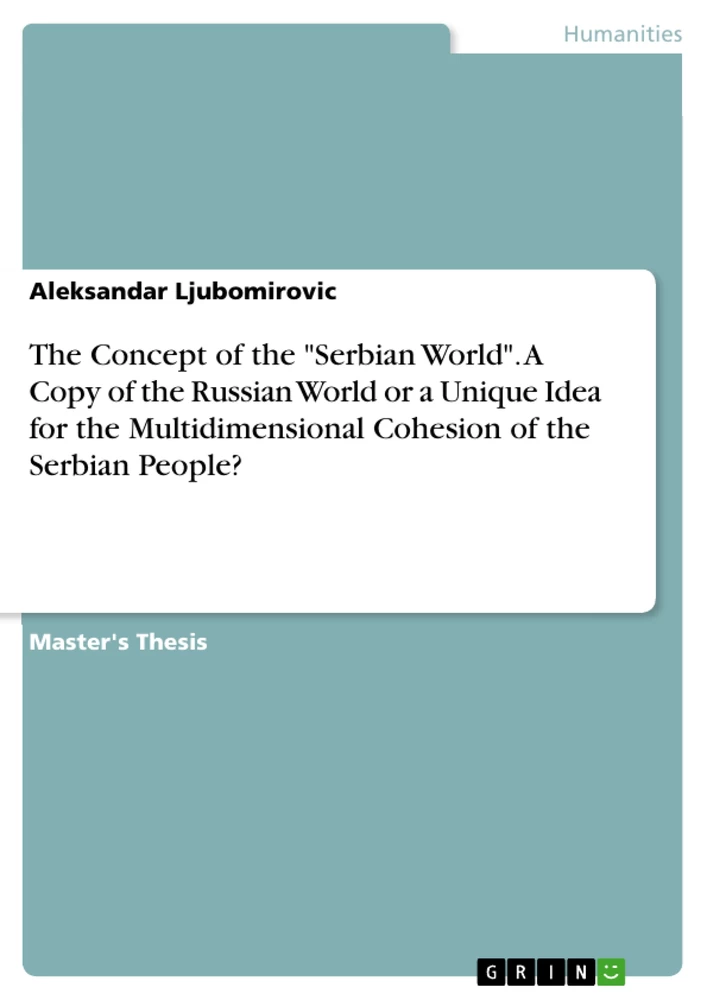
Table of Contents
1. Introduction
1.1 Research status
1.2 Methodology and Time Framework
1.3 Theoretical structure
1.3.1 Sources of ‘soft power’ and Nye’s conversion model
1.3.2 Soft Power and Serbia: A nation on the rise?
2. Defining the Serbian world concept
2.1 Moving through time and space
2.2 Modern-day meaning and use of the term
2.3 Dimensions of the Serbian world
2.3.1 Nationality-oriented dimension
2.3.2 Cultural dimension
2.3.3 Spiritual dimension
2.3.4 Psychological dimension
2.3.5 Geopolitical & territorial dimension
3. ‘Serbian world’ – A Borrowed Concept?
3.1 The Concept of the ‘Russian World’
3.2 The Serbian World – A Copy of the Russian World or a Unique Concept?
4. Conclusion: Does the Serbian world have a future?
Research Objectives and Themes
This master thesis investigates the concept of the "Serbian world" to determine whether it is a derivative of the Russian "Russian World" (Russkiy mir) doctrine or a unique strategy aimed at fostering multidimensional cohesion among the Serbian people. It explores the origins, definitions, and implementation of this concept within contemporary Serbian political discourse.
- Analysis of the "Serbian world" concept and its historical development.
- Examination of "soft power" as a central theoretical framework.
- Reconstruction of five key dimensions: nationality-oriented, cultural, spiritual, psychological, and geopolitical.
- Comparative study between the "Serbian world" and the Russian "Russian World" (Russkiy mir).
- Evaluation of the political discourse and the role of social actors in shaping the concept.
Excerpt from the Book
2.3 Dimensions of the Serbian world:
Alexander Dugin, a well-known Russian geopolitician, notes that the concept of boundaries determines the future of a state and is the essence of politics: “The boundary is the quintessence of politics. […] Boundaries determine success or failure, define starting conditions, and decide an inevitable defeat in the future. The problem of the greatness of a state and the entire abyss of a state’s fall is but part of the question of state boundaries. This is the very metaphysics of boundaries” (Kozdra 2018: 62). However, boundaries are not only real geographical objects, but also in certain ways mental constructs. This mental construct is often invoked in public discourse by political elites of institutional and symbolic power. For the reality, it is also a space of social awareness and a network of concepts that operates below and above distinct institutions. Boundaries are closely linked to mechanisms of social inclusion and exclusion, dividing lines between different cultures. However, mental representations of boundaries reproduced in the public discourse by elites are not only figments of imagination. They are also a source for creating contemporary identities and taking concrete action.
Summary of Chapters
1. Introduction: Outlines the historical context of the dissolution of Yugoslavia and the subsequent desire for cultural and political cohesion among Serbs in the region and diaspora, introducing the "Serbian world" as a soft power project.
2. Defining the Serbian world concept: Explores the historical roots of the term, its modern-day usage in political discourse, and categorizes it into five distinct dimensions: nationality-oriented, cultural, spiritual, psychological, and geopolitical.
3. ‘Serbian world’ – A Borrowed Concept?: Compares the "Serbian world" with the Russian "Russian World" (Russkiy mir), examining their similarities, historical connections, and whether the Serbian concept is an authentic or borrowed idea.
4. Conclusion: Does the Serbian world have a future?: Summarizes that the concept is a flexible, multifaceted construct serving as soft power, and argues that despite political shifts, its implementation as a tool for preserving Serbs' national identity will likely continue.
Keywords
Serbian world, Serbian identity, soft power, Balkans, Russian World, Russkiy mir, national cohesion, Serbian Orthodox Church, geopolitical dimensions, discourse analysis, foreign policy, mental boundaries, diaspora, integration, political discourse.
Frequently Asked Questions
What is the fundamental subject of this thesis?
The work explores the contemporary concept of the "Serbian world" (Srpski svet), its emergence in Serbian political discourse, and its role as a foreign policy tool for regional and global influence.
What are the primary thematic fields covered?
The thesis covers ethnic nationalism, the use of soft power in international relations, the influence of the Serbian Orthodox Church, and the role of intellectual and political elites in state-building narratives.
What is the primary research question?
The research intends to clarify whether the "Serbian world" is a direct copy of the Russian "Russian World" doctrine or a unique, indigenous idea designed to foster the cohesion of the Serbian people.
Which scientific methodology is employed?
The author uses political discourse analysis and cognitive semantics to evaluate how political and social actors construct the meaning of the "Serbian world" across various public platforms.
What does the main body of the work address?
It provides a historical backdrop, establishes a theoretical framework based on Joseph S. Nye’s soft power, defines the five dimensions of the concept (nationality, cultural, spiritual, psychological, geopolitical), and conducts a comparative analysis with Russia’s foreign policy.
Which keywords characterize this work?
Central terms include the Serbian world, Serbian identity, soft power, the Balkans, and the concept of national cohesion.
In what way does the Serbian Orthodox Church influence this concept?
The church is identified as a crucial "soft power" instrument, acting as a cross-border institution that reinforces spiritual unity and preserves Serbian identity beyond administrative state borders.
How do regional actors perceive the "Serbian world"?
Many regional actors from neighboring countries view it with suspicion, often labeling it an expansionist, imperialistic tool similar to "Greater Serbia" narratives from the 1990s, while the authors of the concept reject this as a misunderstanding.
Ende der Leseprobe aus 80 Seiten
- nach oben
- Arbeit zitieren
- Aleksandar Ljubomirovic (Autor:in), 2022, The Concept of the "Serbian World". A Copy of the Russian World or a Unique Idea for the Multidimensional Cohesion of the Serbian People?, München, Page::Imprint:: GRINVerlagOHG, https://www.diplomarbeiten24.de/document/1342640

neugierig - aktuell - relevant
Entdecken Sie hilfreiche Tipps und Tricks rund ums Studium!

Entdecken Sie hilfreiche Tipps und Tricks rund ums Studium!
Ihre Hausarbeit / Abschlussarbeit:

- - Publikation als E-Book und Buch
- - Hohes Honorar auf die Verkäufe
- - Für Sie komplett kostenlos - mit ISBN
- - Es dauert nur 5 Minuten
- - Jede Arbeit findet Leser

- © GRIN Publishing GmbH.
- Alle Inhalte urheberrechtlich geschützt. Kopieren und verbreiten untersagt.
- info@grin.com
- AGB
- Open Publishing
Der GRIN Verlag hat sich seit 1998 auf die Veröffentlichung akademischer eBooks und Bücher spezialisiert. Der GRIN Verlag steht damit als erstes Unternehmen für User Generated Quality Content. Die Verlagsseiten GRIN.com, Hausarbeiten.de und Diplomarbeiten24 bieten für Hochschullehrer, Absolventen und Studenten die ideale Plattform, wissenschaftliche Texte wie Hausarbeiten, Referate, Bachelorarbeiten, Masterarbeiten, Diplomarbeiten, Dissertationen und wissenschaftliche Aufsätze einem breiten Publikum zu präsentieren.
Kostenfreie Veröffentlichung: Hausarbeit, Bachelorarbeit, Diplomarbeit, Dissertation, Masterarbeit, Interpretation oder Referat jetzt veröffentlichen!
Folgen Sie GRIN auf


- GRIN Verlag GmbH
-
- Nymphenburger Str. 86
- 80636
- Munich, Deutschland
- +49 89-550559-0
- +49 89-550559-10
- info@grin.com
-
