
präsentiert von

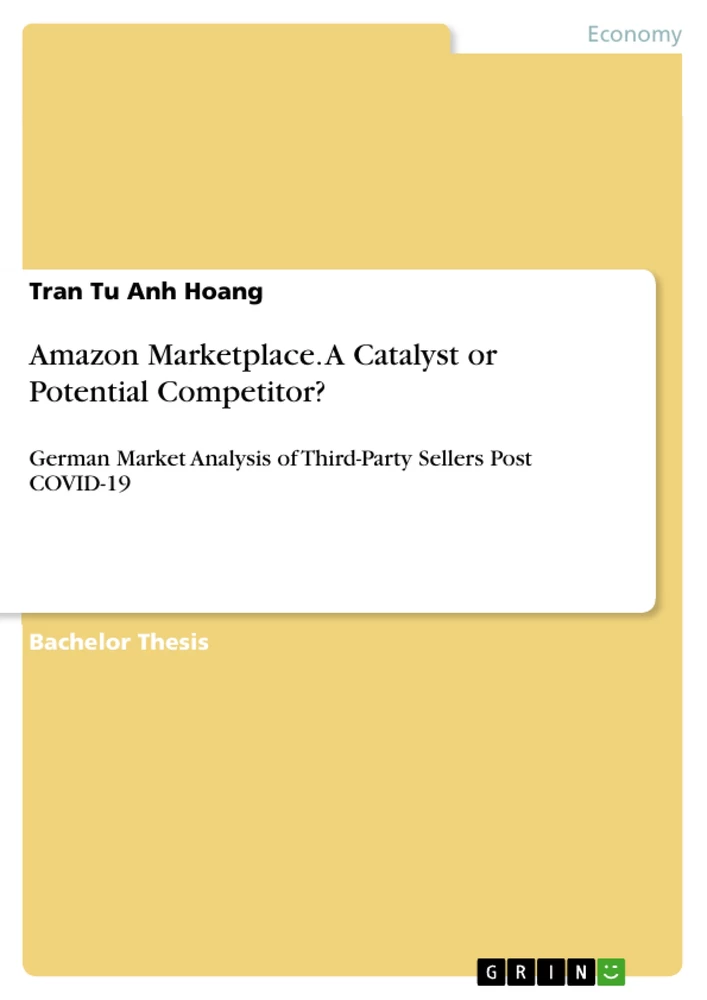
Table of Contents
1 Introduction
1.1 Problem and Mission Statement
1.2 Structure
2 Literature Review
2.1 Amazon’s Value Capture through its Ecosystem
2.1.1 Value Creation through Coopetition
2.1.2 Marketplace as an Ecosystem
2.2 Amazon’s Entry into E-tailer’s Product Space
2.3 Defense Strategies for Third-Party Sellers
2.4 Influence of COVID-19 on E-Commerce
2.5 Research Gap
3 Methodology
3.1 Research Design
3.2 Sample and Data Collection
3.3 Interview Guide
3.4 Data Analysis and Credibility
4 Results and Discussion
4.1 Business Models on Amazon Marketplace
4.2 Benefits
4.3 Risks
4.4 Strategies to Mitigate Risks and Sell Successfully
4.5 Influence of COVID-19 on Third-Party Sellers
4.6 Market Saturation and Future Outlook
5 Practical Implications and Recommendations
6 Limitations and Future Research Approaches
7 Conclusion
Research Objectives and Themes
This thesis examines the role of the Amazon Marketplace as either a catalyst or a competitor for third-party sellers in the German market, with a specific focus on the shifts caused by the COVID-19 pandemic. The core research question addresses whether selling on Amazon remains a viable long-term business model for e-retailers in an increasingly saturated environment.
- Strategic impact of Amazon’s coopetition business model on third-party vendors.
- Analysis of opportunities and risks regarding market dependency and platform saturation.
- Evaluation of seller defense strategies against Amazon’s private label competition.
- Investigation of COVID-19 as a transformative factor for e-commerce growth strategies.
Excerpt from the Book
2.1.1 Value Creation through Coopetition
Companies today are adopting business strategies to embrace competition. In tandem with collaboration, the phenomenon of "coopetition" emerged, attracting various scholars to study this interplay. Coopetition is defined as “a paradoxical relationship between two or more actors simultaneously involved in cooperative and competitive interactions, regardless of whether their relationship is horizontal or vertical” (Bengtsson and Kock, 2014, p. 182). Prior research stated that collaboration and competition stand in contrast to each other (Lado et al., 1997). Competition was thought to benefit from heated rivalry, while collaboration would damage competitive relationships (Bengtsson and Kock, 2000). Nevertheless, recent academic discussions emerged about how competition and collaboration correspond in a multi-actor structure in the context of coopetition and what advantages appear for firms when integrating this strategy (Bengtsson and Kock, 2014; Ritala et al., 2011; Wegmann et al., 2018).
There are various reasons to implement coopetition as a business strategy. The literature came to the consensus that there are three motivational factors for it (Bengtsson and Kock, 2000; Gnyawali and Park, 2011, pp. 658-659). Challenges such as raging costs materialized through decreasing product lifecycles, forcing the companies to expedite innovation within their products. Expensive research and development can rarely be borne by a sole company. Hence, rivals in similar industries collaborate to divide those costs. Ultimately, they compete with each other in order to each withdraw value from the joint alignment (Velu, 2018, p. 1). An example of this is the collaboration between aviation companies that form alliances and are able to share marketing and management expenses (Kleymann and Seristo, 2001). In addition to that, risk sharing also pertains to technological innovations. Concerns about technological investments cause rivals to collaborate in order to help minimize their upfront costs and therefore leverage faster access to new systems (Gnyawali and Park, 2011, p. 652).
Summary of Chapters
1 Introduction: This chapter introduces Amazon's global influence and provides the core mission statement, research questions, and the structural roadmap of the thesis.
2 Literature Review: The chapter explores fundamental academic discussions regarding Amazon's coopetition, ecosystem dynamics, and the impact of the pandemic on retail.
3 Methodology: This section details the qualitative research design, outlining the process of conducting semi-structured expert interviews to gather empirical data.
4 Results and Discussion: The author presents and interprets the findings from the expert interviews, categorizing benefits, risks, and strategies implemented by third-party sellers.
5 Practical Implications and Recommendations: Derived from the discussion, this chapter offers concrete advice for current and prospective Amazon sellers in the German market.
6 Limitations and Future Research Approaches: The chapter critically reflects on the study's scope, including its limited sample size, and suggests areas for future empirical investigations.
7 Conclusion: The summary integrates all findings to answer the primary research question regarding Amazon's dual role as a partner and competitor.
Keywords
Amazon Marketplace, Third-Party Sellers, Coopetition, E-Commerce, COVID-19, Business Strategy, Market Saturation, Fulfillment by Amazon (FBA), Fulfillment by Merchant (FBM), Retail Analytics, Online Distribution, Digital Transformation.
Frequently Asked Questions
What does this study investigate?
The study investigates the relationship between Amazon and third-party sellers in the German market, analyzing whether Amazon serves primarily as a partner or as a threat to these businesses.
What are the primary areas covered in this thesis?
It covers business models, the impact of coopetition, platform risks, the effects of the pandemic on e-commerce, and strategies for maintaining relevance on the platform.
What is the core objective of the research?
The primary goal is to provide a comprehensive outlook for e-retailers in Germany, offering data-driven insights into whether Amazon should remain their core distribution channel.
What scientific methods were applied?
The research uses a qualitative methodological approach, specifically utilizing semi-structured expert interviews and written surveys with eight industry participants.
What is discussed in the main part of the thesis?
The main part focuses on the empirical results derived from interviews, specifically examining business models (FBA vs. FBM), benefits like scalability, and risks like dependency and algorithm-driven ranking.
Which keywords define this research?
Key terms include Amazon Marketplace, Coopetition, Third-Party Sellers, and COVID-19, which represent the intersection of platform strategy and market demand.
How does Amazon's coopetition model affect sellers?
It creates a paradox where sellers benefit from the massive customer base Amazon provides, while simultaneously facing the risk of Amazon copying their successful products using internal data.
What strategy do experts suggest to mitigate Amazon's competitive threat?
Experts recommend building a strong brand identity outside of Amazon, diversifying sales channels, and continuously innovating to prevent product imitation.
Did the COVID-19 pandemic change the necessity of selling on Amazon?
Yes, the pandemic accelerated existing trends, forcing more businesses to transition to online models and making the Amazon Marketplace a vital, though challenging, lifeline for many.
What does the outlook for the German market look like?
The market is increasingly saturated, and experts suggest that while Amazon remains very profitable, success today requires higher upfront investment and more sophisticated marketing expertise than in the past.
Ende der Leseprobe aus 102 Seiten
- nach oben
- Arbeit zitieren
- Tran Tu Anh Hoang (Autor:in), 2022, Amazon Marketplace. A Catalyst or Potential Competitor?, München, Page::Imprint:: GRINVerlagOHG, https://www.diplomarbeiten24.de/document/1353269

neugierig - aktuell - relevant
Entdecken Sie hilfreiche Tipps und Tricks rund ums Studium!

Entdecken Sie hilfreiche Tipps und Tricks rund ums Studium!
Ihre Hausarbeit / Abschlussarbeit:

- - Publikation als E-Book und Buch
- - Hohes Honorar auf die Verkäufe
- - Für Sie komplett kostenlos - mit ISBN
- - Es dauert nur 5 Minuten
- - Jede Arbeit findet Leser

- © GRIN Publishing GmbH.
- Alle Inhalte urheberrechtlich geschützt. Kopieren und verbreiten untersagt.
- info@grin.com
- AGB
- Open Publishing
Der GRIN Verlag hat sich seit 1998 auf die Veröffentlichung akademischer eBooks und Bücher spezialisiert. Der GRIN Verlag steht damit als erstes Unternehmen für User Generated Quality Content. Die Verlagsseiten GRIN.com, Hausarbeiten.de und Diplomarbeiten24 bieten für Hochschullehrer, Absolventen und Studenten die ideale Plattform, wissenschaftliche Texte wie Hausarbeiten, Referate, Bachelorarbeiten, Masterarbeiten, Diplomarbeiten, Dissertationen und wissenschaftliche Aufsätze einem breiten Publikum zu präsentieren.
Kostenfreie Veröffentlichung: Hausarbeit, Bachelorarbeit, Diplomarbeit, Dissertation, Masterarbeit, Interpretation oder Referat jetzt veröffentlichen!
Folgen Sie GRIN auf


- GRIN Verlag GmbH
-
- Nymphenburger Str. 86
- 80636
- Munich, Deutschland
- +49 89-550559-0
- +49 89-550559-10
- info@grin.com
-
