
präsentiert von

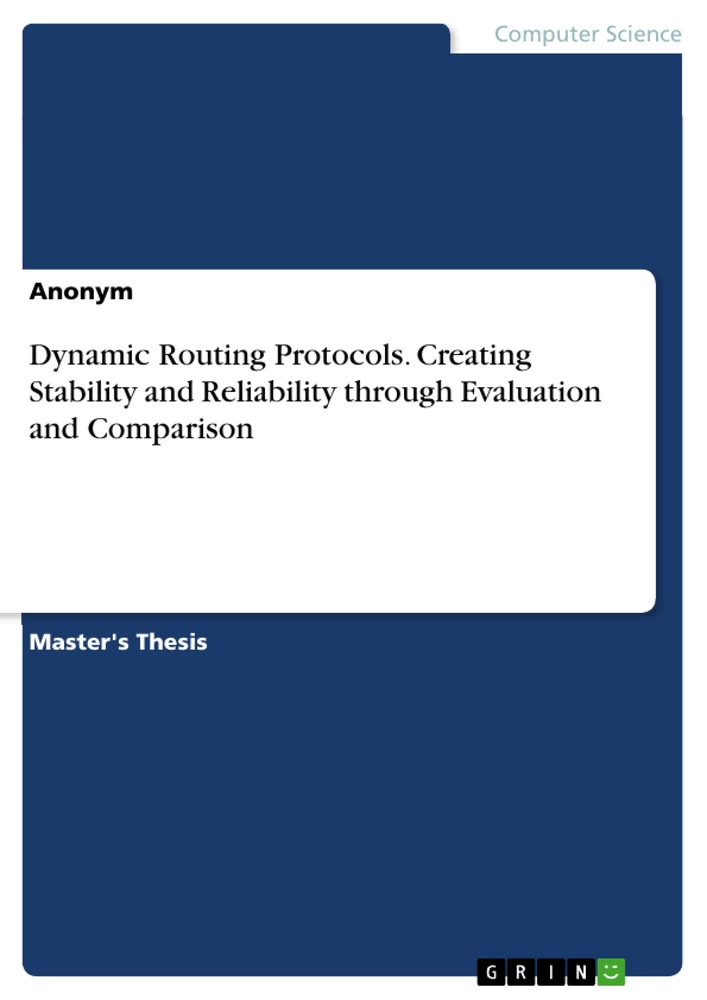
Table of Contents
Chapter one
Introduction
1.1. Background of the study
1.2. Statement of the problem
1.3. Research questions
1.4. Objectives the study
1.4.1. General Objectives
1.4.2. Specific Objectives
1.5. Significance of the study
1.6. Scope of the study
1.7. Limitation of the study
1.8. Structure of the Thesis
Chapter two
Literature Review
2.1 Theoretical Overview of Routing Protocols
2.1.1 General Overview
2.1.2 IP Routing
2.2 Functionality of IP Routing
2.2.1 Proactive Routing Protocols
2.2.2 Metric Parameters
2.2.3 Types of Routing Protocols
2.2.4 Static versus Dynamic Routing
2.2.5 Types of Dynamic Routing Protocols
1 Routing Information Protocol (RIP)
2. Open Shortest Path First (OSPF) Protocol
3. IS-IS
4. ENHANCED INTERIOR GATEWAY ROUTING PROTOCOL
2.2.6 PERFORMANCE METRICS
2.3. Related works
Chapter Three
Research Methods and Design
3.1. Introduction
3.2. Research method
3.3. Research Design
3.4. Data Collection
3.4.1. Document Analysis
3.5. Method of Data Analysis
CHAPTER FOUR
RESULTS AND DISCUSSIONS
4.1. Introduction
4.2. Structure of Cisco packet tracer
4.3 Protocols selected for the study
4.4. Simulation Setup
4.5. Delay Comparison
4.6. Destination Unreachable comparison
4.7. Total traveling time of RIP, EIGRP and OSPF protocol scomparison
4.8. Discussion
Chapter Five
Conclusion and recommendation
5.1 Conclusion
5.2. Recommendation for Future Work
Research Objectives and Themes
The primary aim of this work is to conduct an empirical analysis on the evaluation and comparison of dynamic routing protocols—specifically RIP, EIGRP, and OSPF—to determine their effectiveness regarding network stability, reliability, convergence speed, and performance under varying topological conditions using the Cisco Packet Tracer simulation tool.
- Comparative performance analysis of RIP, EIGRP, and OSPF routing protocols.
- Evaluation of network convergence times during link failures or router shutdowns.
- Analysis of end-to-end packet delay and destination unreachable metrics.
- Investigation of protocol efficiency in large-scale vs. small-scale network topologies.
- Assessment of the scalability and routing table maintenance behavior of each protocol.
Excerpt from the Book
A. Routing Information Protocol(RIP)
As discussed in review parts, RIP is a standardized vector distance routing protocol and uses a form of distance as hop count metric. RIP is also known as a distance vector. RIP prevents routing loops, by limiting the number of hop counts allowed in paths between sources and destinations. Basically, the maximum number of hops allowed for RIP is 15. However, by achieving the routing loop prevention, the size of supporting networks is sacrificed. Because of the maximum number of hop counts allowed for RIP is 15, as long as the number goes beyond 15, the route would be considered as unreachable.
When first developed, RIP only transmitted full updates every 30 seconds. In the early distributions, traffic was not important because the routing tables were small enough. As networks become larger, massive traffic burst becomes more likely during the 30 seconds period, even if the routers had been initialized at different times. Because of this random initialization, it is commonly understood that the routing updates would spread out in time, but that is not the case in real practice.
Summary of Chapters
Chapter one: Provides the background of routing protocols, defines the problem statement regarding network performance, and outlines research objectives and scope.
Chapter two: Reviews relevant literature on IP routing functionality, different routing protocol types, metrics, and related previous research studies.
Chapter Three: Details the methodologies used, including Design Science and qualitative research, alongside the data collection instruments and analysis techniques.
CHAPTER FOUR: Presents the results and discussions of the Packet Tracer simulations, comparing delay, convergence, and packet delivery across the selected protocols.
Chapter Five: Concludes the thesis by summarizing findings and providing recommendations for future work.
Keywords
RIP, EIGRP, OSPF, Cisco Packet Tracer, Network Stability, Reliability, Convergence Speed, Routing Protocols, Distance Vector, Link State, Network Simulation, Packet Delay, Bandwidth Optimization, Routing Tables, IP Networks.
Frequently Asked Questions
What is the core focus of this research?
The research focuses on the empirical analysis, evaluation, and performance comparison of dynamic routing protocols (RIP, EIGRP, and OSPF) to determine which is most suitable for ensuring network stability and reliability.
What are the primary themes covered in the thesis?
The work covers theoretical concepts of interior gateway protocols, Cisco Packet Tracer simulation methodologies, performance metrics such as convergence time and delay, and the impact of topological changes on routing efficiency.
What is the primary research goal?
The primary goal is to identify which routing protocol performs best in terms of building and maintaining routing tables, selecting the optimal path, and achieving the fastest convergence during network failures like link outages or router shutdowns.
Which scientific methods were employed?
The study utilizes Design Science research and qualitative analysis, backed by simulation experiments conducted within the Cisco Packet Tracer environment to generate quantitative data on network performance.
What is covered in the main body of the work?
The main body examines the architecture and functionality of RIP, EIGRP, and OSPF, describes the simulation setup using Packet Tracer, and analyzes performance metrics like end-to-end delay, destination unreachable packets, and convergence duration.
Which keywords characterize this work?
Key terms include Routing Protocols, RIP, EIGRP, OSPF, Cisco Packet Tracer, Network Convergence, Stability, Reliability, and Performance Analysis.
How does OSPF perform compared to RIP and EIGRP according to the findings?
The simulation results demonstrate that OSPF generally provides faster convergence and greater reliability than RIP and EIGRP, making it preferable for large enterprise networks with many routers and frequent topology changes.
How does EIGRP distinguish itself from the other protocols?
EIGRP is categorized as a hybrid protocol that uses the Diffusing Update Algorithm (DUAL) for fast convergence and triggered updates, which significantly reduces the routing protocol load compared to the periodic updates used by RIP.
Ende der Leseprobe aus 54 Seiten
- nach oben
- Arbeit zitieren
- Anonym (Autor:in), 2022, Dynamic Routing Protocols. Creating Stability and Reliability through Evaluation and Comparison, München, Page::Imprint:: GRINVerlagOHG, https://www.diplomarbeiten24.de/document/1353430


neugierig - aktuell - relevant
Entdecken Sie hilfreiche Tipps und Tricks rund ums Studium!

Entdecken Sie hilfreiche Tipps und Tricks rund ums Studium!
Ihre Hausarbeit / Abschlussarbeit:

- - Publikation als E-Book und Buch
- - Hohes Honorar auf die Verkäufe
- - Für Sie komplett kostenlos - mit ISBN
- - Es dauert nur 5 Minuten
- - Jede Arbeit findet Leser

- © GRIN Publishing GmbH.
- Alle Inhalte urheberrechtlich geschützt. Kopieren und verbreiten untersagt.
- info@grin.com
- AGB
- Open Publishing
Der GRIN Verlag hat sich seit 1998 auf die Veröffentlichung akademischer eBooks und Bücher spezialisiert. Der GRIN Verlag steht damit als erstes Unternehmen für User Generated Quality Content. Die Verlagsseiten GRIN.com, Hausarbeiten.de und Diplomarbeiten24 bieten für Hochschullehrer, Absolventen und Studenten die ideale Plattform, wissenschaftliche Texte wie Hausarbeiten, Referate, Bachelorarbeiten, Masterarbeiten, Diplomarbeiten, Dissertationen und wissenschaftliche Aufsätze einem breiten Publikum zu präsentieren.
Kostenfreie Veröffentlichung: Hausarbeit, Bachelorarbeit, Diplomarbeit, Dissertation, Masterarbeit, Interpretation oder Referat jetzt veröffentlichen!
Folgen Sie GRIN auf


- GRIN Verlag GmbH
-
- Nymphenburger Str. 86
- 80636
- Munich, Deutschland
- +49 89-550559-0
- +49 89-550559-10
- info@grin.com
-
