
präsentiert von

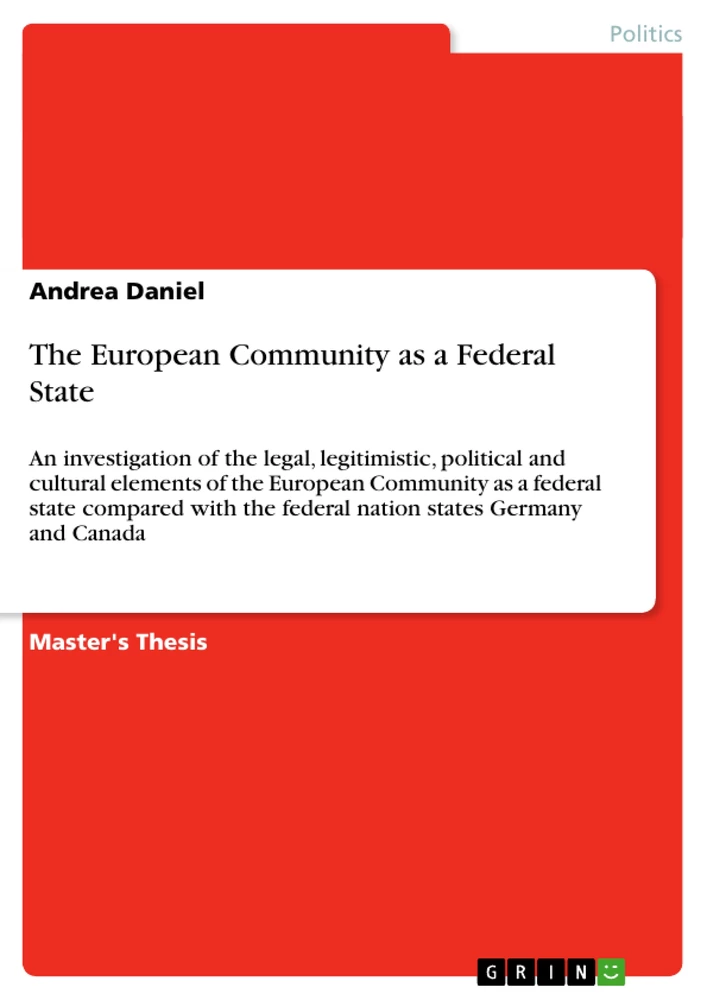
Table of Contents
1. INTRODUCTION
1.1. THE SUBJECT
1.2. THE METHODOLOGY
2. LEGAL AND STRUCTURAL ELEMENTS OF A FEDERAL STATE
2.1. WHAT MAKES A STATE FEDERAL? THEORY, PRACTICE AND PROBLEMS OF COMPARISON
2.2. WHAT MAKES A STATE A STATE?
3. THE EC AND THE STRUCTURAL ELEMENTS OF A STATE
3.1. WHOSE TERRITORY IS IT, ANYWAY?
3.2. THE ORIGINAL POWER OF A STATE TO RULE
3.2.1. LEGISLATIVE POWER – DEFINING A SUPREME LEGAL ORDER
3.2.2. MORE ON LEGISLATIVE POWER – THE SUBSIDIARITY PRINCIPLE
3.2.3. JUDICIAL POWER - ECJ, NATIONAL COURTS AND THE QUESTION OF SUPREMACY
3.2.4. EXECUTIVE POWER - GOVERNED BY THE COMMISSION OR A GOVERNED COMMISSION?
3.2.5. ORIGINAL POWER - DO STATES MAKE TREATIES OR DO TREATIES MAKE A STATE?
3.3. PERMANENT POPULATION: – SEARCHING THE CITIZENS OF EUROPE
4. THE EC AND THE LEGITIMISTIC ELEMENTS OF A FEDERAL STATE
4.1. STATES RULED BY THE LAW
4.1.1. THE PRINCIPLE
4.1.2. LAW RULED BY RIGHTS - THE GUARANTEE OF HUMAN AND FUNDAMENTAL RIGHTS
4.2. THE SEPARATION OF POWERS
4.3. LEGITIMIZED BY THE DEMOS – HOW MUCH PARLIAMENT DO YOU NEED?
5. THE EC AND ITS POLITICAL POWER
5.1. MUST A FEDERATION HAVE A CORE?
5.1.1. A COMMON CURRENCY
5.1.2. A COMMON DEFENCE
5.1.3. A COMMON FOREIGN POLICY
5.1.4. THE FEDERATION’S STONE
5.2. THE EC – AN EMPTY SHELL?
5.2.1. ALL CURRENCIES ARE EQUAL BUT ONE CURRENCY IS MORE EQUAL
5.2.2. THE CFSP – A DIFFICULT BIRTH STILL IN PROGRESS
5.2.3. THE FILLING OF THE SHELL
6. A STATE’S IDENTITY
6.1. SEARCHING FOR A COMMON CULTURE
6.2. CULTURAL DIVERSITY – ENEMY OR JUSTIFICATION OF FEDERAL SYSTEMS?
7. CONCLUSION - SUIS GENERIS OR YES IT COULD, BUT IT MUST NOT (YET)
Objectives and Research Themes
The primary objective of this work is to demonstrate that the European Community qualifies as a federal state by fulfilling the core legal and structural criteria, despite its current lack of sufficient political competence. The author examines whether the Community's structural development has outpaced its political authority, arguing that its potential is currently constrained by Member States retaining essential core powers.
- Analysis of the legal, legitimistic, and structural elements of the European Community compared to German and Canadian federal models.
- Investigation of the "democratic deficit" and the expansion of the European Parliament's role.
- Evaluation of core state functions, specifically foreign policy, defence, and monetary policy.
- Discussion on the necessity of a unified cultural identity for the cohesion of a federal state.
- Critical assessment of the Community's internal "checks and balances" and its functional separation of powers.
Excerpt from the Book
3.2.3. JUDICIAL POWER - ECJ, NATIONAL COURTS AND THE QUESTION OF SUPREMACY
It is a core principle of a modern state that every act of state power must be perusable by an independent judge who is only bound to the law. (SchmidtR, 2008 p. 63 ff.) This principle necessarily includes the individual right to call for a decision of the “legal judge”.
The German GG constitutes the judiciary power in Art 92 and 97. Art 93-94 GG constitute the BVerfG. This Court is responsible for the “interpretation of the Constitution”, e.g. for safeguarding the legality and adequacy of the legislative processes. The BVerfG can also hear every natural or legal person’s claim that his individual rights were diminished by an act of federal public force (Art 93 lit 4a GG).
For the other areas of the legal order Art 95 GG constitutes supreme Federal Courts, which are mostly Courts of Appeal (BGH) or Courts of last instance (e.g. the Federal Labour Court). The “levels of judicial review” start on the level of the Länder Courts and proceeds to (one or two instances of) Higher Länder Courts and then to the resp. Federal Courts, but the “chain of instances” differs from area to area of the legal order.
The Länder have own judiciary power constituted in the resp. Länder Constitution. All Länder have constituted a Supreme Constitutional Court but the other Länder Courts are constituted by federal laws, like the German Code on Court Constitution (Gerichtsverfassungsgesetz). As a result, where federal law is affected, the Länder and the Federal Courts are “legal judges”, while, where exclusively Länder laws are affected, the “chain of instances” generally terminates with the Higher Länder Courts or the Länder Supreme Courts. The judges of the Länder Courts are appointed by the Länder while the federal judges are civil servants of the federation and appointed by her.
Summary of Chapters
1. INTRODUCTION: Outlines the thesis that the EC is a federal state without adequate political power and defines the methodology of using German and Canadian systems as a comparative framework.
2. LEGAL AND STRUCTURAL ELEMENTS OF A FEDERAL STATE: Establishes the theoretical requirements for a federal state, specifically focusing on Jellinek’s "three elements" theory.
3. THE EC AND THE STRUCTURAL ELEMENTS OF A STATE: Analyzes how the EC satisfies the criteria of defined territory, original power, and permanent population compared to established federations.
4. THE EC AND THE LEGITIMISTIC ELEMENTS OF A FEDERAL STATE: Examines how the EC adheres to the rule of law, separation of powers, and democratic legitimacy through its institutional frameworks.
5. THE EC AND ITS POLITICAL POWER: Discusses the Community's limitations in core policy areas like currency, defence, and foreign policy, arguing for further integration.
6. A STATE’S IDENTITY: Challenges the assumption that a unified cultural identity is a prerequisite for a federal state by analyzing German and Canadian historical experiences.
7. CONCLUSION - SUIS GENERIS OR YES IT COULD, BUT IT MUST NOT (YET): Summarizes that while the EC functions as a federal state, it requires further transfer of competences to fully utilize its potential.
Key Words
Federal State, European Community, Subsidiarity, European Court of Justice, Constitutional Law, Sovereignty, Legislative Power, Democratic Deficit, Political Competence, Member States, Citizenship, Separation of Powers, Cultural Identity, European Integration, Comparative Law
Frequently Asked Questions
What is the core argument of this publication?
The work argues that the European Community has already developed into a federal state regarding its legal and structural elements, but currently suffers from inadequate political power because Member States retain control over core policy fields like foreign, defence, and monetary policy.
What are the primary thematic areas of this book?
The book covers the legal and structural elements of a state, the principles of subsidiarity, the judiciary power within the European Community, democratic legitimacy, and the significance of identity in federal systems.
What is the central research question?
The research explores to what extent the European Community can be regarded as a federal state and whether it possesses the legal personality and structural capacity to effectively handle federal-level competences.
Which scientific methods are employed?
The author uses a comparative analysis, benchmarking the European Community’s system against the German and Canadian federal models to evaluate its "federal state" potential.
What does the main body of the work focus on?
The main body systematically analyzes the Community’s territory, the originality of its power, its legislative, judicial, and executive structures, and its adherence to the rule of law and separation of powers.
Which keywords best characterize this work?
The work is best characterized by terms such as Federal State, European Community, Subsidiarity, European Court of Justice, Sovereignty, and Democratic Deficit.
How does the author view the "democratic deficit" in the European Community?
The author argues that while the democratic deficit was historically significant, it has been substantially reduced through the increased legislative powers of the European Parliament and expanded civil society participation.
Is a common cultural identity necessary for a federal state?
No, the author explicitly argues that a unified cultural identity is not a mandatory condition for a federal state, using the successful examples of Canada and Germany to illustrate that tolerance for diversity is more important.
Ende der Leseprobe aus 70 Seiten
- nach oben
- Arbeit zitieren
- Andrea Daniel (Autor:in), 2009, The European Community as a Federal State, München, Page::Imprint:: GRINVerlagOHG, https://www.diplomarbeiten24.de/document/135429

neugierig - aktuell - relevant
Entdecken Sie hilfreiche Tipps und Tricks rund ums Studium!

Entdecken Sie hilfreiche Tipps und Tricks rund ums Studium!
Ihre Hausarbeit / Abschlussarbeit:

- - Publikation als E-Book und Buch
- - Hohes Honorar auf die Verkäufe
- - Für Sie komplett kostenlos - mit ISBN
- - Es dauert nur 5 Minuten
- - Jede Arbeit findet Leser

- © GRIN Publishing GmbH.
- Alle Inhalte urheberrechtlich geschützt. Kopieren und verbreiten untersagt.
- info@grin.com
- AGB
- Open Publishing
Der GRIN Verlag hat sich seit 1998 auf die Veröffentlichung akademischer eBooks und Bücher spezialisiert. Der GRIN Verlag steht damit als erstes Unternehmen für User Generated Quality Content. Die Verlagsseiten GRIN.com, Hausarbeiten.de und Diplomarbeiten24 bieten für Hochschullehrer, Absolventen und Studenten die ideale Plattform, wissenschaftliche Texte wie Hausarbeiten, Referate, Bachelorarbeiten, Masterarbeiten, Diplomarbeiten, Dissertationen und wissenschaftliche Aufsätze einem breiten Publikum zu präsentieren.
Kostenfreie Veröffentlichung: Hausarbeit, Bachelorarbeit, Diplomarbeit, Dissertation, Masterarbeit, Interpretation oder Referat jetzt veröffentlichen!
Folgen Sie GRIN auf


- GRIN Verlag GmbH
-
- Nymphenburger Str. 86
- 80636
- Munich, Deutschland
- +49 89-550559-0
- +49 89-550559-10
- info@grin.com
-
