
präsentiert von

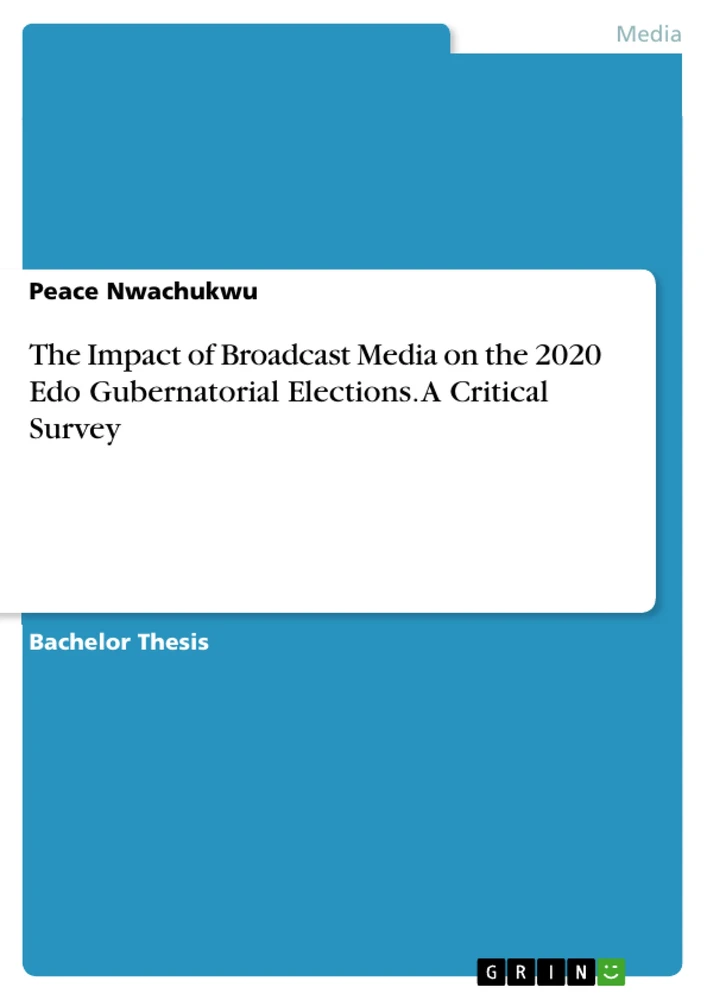
Table of Contents
CHAPTER ONE: INTRODUCTION
1.1 Background of the study
1.2 Statement of problem
1.3 Aim and objectives of the study
1.4 Research questions
1.5 Significance of the study
1.6 Scope of the study
1.7 Limitations of the study
1.8 Definition of terms
CHAPTER TWO: LITERATURE REVIEW
2.1 Theoretical Framework
2.1.1 Agenda Setting Theory
2.2 Conceptual framework
2.2.1 Broadcast media and elections
2.2.2 Purpose of elections
2.2.3 Broadcast media and electoral process
2.2.4 Nigerian broadcast media in retrospect
2.2.5 Radio, television and the 2020 Edo State gubernatorial elections
2.2.6 Roles of the Media in Elections
2.2.7 Media as Watchdog
2.3 Empirical review
CHAPTER THREE: RESEARCH METHODOLOGY
3.1 Research design
3.2 Population of the study
3.3 Sample size and sampling technique
3.4 Data collection method
3.5 Research instrument
3.6 Data analysis
CHAPTER FOUR: DATA ANALYSIS AND INTERPRETATION
CHAPTER FIVE: SUMMARY, RECOMMENDATIONS AND CONCLUSION
5.1 Summary
5.2 Conclusion
5.3 Recommendations
Research Objectives and Themes
The primary aim of this research is to evaluate the influence and role of broadcast media (radio and television) in shaping the political landscape and voter behavior during the 2020 Edo State gubernatorial elections. The study seeks to investigate how media coverage contributes to the electoral process, whether it fosters an informed electorate, and the extent to which broadcast platforms adhere to journalistic responsibilities in a democratic society.
- The impact of broadcast media on the political habits of the electorate.
- The application of the Agenda Setting Theory in the context of political broadcasting.
- The effectiveness of radio and television as tools for social and political mobilization.
- The evaluation of media fairness in providing equitable access to political candidates and parties.
- The assessment of the media's function as a watchdog for democratic transparency.
Excerpt from the Book
2.2.1 Broadcast media and elections
It has been established that there is a very strong relationship between media performance and the conduct and vibrancy of politics and political activities in democracies. It is often said that in democracies, “the media have a complex relationship with sources of power and the political system” (McQuail, 2005). Both politics and the media have the singular aim of promoting the individual and collective interests of the general society.
Thus, while politics serves as a route and means of uplifting the society through good governance, protection and advancement of people’s rights, and the creation of an enabling environment for democracy to thrive; the media on their part operate within the prevailing environment to engage in the public sphere thereby expanding the frontiers of freedom and enabling the citizens to have access to quality information that will influence their judgments and decisions for sustainable democracy. Stated differently, the media in a democratic context “distribute entitlements to speak and to be heard”, even if unevenly (Keane, 2008).
From the foregoing, it is clear that the existence of a vibrant media system is quite fundamental to the enthronement and sustenance of a credible democratic process in a setting like Nigeria. As one scholar had argued: A responsible nationwide democratic system requires a media system which is coterminous with it and which can generate discussion of issues of public concern in a way which does not favour partisan interests; whether these be the interests of particular political parties, the interests of media bosses or media professionals (Boyd Barrett, 2011).
Summary of Chapters
CHAPTER ONE: INTRODUCTION: Introduces the critical role of media in democracy, outlines the problem statement regarding electoral integrity in Nigeria, and defines the research scope for the 2020 Edo gubernatorial study.
CHAPTER TWO: LITERATURE REVIEW: Examines theoretical foundations like Agenda Setting Theory and explores the conceptual relationship between broadcast media, elections, and the media's role as a societal watchdog.
CHAPTER THREE: RESEARCH METHODOLOGY: Details the descriptive survey approach, sampling techniques for the population in Ikorodu, and the instruments used for data gathering and analysis.
CHAPTER FOUR: DATA ANALYSIS AND INTERPRETATION: Presents the findings from collected questionnaires, using statistical tables to assess respondent demographics, political interests, and perceptions of media influence.
CHAPTER FIVE: SUMMARY, RECOMMENDATIONS AND CONCLUSION: Synthesizes research findings, concludes on the media’s ability to affect election outcomes, and provides strategic recommendations for future media conduct during elections.
Keywords
Broadcast media, Gubernatorial elections, Edo State, Democracy, Agenda Setting Theory, Political communication, Voter behavior, Electoral process, Media accountability, Social mobilization, Watchdog role, Political parties, Public opinion, Journalism, Media coverage.
Frequently Asked Questions
What is the core focus of this research?
The research evaluates the impact and effectiveness of radio and television broadcast media on the 2020 Edo State gubernatorial election, specifically focusing on how they educate the populace and shape political discourse.
What are the primary themes discussed?
The work covers themes such as the media's watchdog role, electoral transparency, agenda-setting, political mobilization, and the challenges of media neutrality in a democratic environment.
What is the central research question?
The study primarily seeks to determine how broadcast media mobilized the Nigerian electorate and whether its coverage helped or hindered the attainment of a free and fair election in the 2020 Edo State context.
Which scientific method is utilized?
The research employs a descriptive survey methodology, utilizing questionnaires distributed to a sample of 250 respondents to gather empirical data for descriptive analysis and chi-square testing.
What does the main body of the work cover?
The main body integrates theoretical literature on media functions in democratic processes with the practical analysis of data collected from respondents regarding their voting behaviors and media consumption.
Which key terms characterize this study?
Key terms include broadcast media, agenda-setting, social mobilization, electoral process, and democracy.
How does the study define the "watchdog" role of the media?
It defines the watchdog role as the media’s duty to scrutinize political activities, prevent corruption, and ensure accountability through transparent reporting of electoral processes.
What conclusion does the author reach regarding the 2020 election?
The author concludes that broadcast media coverage significantly impacts electoral results and suggests that, while generally active in mobilization, there is a continued need for media practitioners to maintain professionalism and provide equal opportunities for all political parties.
Ende der Leseprobe aus 46 Seiten
- nach oben
- Arbeit zitieren
- Peace Nwachukwu (Autor:in), 2020, The Impact of Broadcast Media on the 2020 Edo Gubernatorial Elections. A Critical Survey, München, Page::Imprint:: GRINVerlagOHG, https://www.diplomarbeiten24.de/document/1360199

neugierig - aktuell - relevant
Entdecken Sie hilfreiche Tipps und Tricks rund ums Studium!

Entdecken Sie hilfreiche Tipps und Tricks rund ums Studium!
Ihre Hausarbeit / Abschlussarbeit:

- - Publikation als E-Book und Buch
- - Hohes Honorar auf die Verkäufe
- - Für Sie komplett kostenlos - mit ISBN
- - Es dauert nur 5 Minuten
- - Jede Arbeit findet Leser

- © GRIN Publishing GmbH.
- Alle Inhalte urheberrechtlich geschützt. Kopieren und verbreiten untersagt.
- info@grin.com
- AGB
- Open Publishing
Der GRIN Verlag hat sich seit 1998 auf die Veröffentlichung akademischer eBooks und Bücher spezialisiert. Der GRIN Verlag steht damit als erstes Unternehmen für User Generated Quality Content. Die Verlagsseiten GRIN.com, Hausarbeiten.de und Diplomarbeiten24 bieten für Hochschullehrer, Absolventen und Studenten die ideale Plattform, wissenschaftliche Texte wie Hausarbeiten, Referate, Bachelorarbeiten, Masterarbeiten, Diplomarbeiten, Dissertationen und wissenschaftliche Aufsätze einem breiten Publikum zu präsentieren.
Kostenfreie Veröffentlichung: Hausarbeit, Bachelorarbeit, Diplomarbeit, Dissertation, Masterarbeit, Interpretation oder Referat jetzt veröffentlichen!
Folgen Sie GRIN auf


- GRIN Verlag GmbH
-
- Nymphenburger Str. 86
- 80636
- Munich, Deutschland
- +49 89-550559-0
- +49 89-550559-10
- info@grin.com
-
