
präsentiert von

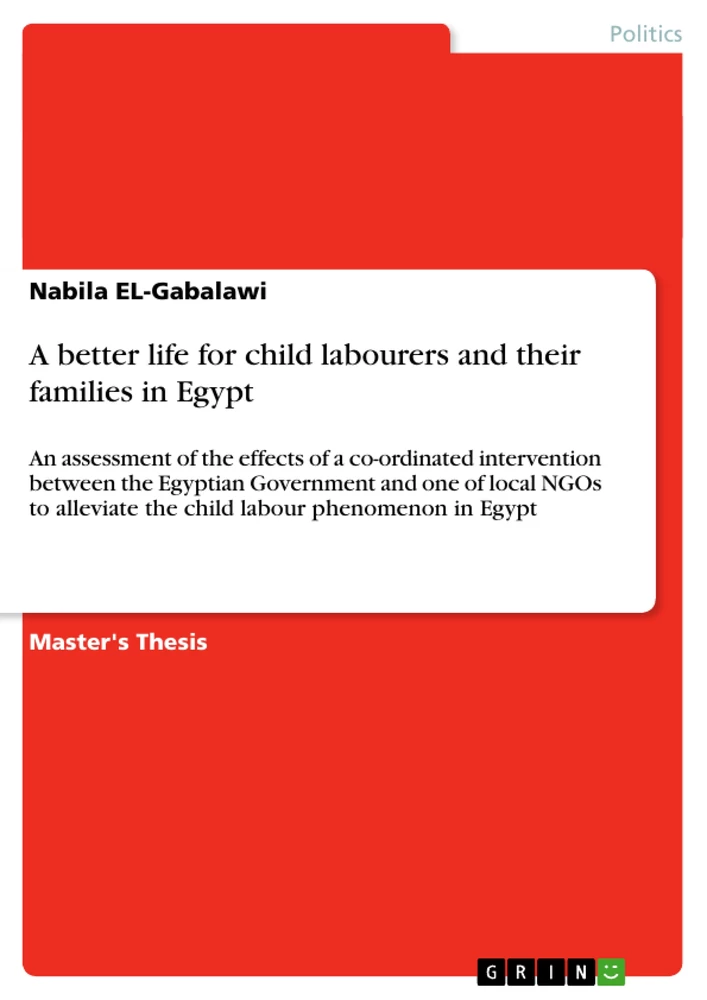
Table of Contents
1. INTRODUCTION
1.1 RATIONALE FOR THE STUDY
1.2 RESEARCH AIM AND OBJECTIVES
1.3 RESEARCH QUESTIONS
1.5 CONCEPTUAL FRAMEWORK OF THE STUDY
2. LITERATURE REVIEW
2.1 BACKGROUND ABOUT CHILD LABOUR
2.2 DEFINITIONS
2.3 HISTORICAL EVOLUTION OF CHILD LABOUR
2.4 CHILD LABOUR FACTORS AND REASONS FOR WORK
2.4.1 Poverty as the main contributor to child labour
2.4.2 The family organisation and its environment
2.4.3 Economic shock
2.4.4 Demand-supply factors of child labour
2.5 CHILD LABOUR INTERVENTIONS
2.6 SUSTAINABILITY OF CHILD LABOUR INTERVENTIONS
2.7 CHILDREN’S RIGHTS AND BEST INTERESTS AS BASICS FOR SUSTAINABILITY
2.8 EXAMINING THE EFFECTIVENESS OF DIFFERENT INTERVENTIONS
2.8.1 Withdrawal of child labourers from labour market
2.8.2 Providing financial support to child labourers families
2.8.3 Education as an appropriate solution to child labour
3. RESEARCH METHODOLOGY
3.1 FIELD RESEARCH AIM
3.2 TARGET GROUPS
3.3 RESEARCH AREA
3.4 RESEARCH TIME
3.5 RESEARCH STRATEGIES AND METHODOLOGY
A) PRIMARY DATA
1) Social survey
2) Observation
3) Focus Group Discussions (FGD)
4) Case studies
5) Semi- structured interviews
B) SECONDARY DATA
3.6 RESEARCH LIMITATIONS
4. ANALYSIS AND DISCUSSION
5. CONCLUSION AND RECOMMENDATIONS
Research Objectives and Focus
This dissertation examines the effectiveness and sustainability of child labour interventions in Egypt, specifically focusing on a joint initiative between the Egyptian government and a local NGO in Cairo. The research aims to shift the focus from merely eliminating child labour to improving the socio-economic conditions and respecting the rights and best interests of the children involved.
- Evaluating the effectiveness of child labour programmes in improving livelihoods.
- Analysing the role of poverty and economic factors in perpetuating child labour.
- Assessing the impact of education and vocational training as alternative interventions.
- Investigating the extent to which children's rights are considered in project design.
- Establishing a conceptual framework for sustainable, rights-based interventions.
Excerpt from the Book
2.4.1 Poverty as the main contributor to child labour
There is a strong link between child labour and poverty. At households’ level, child labour is a consequence of poverty, as poor people find no alternative to secure their daily income but to send their children to work. At countries level especially the poor ones; child labour is both a cause and a consequence of poverty. The reasons behind having high incidence of child labour in low-income countries are the existence of high number of households in extreme poverty, and the exhibition of some socio-economic patterns like the low productivity per head, which is suitable for children’s work, and the unaffordable high quality education. It is argued that there is no direct relation between the economic growth of a country and the increase in a household income, as observed in different parts of the world, the national income is directly interlinked to the incidence of child labour, while the household income is not (ILO, 2004).
Being a cause and a consequence of poverty at a country’s level like Egypt, was confirmed by Egypt’s First Lady in her speech in one of the conferences. She said, “Instead of becoming a means of combating poverty and improving the living conditions of poor families; child labour is a guarantee of devoting poverty and inheriting it from one generation to another. Child labour is costly on society because child labourers become infected with diseases and subjected to accidents at work. Over and above, they become malnourished and deprived from entertainment, expression of opinion and education, which result in working always in simple occupations throughout their lives. Hence, their living standards can never be improved” (Al-ahram Al-Masaai, 2008).
Summary of Chapters
1. INTRODUCTION: This chapter outlines the rationale for the study, research aims, and the conceptual framework regarding child labour in Egypt.
2. LITERATURE REVIEW: This chapter explores historical perspectives, definitions, and factors influencing child labour, along with an examination of existing interventions.
3. RESEARCH METHODOLOGY: This section details the field research strategy, including target groups, primary data collection techniques, and research limitations.
4. ANALYSIS AND DISCUSSION: This chapter analyses the findings from the field research, comparing qualitative and quantitative data against the literature review.
5. CONCLUSION AND RECOMMENDATIONS: This final chapter summarises the study's findings and provides recommendations for enhancing future child labour interventions.
Keywords
Child labour, Egypt, Poverty, Interventions, Withdrawal from labour market, Financial support, Education, Child’s rights, Child’s best interests, Sustainability, Socio-economic, Households, Empowerment, Vulnerable groups, NGO activities.
Frequently Asked Questions
What is the core focus of this dissertation?
The dissertation investigates the effectiveness and long-term sustainability of specific child labour interventions in Egypt, specifically the 'Promoting Working Children’s, Youths’ and Women’s Wellbeing in Abu El-Soud area' project.
What are the primary themes addressed in this work?
The main themes include the relationship between poverty and child labour, the importance of child-centred approaches, the role of education and vocational training, and the necessity of aligning interventions with the rights and best interests of the child.
What is the central research question?
The overarching theme is the sustainability of child labour interventions. It asks to what extent target groups are satisfied, how they perceive the effectiveness of the support, and how these programmes can best endorse the rights and needs of the children.
Which scientific methodology was used?
The researcher employed a mixed-methods approach, combining quantitative data (social surveys of 100 families) with qualitative data (focus group discussions, case studies, and semi-structured interviews with key stakeholders).
What is covered in the main body of the work?
The main body reviews the literature on the global and Egyptian context of child labour, details the specific research methodology, presents field findings on family conditions and project impacts, and conducts a SWOT analysis of the assessed project.
Which keywords best characterise this study?
Key terms include Child labour, Egypt, Poverty, Sustainability, Rights-based approach, Interventions, Vocational training, and Social welfare.
How does this study contribute to the current debate on child labour?
It challenges the argument that child labour is an unavoidable necessity for the survival of poor families, suggesting instead that sustainable solutions must integrate children's rights and education into local socio-economic contexts.
What unique insights does the field research in the Abu El-Soud area provide?
The study provides granular insight into the daily realities of children working in informal, hazardous sectors like tanning and pottery, demonstrating how traditional interventions often fail because they ignore the families' urgent financial needs.
Ende der Leseprobe aus 173 Seiten
- nach oben
- Arbeit zitieren
- Nabila EL-Gabalawi (Autor:in), 2008, A better life for child labourers and their families in Egypt, München, Page::Imprint:: GRINVerlagOHG, https://www.diplomarbeiten24.de/document/136049

neugierig - aktuell - relevant
Entdecken Sie hilfreiche Tipps und Tricks rund ums Studium!

Entdecken Sie hilfreiche Tipps und Tricks rund ums Studium!
Ihre Hausarbeit / Abschlussarbeit:

- - Publikation als E-Book und Buch
- - Hohes Honorar auf die Verkäufe
- - Für Sie komplett kostenlos - mit ISBN
- - Es dauert nur 5 Minuten
- - Jede Arbeit findet Leser

- © GRIN Publishing GmbH.
- Alle Inhalte urheberrechtlich geschützt. Kopieren und verbreiten untersagt.
- info@grin.com
- AGB
- Open Publishing
Der GRIN Verlag hat sich seit 1998 auf die Veröffentlichung akademischer eBooks und Bücher spezialisiert. Der GRIN Verlag steht damit als erstes Unternehmen für User Generated Quality Content. Die Verlagsseiten GRIN.com, Hausarbeiten.de und Diplomarbeiten24 bieten für Hochschullehrer, Absolventen und Studenten die ideale Plattform, wissenschaftliche Texte wie Hausarbeiten, Referate, Bachelorarbeiten, Masterarbeiten, Diplomarbeiten, Dissertationen und wissenschaftliche Aufsätze einem breiten Publikum zu präsentieren.
Kostenfreie Veröffentlichung: Hausarbeit, Bachelorarbeit, Diplomarbeit, Dissertation, Masterarbeit, Interpretation oder Referat jetzt veröffentlichen!
Folgen Sie GRIN auf


- GRIN Verlag GmbH
-
- Nymphenburger Str. 86
- 80636
- Munich, Deutschland
- +49 89-550559-0
- +49 89-550559-10
- info@grin.com
-
