
präsentiert von

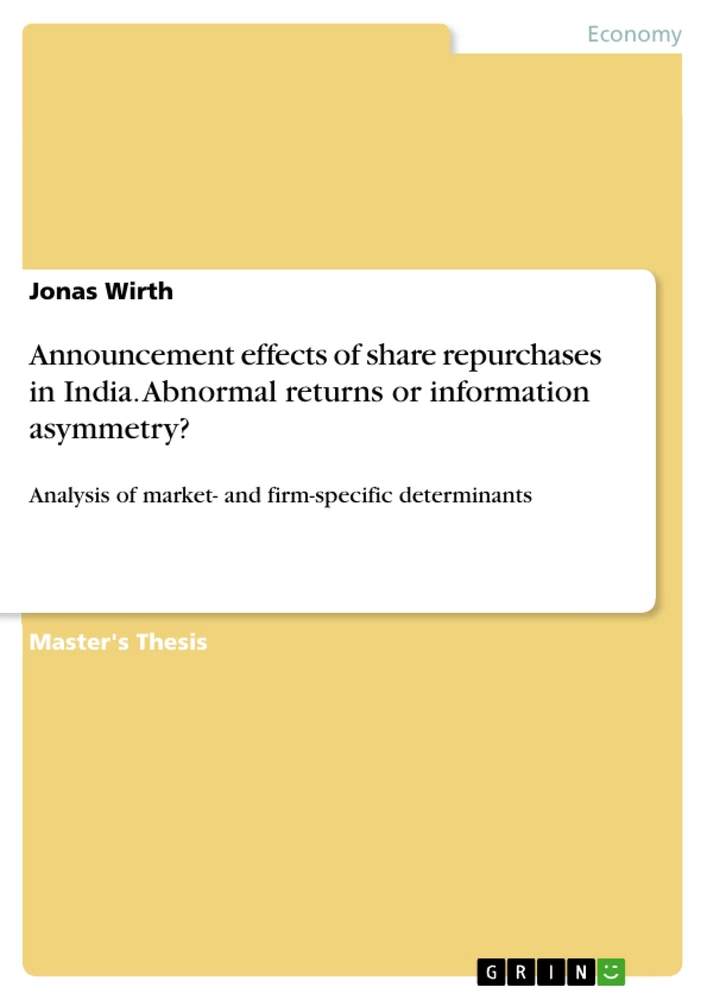
Table of Contents
1 Introduction
2 Law of Regulations
3 Literature Review
3.1 Market-based
3.2 Firm-specific
4 Hypotheses
4.1 Firm-specific
4.2 Market-based
5 Methodology
5.1 Calculating abnormal returns
5.2 Liquidity measures
5.3 Regressions
6 Data
6.1 Share repurchase announcements
6.2 Data selection
7 Empirical Analysis
7.1 Abnormal returns
7.2 Market-based and firm-specific regressions
7.3 Robustness
8 Conclusion
Research Objectives and Key Topics
This thesis examines the announcement effects of share repurchases in the Indian market, specifically comparing tender offers and open market repurchases to determine the significance of abnormal returns and the influence of various market-specific and firm-specific determinants.
- Analysis of share repurchase announcements in India from 2011 to 2021.
- Evaluation of market-based determinants like uncertainty, liquidity, and monetary environment on abnormal returns.
- Testing of firm-specific hypotheses including signaling, free cash flow, leverage, and substitution.
- Comparison of valuation effects between tender offer and open market repurchase methods.
- Examination of the efficacy of the signaling hypothesis in an emerging market context.
Excerpt from the Book
1 Introduction
The growing importance of share buybacks as an instrument for distributing excess cash to shareholders to improve the stock price performance is evident worldwide (Anolick, et al., 2021). It is a process whereby companies acquire a certain proportion of their own shares from existing shareholders, resulting in a reduction of outstanding shares and creating long-term value for remaining shareholders (Gupta, 2014; Varma et al., 2018). In India, the repurchase of listed shares was permitted by the Companies (Amendment) Act, 1999 by inserting Sections 77A, 77AA and 77B into the Indian Companies Act, 1956. Since then, most companies either buy back their shares directly from the stock exchange, which is known as an open market offer, or buy them directly from shareholders, which is known as a tender offer (Varma et al., 2018; Securities and Exchange Board of India, 2018).
Most previous studies have examined the relationship between the valuation effect and firm-specific variables (Anolick, et al., 2021). One of them is the “signaling hypothesis”, which states that managers have more information than investors and want to send a signal to the market with a buyback announcement (Vermaelen, 1981; Comment & Jarrell, 1991; Pandey et al., 2020). Other crucial motives are: The “free cash flow” hypothesis declares that by providing excess cash to shareholders, agency costs are reduced (Jensen, 1986; Lie, 2000; Pandey et al., 2020); “Leverage hypothesis”, which says that buybacks are announced to alter the capital structure to its optimal leverage (Tsetsekos et al., 1991; Dittmar, 2000; Dixon et al., 2008; Pandey et al., 2020) and the “substitution hypothesis”, which claims that buybacks are made in lieu of dividends, in order to flexibly distribute excess cash to shareholders (Grullon & Michaely, 2002; Pandey et al., 2020).
Summary of Chapters
1 Introduction: Provides the context of share buybacks as a financial instrument and sets the research framework regarding firm-specific and market-based determinants for the Indian market.
2 Law of Regulations: Outlines the historical and contemporary legal framework governing share repurchases in India, including specific regulatory bodies and rules.
3 Literature Review: Synthesizes existing research on market-based and firm-specific factors influencing share buyback valuation effects globally and within India.
4 Hypotheses: Formulates seven hypotheses regarding the expected impacts of firm-specific variables (cash, liquidity, substitution, ownership, leverage, signaling) and market-based variables on abnormal returns.
5 Methodology: Details the event study approach, the calculation of abnormal returns using market models, and the regression specifications used for statistical analysis.
6 Data: Describes the collection of 359 share repurchase observations, detailing data sources, sample selection, and descriptive statistics of the variables used.
7 Empirical Analysis: Presents the findings regarding abnormal returns and reports the results of univariate and multivariate regressions testing the hypotheses.
8 Conclusion: Summarizes the study’s findings, emphasizing the dominance of firm-specific determinants over market-based effects and providing implications for managers and future research.
Keywords
Share Repurchases, India, Abnormal Returns, Signaling Hypothesis, Tender Offer, Open Market, Market-based Determinants, Firm-specific Determinants, Information Asymmetry, Valuation Effect, Economic Policy Uncertainty, Liquidity Risk, Capital Structure, Agency Costs, Event Study
Frequently Asked Questions
What is the primary focus of this research?
The research investigates the announcement effects of share repurchases in India between 2011 and 2021, specifically analyzing how firm-specific and market-based factors drive abnormal stock returns.
What are the two main types of share repurchases analyzed?
The paper focuses on tender offer repurchases, where companies invite existing shareholders to sell their shares, and open market repurchases, where companies buy back shares directly through the stock exchange.
What is the core objective of the study?
The goal is to determine whether investor reactions to buyback announcements are driven by market-wide conditions or by internal company-specific factors, such as free cash flow and capital structure needs.
Which statistical methodology is primarily used?
The analysis employs an event study methodology using the market model to calculate abnormal returns for specific windows around the announcement date, followed by univariate and multivariate cross-sectional regressions.
What does the literature suggest about market-based determinants?
Previous global literature often overlooks market-based determinants in share buybacks; this research fills that gap by investigating if uncertainty and liquidity risks significantly impact the valuation effects of such announcements.
What characterizes the firm-specific hypotheses?
They include the signaling hypothesis, free cash flow reduction, leverage adjustments, and dividend substitution as primary drivers for why firms choose to purchase their own shares.
How does market uncertainty affect the market's reaction?
The study finds that in periods of heightened uncertainty, the market reaction to buybacks in the Indian market tends to be muted, suggesting that managers should be cautious in such scenarios.
To what extent do market-based variables explain the valuation effects?
The empirical findings indicate that market-based variables have limited explanatory power for the valuation effect, pointing to the conclusion that company-specific drivers are the primary determinants in India.
Ende der Leseprobe aus 106 Seiten
- nach oben
- Arbeit zitieren
- Jonas Wirth (Autor:in), 2022, Announcement effects of share repurchases in India. Abnormal returns or information asymmetry?, München, Page::Imprint:: GRINVerlagOHG, https://www.diplomarbeiten24.de/document/1361500

neugierig - aktuell - relevant
Entdecken Sie hilfreiche Tipps und Tricks rund ums Studium!

Entdecken Sie hilfreiche Tipps und Tricks rund ums Studium!
Ihre Hausarbeit / Abschlussarbeit:

- - Publikation als E-Book und Buch
- - Hohes Honorar auf die Verkäufe
- - Für Sie komplett kostenlos - mit ISBN
- - Es dauert nur 5 Minuten
- - Jede Arbeit findet Leser

- © GRIN Publishing GmbH.
- Alle Inhalte urheberrechtlich geschützt. Kopieren und verbreiten untersagt.
- info@grin.com
- AGB
- Open Publishing
Der GRIN Verlag hat sich seit 1998 auf die Veröffentlichung akademischer eBooks und Bücher spezialisiert. Der GRIN Verlag steht damit als erstes Unternehmen für User Generated Quality Content. Die Verlagsseiten GRIN.com, Hausarbeiten.de und Diplomarbeiten24 bieten für Hochschullehrer, Absolventen und Studenten die ideale Plattform, wissenschaftliche Texte wie Hausarbeiten, Referate, Bachelorarbeiten, Masterarbeiten, Diplomarbeiten, Dissertationen und wissenschaftliche Aufsätze einem breiten Publikum zu präsentieren.
Kostenfreie Veröffentlichung: Hausarbeit, Bachelorarbeit, Diplomarbeit, Dissertation, Masterarbeit, Interpretation oder Referat jetzt veröffentlichen!
Folgen Sie GRIN auf


- GRIN Verlag GmbH
-
- Nymphenburger Str. 86
- 80636
- Munich, Deutschland
- +49 89-550559-0
- +49 89-550559-10
- info@grin.com
-
