
präsentiert von

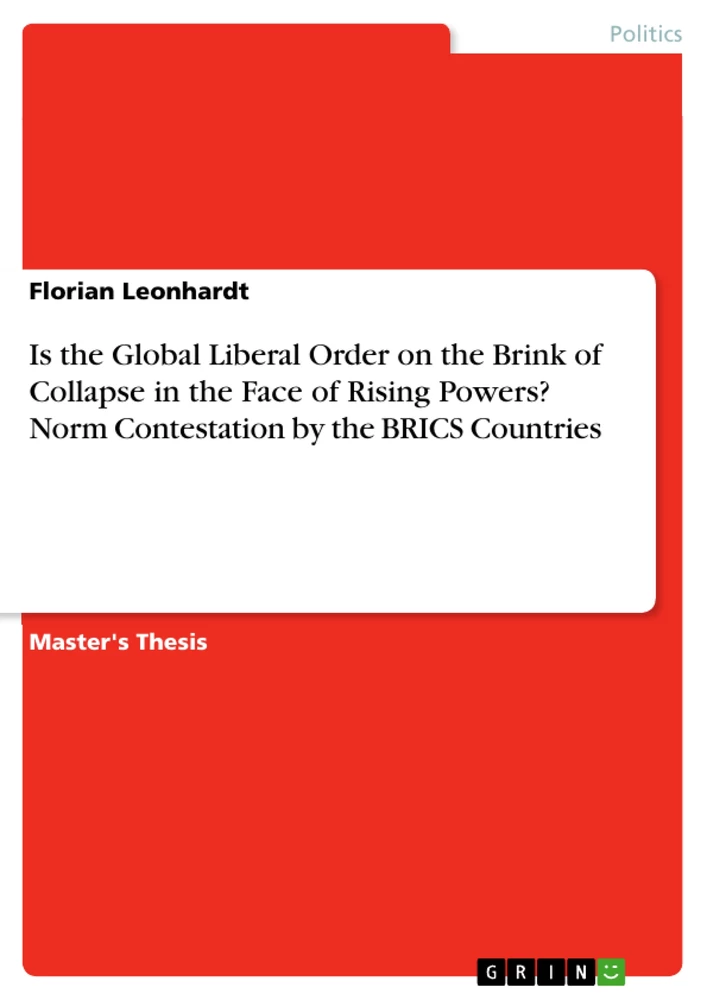
Table of Contents
1. Introduction
1.1 Research question and interest
1.2 Definition and operationalisation
1.3 Procedure and structure of the work
2. Theoretical foundations
2.1 Norms as a constructivist research programme
2.1.1 Definition of norms
2.1.2 Overview of norm research
2.2 Contested nature of norms
2.2.1 Contestation and the dual quality of standards
2.2.2 Types of norm contestation
2.3 Conditionality norm
2.3.1 Constructivist model of the conditionality norm
2.3.2 Background: The conditionality norm as a historical legacy since Bretton Woods
2.4 Research gap: non-Western agency as a blind spot in norms research
3. Rising powers in research on resistance to norms
3.1 Rising powers as agents of resistance
3.2 Norm contestation by non-Western rising powers
4. Research design and methodological approach
4.1 Research question and objective
4.2 Case selection
4.3 Analytical approach and period of investigation
4.4 Operationalisation
4.5 Data collection and analysis
4.5.1 Data collection
4.5.2 Qualitative content analysis
4.5.3 Dealing with quality criteria of qualitative research
5. BRICS within the current global economic governance
5.1 Background: The Rise of BRICS
5.2 BRICS' vision of order in global economic governance
5.2.1 Perception of the prevailing order
5.2.2 BRICS' self-assigned role as a pioneer in the global economy
5.2.3 Elements of a BRICS' vision of order in global economic governance
5.3 Interim conclusion: positioning of the BRICS in global economic governance
6. BRICS as contester of the conditionality norm
6.1 Conditionality contestation by BRICS in international institutions
6.1.1 G20
6.1.2 IMF
6.2 Conditionality contestation by BRICS over time
6.2.1 2009-2013
6.2.2 2014-2021
6.3 Behavioural contestation of conditionality
6.4 Accumulation of total reserves
6.4.1 Discursive references to accumulation of total reserves in the G20
6.4.2 Discursive references to accumulation of total reserves in the IMF
6.5 BRICS' foundation of alternative institutions
6.5.1 Discursive references to BRICS' foundation of alternative institutions in the G20
6.5.2 Discursive references to BRICS' foundation of alternative institutions in the IMF
7. Discussion of the results and conclusions
7.1 Key theoretical argument
7.2 Recap: Applying norm contestation to BRICS and conditionality
7.2.1 Conditionality contestation by BRICS in international institutions
7.2.2 Conditionality contestation by BRICS over time
7.2.3 Behavioural contestation of conditionality
7.3 Theoretical implications for norms research
7.3.1 Types of norm contestation
7.3.2 Directions of norm contestation and contextual factors
7.3.3 Justice conflicts as a driving force of norm contestation
7.4 Empirical implications for research
7.5 Practical implications for dealing with norm-contesting rising powers
7.6 Outlook for future research
Research Objectives and Key Themes
This thesis examines the role of BRICS countries as "norm contesters" within the context of neoliberal global economic governance. It seeks to understand whether and how these rising powers challenge the prevailing Western-liberal conditionality norm, exploring both discursive and behavioural forms of contestation to address the perceived knowledge gap regarding non-Western agency.
- The reconstruction of BRICS' vision of order in global economic governance.
- The identification of "moments of norm contestation" regarding conditionality.
- An analysis of how institutional settings influence the nature of contestation.
- The use of "within-case analysis" to contrast discursive patterns and practical activities.
- A critique of the neoliberal framing of conditionality and alternative institution-building (NDB, CRA) as a form of contestation.
Book Excerpt
1.1 Research question and interest
Against the background of the limited view of non-Western agency on the one hand, and the resistance to the prevailing normative order on the other, I consider a more intensive examination of non-Western rising powers and their normative strategies within the global order to be appropriate. Do they engage in norm contestation? What are the consequences? A successful transfer of norm contestation to supposed non-Western rising powers as norm resisters would raise further questions: Do their interpretations of norms differ greatly from those of Western-liberal states? Do they fundamentally reject Western-liberal norms or are rising powers also concerned with changing and supplementing norms within the current order?
Therefore, this paper first attempts to reconstruct normative order visions in neoliberal-western global economic governance represented by common rising powers. In this regard, the question is posed as to how they relate to the prevailing order. Next, it will be analysed whether moments of norm contestation can be detected in the policies of these states (groups). Thus, the thesis aims to profitably introduce new insights into alternative norm(s) promoted by certain actors into the research on norms and rising powers, instead of ignoring them as usual. The assumption that rising powers have resistance to international norms in mind seems to me appropriate for more intensive empirical examination. The oppositional attitude may also conceal an effort to represent alternative interpretations of norms that differ substantially from the Western liberal consensus. In doing so, I do not equate contestation with an irrelevance of norms, but argue according to Wiener (2004) and Acharya (2004) that their analysis can reveal divergent views of norms, which at best can strengthen the communal legitimacy of norms.
Summary of Chapters
1. Introduction: Outlines the research focus on non-Western agency and norm contestation, defining the central research questions and the procedural framework of the thesis.
2. Theoretical foundations: Establishes a critical constructivist framework for understanding norms as inherently contested and subject to ongoing discursive and behavioural negotiation.
3. Rising powers in research on resistance to norms: Reviews existing literature on how rising powers challenge global norms, moving beyond the binary "norm-taker" vs "norm-maker" dichotomy.
4. Research design and methodological approach: Details the exploratory single-case study design using qualitative content analysis of primary sources and secondary literature.
5. BRICS within the current global economic governance: Analyzes the discursive vision that BRICS countries hold regarding the existing global economic order.
6. BRICS as contester of the conditionality norm: Investigates the empirical evidence of conditionality contestation by BRICS within institutions like the G20 and IMF.
7. Discussion of the results and conclusions: Synthesizes the empirical findings, validating the assumption that BRICS act as "norm contesters" and discussing implications for future research.
Keywords
BRICS, norm contestation, conditionality, global economic governance, non-Western agency, neoliberalism, norm resistance, discursive contestation, behavioural contestation, International Monetary Fund, World Bank, G20, New Development Bank, Contingent Reserve Arrangement.
Frequently Asked Questions
What is the core subject of this thesis?
The thesis investigates how rising non-Western powers—specifically the BRICS (Brazil, Russia, India, China, and South Africa)—contest international norms, focusing particularly on the "conditionality norm" in global economic governance.
What are the primary themes addressed?
Key themes include the agency of non-Western states, the theory of norm contestation (discursive and behavioural), criticism of the Washington Consensus, and the role of alternative institutions like the NDB and CRA.
What is the central research question?
The study asks whether and to what extent non-Western rising powers engage in norm contestation, and how this contestation manifests within global economic governance frameworks.
Which methodology is employed?
The author uses a qualitative, theory-guided single-case study approach, utilizing a "within-case analysis" to examine primary documents and secondary literature via qualitative content analysis.
What does the main body explore?
The body reconstructs the normative visions of the BRICS, identifies moments of conditionality contestation in international institutions (G20, IMF), and examines alternative institution-building as a form of behavioural norm contestation.
What critical keywords define this work?
The work is heavily characterized by terms such as norm contestation, non-Western agency, global economic governance, BRICS, and conditionality.
How does the author define "norm contestation"?
Following Stimmer and Wisken (2019), the author defines it as social practices involving at least two agents directed against a norm, expressing "dissatisfaction" either discursively or through non-discursive behavioural actions.
What role does the IMF play in the analysis?
The IMF serves as the primary empirical site for observing conditionality contestation, specifically criticizing its surveillance methods, governance imbalances, and the neoliberal orientation of its policy conditions.
Ende der Leseprobe aus 126 Seiten
- nach oben
- Arbeit zitieren
- Florian Leonhardt (Autor:in), 2021, Is the Global Liberal Order on the Brink of Collapse in the Face of Rising Powers? Norm Contestation by the BRICS Countries, München, Page::Imprint:: GRINVerlagOHG, https://www.diplomarbeiten24.de/document/1362873

neugierig - aktuell - relevant
Entdecken Sie hilfreiche Tipps und Tricks rund ums Studium!

Entdecken Sie hilfreiche Tipps und Tricks rund ums Studium!
Ihre Hausarbeit / Abschlussarbeit:

- - Publikation als E-Book und Buch
- - Hohes Honorar auf die Verkäufe
- - Für Sie komplett kostenlos - mit ISBN
- - Es dauert nur 5 Minuten
- - Jede Arbeit findet Leser

- © GRIN Publishing GmbH.
- Alle Inhalte urheberrechtlich geschützt. Kopieren und verbreiten untersagt.
- info@grin.com
- AGB
- Open Publishing
Der GRIN Verlag hat sich seit 1998 auf die Veröffentlichung akademischer eBooks und Bücher spezialisiert. Der GRIN Verlag steht damit als erstes Unternehmen für User Generated Quality Content. Die Verlagsseiten GRIN.com, Hausarbeiten.de und Diplomarbeiten24 bieten für Hochschullehrer, Absolventen und Studenten die ideale Plattform, wissenschaftliche Texte wie Hausarbeiten, Referate, Bachelorarbeiten, Masterarbeiten, Diplomarbeiten, Dissertationen und wissenschaftliche Aufsätze einem breiten Publikum zu präsentieren.
Kostenfreie Veröffentlichung: Hausarbeit, Bachelorarbeit, Diplomarbeit, Dissertation, Masterarbeit, Interpretation oder Referat jetzt veröffentlichen!
Folgen Sie GRIN auf


- GRIN Verlag GmbH
-
- Nymphenburger Str. 86
- 80636
- Munich, Deutschland
- +49 89-550559-0
- +49 89-550559-10
- info@grin.com
-
