
präsentiert von

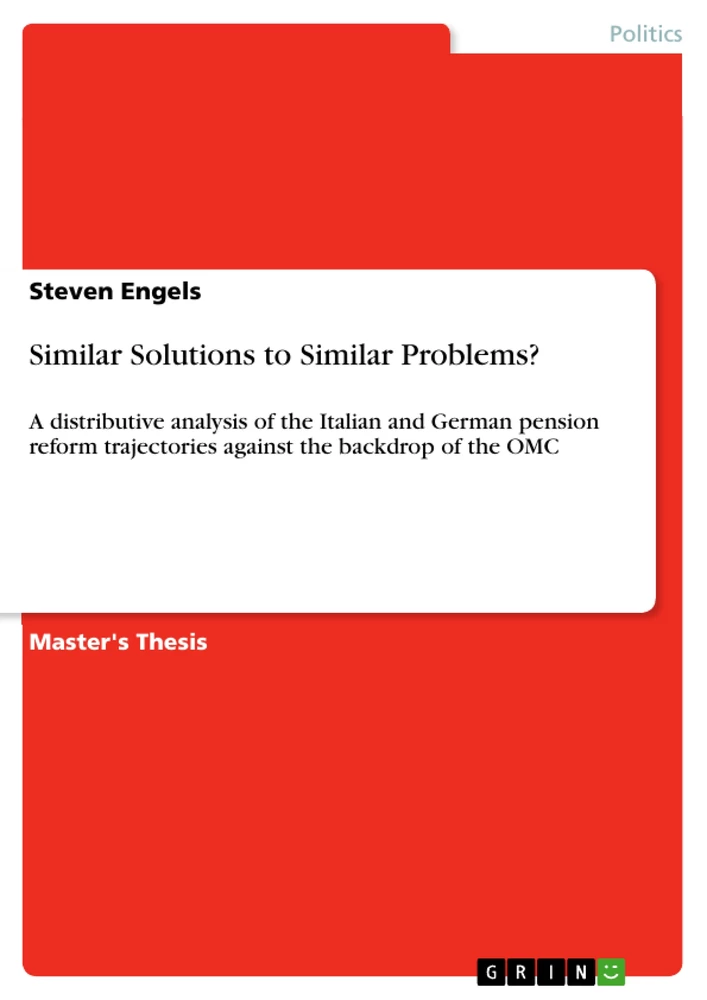
Table of Contents
Introduction
Chapter 1: Distributional effects of Italy’s pension reform trajectory (1989 – 2009)
1. Essential characteristics of the Italian Pension System at the end of the 1980s
2. Challenges and pressures for reform
3. The direction of Reform
3.1. Towards a multipillar system and a clear separation of functions
3.2. Towards a harmonization and tightening of eligibility criteria
3.4. Towards reduced collective risk pooling
4. The Costs of Reform
Chapter 2: Distributional effects of Germany’s pension reform trajectory (1989 – 2009)
1. Essential characteristics of the German Pension System at the end of the 1980s
2. Challenges and pressures for reform
3. The direction of Reform
3.1. Towards a multipillar system
3.2. Recalibrating the eligibility criteria
3.3. Towards a self-regulating benefit formula
4. The costs of Reform
Conclusions
Bibliography
Objectives and Thematic Focus
This master thesis provides a comparative analysis of Italian and German pension reform trajectories between 1989 and 2008, evaluating how these reforms have altered the distributional logic of social security systems and how they address intergenerational fairness in the context of population ageing.
- Analysis of distributional patterns regarding eligibility, costs, and risks.
- Evaluation of the transition from monopillar to multipillar pension systems.
- Examination of intergenerational burden sharing and fairness.
- Comparison of actuarial mechanisms and risk pooling in pension design.
Excerpt from the Book
1. ESSENTIAL CHARACTERISTICS OF THE ITALIAN PENSION SYSTEM AT THE END OF THE 1980S
What holds true for the overall architecture of the Italian welfare state holds true as well for its pension system: although it is closely related to the pension systems of other continental European states, it is important not to overlook the distinguishing characteristics which set it apart from that of neighbouring countries.
The similarities are most readily apparent at the level of the financing mechanism underlying the Italian public pension system. Like that of most EU-15 countries, the Italian system of the 1980s is contribution-based and operates on a pay-as-you-go basis (PAYG). Whereas so-called “fully-funded” or “capitalized” pension schemes are invested in the capital markets, PAYG pension schemes are funded on the basis of “repartition”. Instead of being invested, the social security contributions paid by the working population at a given moment in time “t” are immediately used to fund the pension benefits of the retired population at that same moment “t”. In exchange, the working population gains the right to future pension benefits, payable at the moment t+1 and funded by the social security contributions of the working population of that time. Thus, the pension benefits enjoyed by each generation are financed directly by the social-security contributions of the next generation.
Summary of Chapters
Introduction: Provides the research scope, outlining a cross-country comparison of pension reforms in Germany and Italy regarding social distribution and intergenerational fairness.
Chapter 1: Distributional effects of Italy’s pension reform trajectory (1989 – 2009): Examines how Italian reforms shifted from a fragmented, status-based system toward a more harmonized, actuarial model, while evaluating the resulting intergenerational costs.
Chapter 2: Distributional effects of Germany’s pension reform trajectory (1989 – 2009): Analyzes German reforms that integrated self-regulating mechanisms and multipillar structures to maintain system sustainability while sharing burdens between current and future generations.
Keywords
Pension reform, Italy, Germany, Open Method of Coordination, PAYG, multipillar system, distributive analysis, intergenerational fairness, actuarial distribution, social security, demographic ageing, sustainability factor, welfare state, retirement benefits, risk pooling.
Frequently Asked Questions
What is the core subject of this thesis?
The thesis conducts a cross-country comparative analysis of pension reform trajectories in Italy and Germany from 1989 to 2008, specifically focusing on social distribution and intergenerational fairness.
What are the central themes of the work?
The central themes include the shift toward multipillar pension systems, the transition to actuarial benefit formulas, the impact of demographic ageing on pension sustainability, and the allocation of reform costs across generations.
What is the primary research goal?
The primary goal is to determine how various reform strategies have altered the distributional logic of old-age social security systems and how these reforms allocate risks and costs between generations.
What scientific methodology is utilized?
The author uses a qualitative, comparative, and thematic analysis of legislative reforms (such as the Amato and Dini reforms in Italy, and the Riester and Rürup reforms in Germany) framed by distributive conceptual models.
What does the main body of the work cover?
The main body is divided into two chapters covering Italy and Germany individually, detailing the initial characteristics of their pension systems, the pressures for reform, the direction of these reforms, and their specific distributional outcomes.
Which keywords define the study?
Key terms include pension reform, intergenerational fairness, PAYG, multipillar system, distributive analysis, demographic ageing, and notional defined contribution (NDC).
How does the Italian pension system differ from the German system in its approach to "acquired rights"?
Unlike Germany, which incorporated more explicit burden-sharing elements, Italy opted for a long transition period that largely shielded older generations and those near retirement, placing the burden of the transition primarily on younger cohorts.
What role does the "sustainability factor" play in the German pension system?
The sustainability factor acts as a self-adjusting feedback mechanism that links pension indexation to demographic and labour market trends, effectively slowing expenditure growth without requiring discretionary government intervention.
How do the reforms address the "double payment" problem in the transition to a multipillar system?
The study highlights different strategies: Italy utilized the "Trattamento di Fine Rapporto" (TFR) to fund the second pillar, while Germany implemented state subsidies and tax incentives to encourage supplementary private savings.
Ende der Leseprobe aus 59 Seiten
- nach oben
- Arbeit zitieren
- Steven Engels (Autor:in), 2009, Similar Solutions to Similar Problems?, München, Page::Imprint:: GRINVerlagOHG, https://www.diplomarbeiten24.de/document/136897

neugierig - aktuell - relevant
Entdecken Sie hilfreiche Tipps und Tricks rund ums Studium!

Entdecken Sie hilfreiche Tipps und Tricks rund ums Studium!
Ihre Hausarbeit / Abschlussarbeit:

- - Publikation als E-Book und Buch
- - Hohes Honorar auf die Verkäufe
- - Für Sie komplett kostenlos - mit ISBN
- - Es dauert nur 5 Minuten
- - Jede Arbeit findet Leser

- © GRIN Publishing GmbH.
- Alle Inhalte urheberrechtlich geschützt. Kopieren und verbreiten untersagt.
- info@grin.com
- AGB
- Open Publishing
Der GRIN Verlag hat sich seit 1998 auf die Veröffentlichung akademischer eBooks und Bücher spezialisiert. Der GRIN Verlag steht damit als erstes Unternehmen für User Generated Quality Content. Die Verlagsseiten GRIN.com, Hausarbeiten.de und Diplomarbeiten24 bieten für Hochschullehrer, Absolventen und Studenten die ideale Plattform, wissenschaftliche Texte wie Hausarbeiten, Referate, Bachelorarbeiten, Masterarbeiten, Diplomarbeiten, Dissertationen und wissenschaftliche Aufsätze einem breiten Publikum zu präsentieren.
Kostenfreie Veröffentlichung: Hausarbeit, Bachelorarbeit, Diplomarbeit, Dissertation, Masterarbeit, Interpretation oder Referat jetzt veröffentlichen!
Folgen Sie GRIN auf


- GRIN Verlag GmbH
-
- Nymphenburger Str. 86
- 80636
- Munich, Deutschland
- +49 89-550559-0
- +49 89-550559-10
- info@grin.com
-
