
präsentiert von

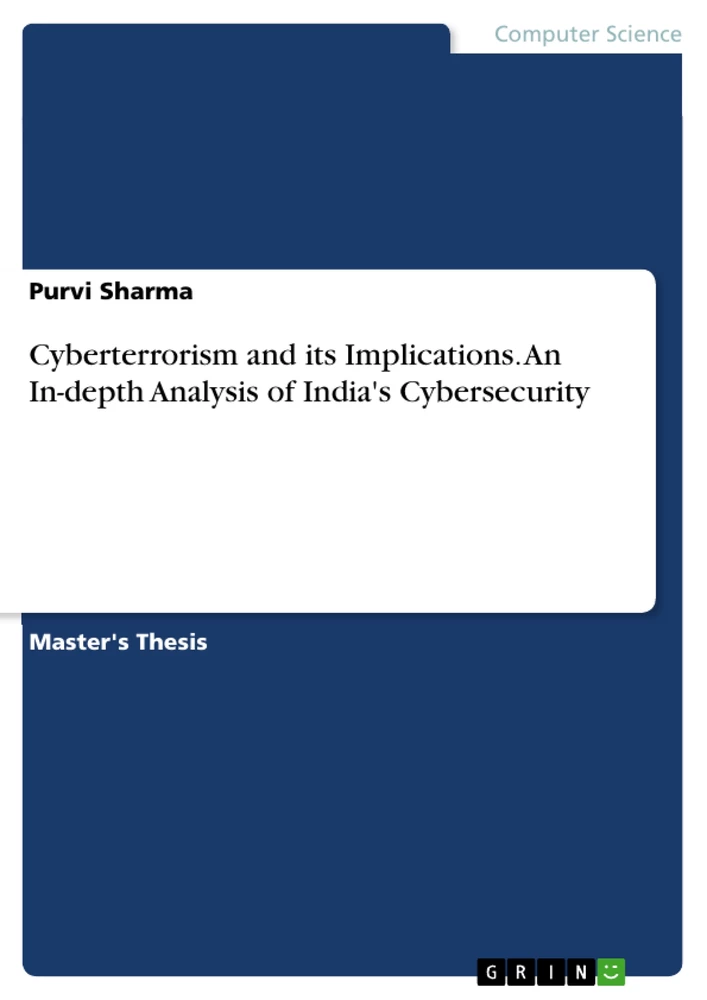
Table of Contents
Chapter 1
1.1 Introduction
1.2 Cyberterrorism
Chapter 2
2.1 Literature review
2.2 Research Design
Chapter 3
India’s Response to Cyber Attacks in Form of Government Initiatives
Chapter 4
India’s Cyber Diplomacy
Chapter 5
India’s Cyber Diplomacy of International Organisations
Chapter 6
Conclusion
Objectives and Thematic Focus
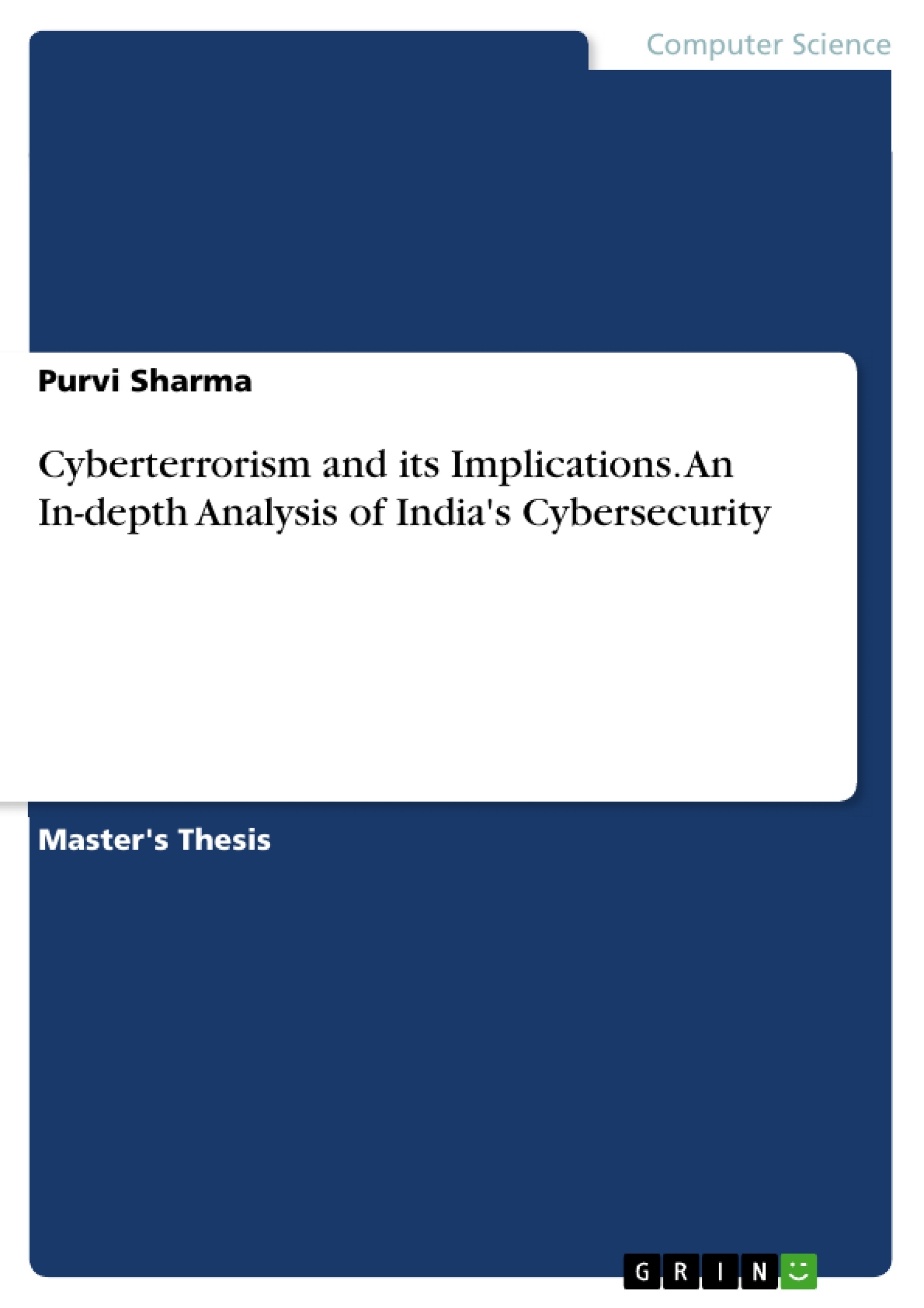
This dissertation aims to clarify the concept of cyberterrorism and examine the specific security challenges it poses to the Indian state. It investigates the current state of cyber threats in India, evaluates governmental and law enforcement responses, and explores the role of international organizations in mitigating these risks.
- Evolution of cyberterrorism threats within the Indian context.
- Evaluation of India's legislative and institutional response mechanisms.
- Analysis of international collaborations and cyber diplomacy strategies.
- Identification of gaps in national cybersecurity policy and infrastructure.
- Assessment of motives and techniques employed by cyber-terrorist entities targeting India.
Excerpt from the Book
1.1 Introduction
One of humanity's greatest technological triumphs has been the invention of cyberspace. Our daily lives have been irrevocably altered as a result of fast improvements in computer technology. These advancements enable us to interact with each other by dissolving massive geographical gaps in an instant, while also allowing us to acquire large volumes of information very quickly. Although these advancements have allowed virtual proximity and ease of access bestowing enormous benefits on humanity in a variety of disciplines, as is the case with all things in nature, too much of anything could be dangerous. The continued progress and rapid upsurge in the utilization of computer technology have given rise to a slew of security risks which societies have to deal with due to the degree of geopolitical contestations that occur between global powers. They are known as cyber threats. The use of this technology to participate in malicious behaviour threatening a state, society or community's ability to sustain order, externally or internally, can be broadly described as cyber threats these nebulous threats can come from a multiplicity of sources; rogue individuals or groups, hostile governments etc that have an agenda to cause harm, financial and political, have the potential to disrupt the socio-economic fabric of the global order.
To look into how order has been maintained in societies throughout history, it is imperative to view it categorically through a two-pronged strategy for their survival and prosperity. Internal order has been historically maintained through rules prescribed in a nation-state's constitutional laws, restricting its citizens from causing any kind of harm to their fellow members through various criminal, unlawful means. The second strategy about the maintenance of external order has for a long time fallen under the purview of military force, often disguised as war; and at times, more so in the modern era, has been regulated by international accords that keep violations by nations or groups in check.
Summary of Chapters
Chapter 1: Provides an introductory overview of the evolution of cyberspace, defines cyber threats, and formally introduces the concept of cyberterrorism.
Chapter 2: Reviews existing academic literature regarding cyberterrorism and outlines the qualitative research design and methodology used for the case study.
Chapter 3: Details specific Indian government initiatives and legislative actions, such as the IT Act, taken to combat cyber attacks and enhance national security.
Chapter 4: Examines India's proactive approach to cyber diplomacy and its efforts to align national interests with global norms and bilateral partnerships.
Chapter 5: Analyzes India's engagement with international organizations and the various challenges faced in international cyber collaboration.
Chapter 6: Concludes the dissertation by summarizing findings on cyber threats in India and offering policy recommendations for strengthening the national cyber defense framework.
Keywords
cyber terrorism, cyber security, threats, cyber diplomacy, computer systems, India, national security, critical infrastructure, cyber warfare, cyber espionage, digital literacy, information technology act, legislative framework, cybercrime, intelligence.
Frequently Asked Questions
What is the core focus of this research?
This work focuses on the phenomenon of cyberterrorism, specifically analyzing the threat profile, mitigation strategies, and geopolitical standing of India in the digital domain.
What are the primary thematic areas covered?
The study covers the conceptualization of cyberterrorism, its structural capacity, India's legislative responses, the role of cyber diplomacy, and the challenges of international collaboration.
What is the primary research objective?
The goal is to analyze the current state of cyberterrorism in India, its impact on national security, and the adequacy of existing government measures to counter these threats.
Which scientific methodology is employed?
The research is based on a descriptive and exploratory qualitative methodology, utilizing secondary sources such as government reports, academic journals, and policy papers.
What topics are addressed in the main body?
The main body treats the classification of cyber threats, the specific legal framework in India (e.g., IT Act), the role of various task forces like NCCC and ICCCC, and India's bilateral and multilateral diplomatic negotiations.
Which keywords best characterize the work?
Key terms include cyber terrorism, national security, cyber diplomacy, legislative framework, critical infrastructure, and digital defense.
How does the author define the "harm principle" in the context of cyberterrorism?
It is framed as an attack targeting collective interests, such as the democratic constitutional order or critical national infrastructure, rather than individual criminal activities.
What significance is attributed to the Indian response post-2008?
The 2008 Mumbai attacks are cited as a pivotal turning point that accelerated the establishment of centralized monitoring systems and more stringent law enforcement policies in India.
Ende der Leseprobe aus 44 Seiten
- nach oben
- Arbeit zitieren
- Purvi Sharma (Autor:in), 2023, Cyberterrorism and its Implications. An In-depth Analysis of India's Cybersecurity, München, Page::Imprint:: GRINVerlagOHG, https://www.diplomarbeiten24.de/document/1372504

neugierig - aktuell - relevant
Entdecken Sie hilfreiche Tipps und Tricks rund ums Studium!

Entdecken Sie hilfreiche Tipps und Tricks rund ums Studium!
Ihre Hausarbeit / Abschlussarbeit:

- - Publikation als E-Book und Buch
- - Hohes Honorar auf die Verkäufe
- - Für Sie komplett kostenlos - mit ISBN
- - Es dauert nur 5 Minuten
- - Jede Arbeit findet Leser

- © GRIN Publishing GmbH.
- Alle Inhalte urheberrechtlich geschützt. Kopieren und verbreiten untersagt.
- info@grin.com
- AGB
- Open Publishing
Der GRIN Verlag hat sich seit 1998 auf die Veröffentlichung akademischer eBooks und Bücher spezialisiert. Der GRIN Verlag steht damit als erstes Unternehmen für User Generated Quality Content. Die Verlagsseiten GRIN.com, Hausarbeiten.de und Diplomarbeiten24 bieten für Hochschullehrer, Absolventen und Studenten die ideale Plattform, wissenschaftliche Texte wie Hausarbeiten, Referate, Bachelorarbeiten, Masterarbeiten, Diplomarbeiten, Dissertationen und wissenschaftliche Aufsätze einem breiten Publikum zu präsentieren.
Kostenfreie Veröffentlichung: Hausarbeit, Bachelorarbeit, Diplomarbeit, Dissertation, Masterarbeit, Interpretation oder Referat jetzt veröffentlichen!
Folgen Sie GRIN auf


- GRIN Verlag GmbH
-
- Nymphenburger Str. 86
- 80636
- Munich, Deutschland
- +49 89-550559-0
- +49 89-550559-10
- info@grin.com
-
