
präsentiert von

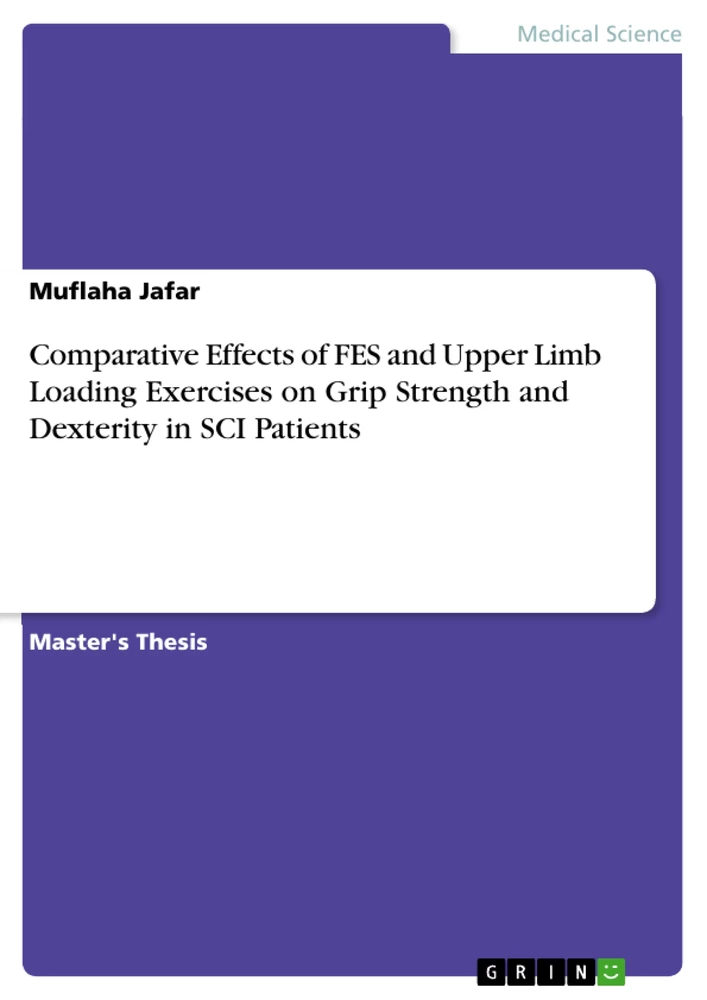
Table of Contents
1. Introduction
1.1 Objective of the study
1.2 Hypothesis
1.2.1 True Hypothesis:
1.2.2 Null Hypothesis
2. Literature Review
3. Materials and methods
3.1 Design
3.2 Sample Size
3.3 Study Duration
3.4 Sampling Technique
3.5 Study Setting
3.6 Selection Criteria
3.6.1 Inclusion Criteria
3.6.2 Exclusion Criteria
3.7 Tools
3.8 Intervention
4. RESULTS
5. Discussion
6. Conclusion
7. References
Research Objective and Focus Areas
The primary objective of this study is to assess and compare the efficacy of Functional Electrical Stimulation (FES) versus Upper Limb Loading Exercises in improving grip strength, manual dexterity, and overall upper limb function in patients diagnosed with subacute Spinal Cord Injury (SCI).
- Comparison of rehabilitation strategies for SCI (FES vs. loading exercises).
- Evaluation of grip strength and upper limb motor function.
- Clinical assessment using Modified Action Research Arm Test (ARAT) and Nine-Hole Peg Test.
- Mechanisms of neuroplasticity and neural recovery in tetraplegic and paraplegic populations.
- Impact of training parameters (session frequency, intensity) on rehabilitation outcomes.
Excerpt from the Book
1. INTRODUCTION
Spinal cord injury is a global health issue that poses a major challenge, resulting in substantial motor and sensory abnormalities caused by damage to the spinal cord. Every year, a range of two hundred fifty thousand to five hundred thousand new incidents of spinal cord injury (SCI) are reported globally. The primary cause of SCI is blunt force trauma, accounting for thirty-eight point two percent of all cases, followed by falls, which contribute to thirty-two point three percent of reported injuries. The economic impact of SCI is significant, with medical expenses surpassing three billion dollars annually.
In the first year following the injury, individual costs can range from $380,000 to $1,160,000, while subsequent years may incur expenses between $46,000 and $202,000. These statistics underscore the urgent need for effective interventions and rehabilitative strategies to mitigate the personal, societal, and economic consequences associated with SCI.
Considering the numerous functional impairments that accompany SCI, the loss of upper limb function is particularly challenging as it hampers individuals' ability to perform daily tasks and actively participate in society. Impairments in grip strength, dexterity, and overall upper limb function significantly diminish their independence and overall quality of life. Consequently, it is crucial to investigate and compare various rehabilitation strategies aimed at improving these outcomes effectively.
Summary of Chapters
1. Introduction: Presents the global impact of Spinal Cord Injury and establishes the critical need for effective rehabilitation strategies to restore upper limb function.
2. Literature Review: Synthesizes existing research on neurorehabilitation, focusing on FES and resistance training interventions for SCI recovery.
3. Materials and methods: Details the study design, including the randomized clinical trial protocol, patient selection criteria, and intervention methods used for both study groups.
4. RESULTS: Provides the statistical outcomes and data analysis comparing pre- and post-intervention scores for both FES and loaded exercise cohorts.
5. Discussion: Interprets the findings in the context of neuroplasticity and existing clinical literature, evaluating the effectiveness of each intervention.
6. Conclusion: Summarizes the study findings, noting that while both interventions were beneficial, the FES group showed more favorable results in functional recovery.
Keywords
Action Research Arm Test, Dexterity, Functional Electrical Stimulation, Hand Function, Hole Peg Test, Spinal Cord Injury, Neurorehabilitation, Grip Strength, Resistance Training, Neuromuscular Electrical Stimulation, Motor Recovery, Physical Therapy, Tetraplegia, Paraplegia, Clinical Trial
Frequently Asked Questions
What is the fundamental focus of this research?
This work focuses on the comparative effectiveness of Functional Electrical Stimulation (FES) versus Upper Limb Loading Exercises in restoring hand and arm function for patients with spinal cord injuries.
What are the primary themes discussed in this paper?
The central themes include upper limb rehabilitation, neuroplasticity, clinical assessment of dexterity and grip strength, and the application of standardized tests to measure motor recovery in SCI patients.
What is the specific research goal?
The goal is to determine whether FES or resistive loading exercises are more effective at improving grip strength and manual function in individuals suffering from subacute spinal cord injuries.
Which scientific methodology was utilized?
The study utilized a randomized clinical trial methodology, allocating patients into two groups to receive either FES or loading exercise protocols over an 8-week period, followed by pre- and post-intervention statistical analysis.
What topics does the main body cover?
The main body covers a comprehensive review of literature on SCI management, detailed descriptions of the training protocols, statistical result tables, and a discussion of how electrical stimulation aids in the recovery of nerve-muscle coordination.
Which keywords best characterize this study?
Key terms include Action Research Arm Test, FES, Spinal Cord Injury, Grip Strength, and manual dexterity measures like the Nine-Hole Peg Test.
How does the study define the target population for this trial?
The study targeted patients between 20-50 years old with incomplete Spinal Cord Injury (ASIA level-C, C5-T1) who are in the sub-acute phase of recovery.
What does the conclusion suggest about the effectiveness of FES?
The conclusion suggests that while both exercise-based interventions lead to improvements, the group treated with Functional Electrical Stimulation demonstrated more favorable clinical results compared to the group performing only loading exercises.
Ende der Leseprobe aus 63 Seiten
- nach oben
- Arbeit zitieren
- Muflaha Jafar (Autor:in), 2023, Comparative Effects of FES and Upper Limb Loading Exercises on Grip Strength and Dexterity in SCI Patients, München, Page::Imprint:: GRINVerlagOHG, https://www.diplomarbeiten24.de/document/1380645

neugierig - aktuell - relevant
Entdecken Sie hilfreiche Tipps und Tricks rund ums Studium!

Entdecken Sie hilfreiche Tipps und Tricks rund ums Studium!
Ihre Hausarbeit / Abschlussarbeit:

- - Publikation als E-Book und Buch
- - Hohes Honorar auf die Verkäufe
- - Für Sie komplett kostenlos - mit ISBN
- - Es dauert nur 5 Minuten
- - Jede Arbeit findet Leser

- © GRIN Publishing GmbH.
- Alle Inhalte urheberrechtlich geschützt. Kopieren und verbreiten untersagt.
- info@grin.com
- AGB
- Open Publishing
Der GRIN Verlag hat sich seit 1998 auf die Veröffentlichung akademischer eBooks und Bücher spezialisiert. Der GRIN Verlag steht damit als erstes Unternehmen für User Generated Quality Content. Die Verlagsseiten GRIN.com, Hausarbeiten.de und Diplomarbeiten24 bieten für Hochschullehrer, Absolventen und Studenten die ideale Plattform, wissenschaftliche Texte wie Hausarbeiten, Referate, Bachelorarbeiten, Masterarbeiten, Diplomarbeiten, Dissertationen und wissenschaftliche Aufsätze einem breiten Publikum zu präsentieren.
Kostenfreie Veröffentlichung: Hausarbeit, Bachelorarbeit, Diplomarbeit, Dissertation, Masterarbeit, Interpretation oder Referat jetzt veröffentlichen!
Folgen Sie GRIN auf


- GRIN Verlag GmbH
-
- Nymphenburger Str. 86
- 80636
- Munich, Deutschland
- +49 89-550559-0
- +49 89-550559-10
- info@grin.com
-
