
präsentiert von

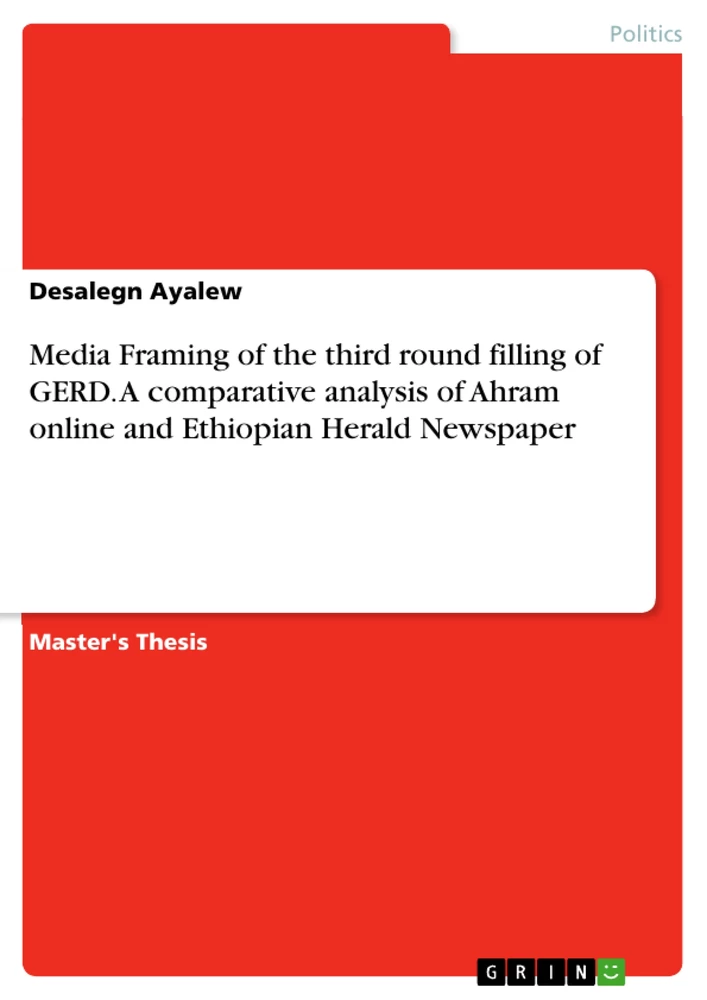
Table of Contents
CHAPTER ONE
INTRODUCTION
1.1 Background of the study
1.2 Statement of the Problem
1.3 Objective of the study
1.3.1 Specific Objective
1.4 Research questions
1.5 Significance of the study
1.6 Scope of the Study
1.7 Limitation of the study
1.8 Organization of the study
CHAPTER TWO
REVIEW OF RELATED LITERATURE
2.1 Overview of the Nile
2.2 Colonial era agreements
2.2.1 The 1891 Anglo-Italian Protocol
2.2.2 The 1906 Tripartite agreement between Great Britain, France and Italy
2.2.3 The Anglo-Egyptian Agreement of 1929
2.2.4 The Egyptian-Sudanese Agreement of 1959
2.3 Water Conflict
2.3.1 Resolving water conflicts
2.4 The Disagreement over GERD
2.5 The Ethiopian perspective of GERD
2.6 Seven pillars of trans-boundary water cooperation
2.7 Communicating Water Issues to National and International Audiences
2.8 Media and Diplomacy
2.9 Theoretical Frameworks
2.9.1 Agenda Setting Theory
2.9.2 Framing theory
2.9.3 Peace Journalism Approach
2.10 Background of Ethiopian Herald Newspaper
2.11 Background of Al-Ahram Online Newspaper
CHAPTER THREE
METHODOLOGY
3.1 Research design
3.2 Research Approach
3.3 Research subjects
3.4 Sampling Method
3.4.1 Sampling period and sampling size
3.5 Data collection technique
3.5.1 Textual analysis
3.6 Data analysis technique
3.7 Data Sources
3.8 Ethical Consideration
CHAPTER FOUR
DATA PRESENTATION AND ANALYSIS
4.1 Chapter review
4.2 Analysis of frames used by Ahram Online
4.2.1 Conflict frame
4.3 Analysis of Frames used by the Ethiopian Herald
4.3.1 Natural right’s frame
4.3.2 Mutual benefits Frame
4.3.3 Development frame
4.3.4 Exclusion Frame
4.4 Comparative analysis
4.4.1 Defining the problem
4.4.2 Interpreting the Cause
4.4.3 Making Moral Judgments
4.4.4 Providing a treatment or Solution
4.4.5 Peace Journalism or War Journalism?
4.4.6 Diplomacy and media framing
4.4.7 Differences and Similarities
CHAPTER FIVE
CONCLUSION AND RECOMMENDATIONS
5.1 Conclusion
5.2 Recommendations
Research Objectives and Key Topics
The primary objective of this research is to perform a comparative analysis of how the Ethiopian Herald and Ahram Online newspapers framed the news surrounding the third round of filling of the Grand Ethiopian Renaissance Dam (GERD) in 2022, specifically focusing on the extent to which these outlets employed peace journalism versus war-oriented journalism.
- Comparative media framing analysis during the 3rd GERD filling phase.
- Application of theoretical frameworks including framing theory, agenda-setting, and peace journalism.
- Evaluation of diplomatic reporting and international conflict narratives in state-owned media.
- Identification of dominant frames such as natural rights, historical rights, and conflict-oriented reporting.
Excerpt from the Book
4.2.1 Conflict frame
The first frame Ahram online newspaper has dominantly used during the study period was the conflict frame. Ahram Online has given more focus to the filling of the dam and its negative impacts, as well as the act of Ethiopia as the step taken to harm the downstream countries. Moreover, Ahram Online has been busy accusing Ethiopia of the failure of the negotiations so far. While accusing Ethiopia of being an obstacle to the negotiations so far, it portrays Egypt and Sudan as if they’ve been attempting to promote cooperation for a win-win solution to the conflict.
Ahram has given more emphasis to provoking the conflict by stressing the controversy alone to make the most of it. The newspaper has been using war-mongering words, phrases, and so forth to make the issue more serious. By doing so, they have been telling their readers that the lower riparian countries will face significant harm due to Ethiopia’s unwillingness to sign the binding agreement, which Egypt and Sudan consider the best solution to resolve the dispute on GERD. Strong vocabularies were utilized while communicating the issue of GERD in a conflict frame. The newspaper has used several techniques in an attempt to bolster the frame of conflict during the study period.
Summary of Chapters
CHAPTER ONE: INTRODUCTION: This chapter provides the background of the study, the statement of the problem regarding media framing of water disputes, research objectives, and the scope of the investigation.
CHAPTER TWO: REVIEW OF RELATED LITERATURE: An overview of the Nile River, colonial-era agreements, and the theoretical frameworks used, specifically agenda setting, framing, and peace journalism.
CHAPTER THREE: METHODOLOGY: Details the qualitative research approach, the use of textual analysis, and the purposive sampling of news stories from the Ethiopian Herald and Ahram Online.
CHAPTER FOUR: DATA PRESENTATION AND ANALYSIS: Analyzes the framing patterns of both media outlets, performing a comparative study of how they defined the problem and interpreted the causes of the GERD dispute.
CHAPTER FIVE: CONCLUSION AND RECOMMENDATIONS: Summarizes the findings regarding how media outlets utilized specific frames for government interests and offers recommendations to encourage peace journalism.
Key Words
GERD, third round filling of reservoir, Nile River, Ethiopia, Egypt, Framing, Peace Journalism, media diplomacy, conflict frame, natural rights, water share, editorial stance, transnational water, international law, media bias.
Frequently Asked Questions
What is the core subject of this research study?
The study examines how two prominent newspapers, the Ethiopian Herald and Ahram Online, framed the news regarding the third round of the GERD reservoir filling in August and September 2022.
What are the primary themes investigated in the media coverage?
The research explores themes such as natural versus historical water rights, the framing of the GERD as either a development project or a security threat, and the role of these outlets in promoting either peace or war journalism.
What is the research goal?
The goal is to provide a comparative analysis of how these two specific media outlets influence public perception and diplomatic narratives surrounding a contentious transboundary water project.
Which methodology was utilized for this research?
The researcher employed a qualitative research method, specifically utilizing thematic and textual analysis to categorize the frames used in the selected news articles.
What information is covered in the main section of the study?
The main section critically analyzes the news narratives, identifying the dominant frames like conflict, historical rights, development, and exclusion, and contrasts these with Galtung’s peace journalism indicators.
Which keywords define this work?
Relevant keywords include GERD, Nile River, media framing, peace journalism, transboundary disputes, and media diplomacy.
How does Ahram Online characterize the GERD project?
Ahram Online frequently uses a conflict frame, emphasizing the project as an existential threat to Egypt's water security, often citing the lack of a binding agreement as an act of bad faith by Ethiopia.
How does the Ethiopian Herald support the Ethiopian government's position?
The Ethiopian Herald frames the GERD as a development necessity and a sovereign right, using natural rights and mutual benefit frames to portray the project as a positive contribution to regional prosperity.
What is the researcher's conclusion on the role of these media outlets?
The researcher concludes that both media outlets have acted as agents of their respective governments' propaganda, failing to play a mediation role and instead aggravating regional tensions.
Ende der Leseprobe aus 92 Seiten
- nach oben
- Arbeit zitieren
- Desalegn Ayalew (Autor:in), 2023, Media Framing of the third round filling of GERD. A comparative analysis of Ahram online and Ethiopian Herald Newspaper, München, Page::Imprint:: GRINVerlagOHG, https://www.diplomarbeiten24.de/document/1383833

neugierig - aktuell - relevant
Entdecken Sie hilfreiche Tipps und Tricks rund ums Studium!

Entdecken Sie hilfreiche Tipps und Tricks rund ums Studium!
Ihre Hausarbeit / Abschlussarbeit:

- - Publikation als E-Book und Buch
- - Hohes Honorar auf die Verkäufe
- - Für Sie komplett kostenlos - mit ISBN
- - Es dauert nur 5 Minuten
- - Jede Arbeit findet Leser

- © GRIN Publishing GmbH.
- Alle Inhalte urheberrechtlich geschützt. Kopieren und verbreiten untersagt.
- info@grin.com
- AGB
- Open Publishing
Der GRIN Verlag hat sich seit 1998 auf die Veröffentlichung akademischer eBooks und Bücher spezialisiert. Der GRIN Verlag steht damit als erstes Unternehmen für User Generated Quality Content. Die Verlagsseiten GRIN.com, Hausarbeiten.de und Diplomarbeiten24 bieten für Hochschullehrer, Absolventen und Studenten die ideale Plattform, wissenschaftliche Texte wie Hausarbeiten, Referate, Bachelorarbeiten, Masterarbeiten, Diplomarbeiten, Dissertationen und wissenschaftliche Aufsätze einem breiten Publikum zu präsentieren.
Kostenfreie Veröffentlichung: Hausarbeit, Bachelorarbeit, Diplomarbeit, Dissertation, Masterarbeit, Interpretation oder Referat jetzt veröffentlichen!
Folgen Sie GRIN auf


- GRIN Verlag GmbH
-
- Nymphenburger Str. 86
- 80636
- Munich, Deutschland
- +49 89-550559-0
- +49 89-550559-10
- info@grin.com
-
