
präsentiert von

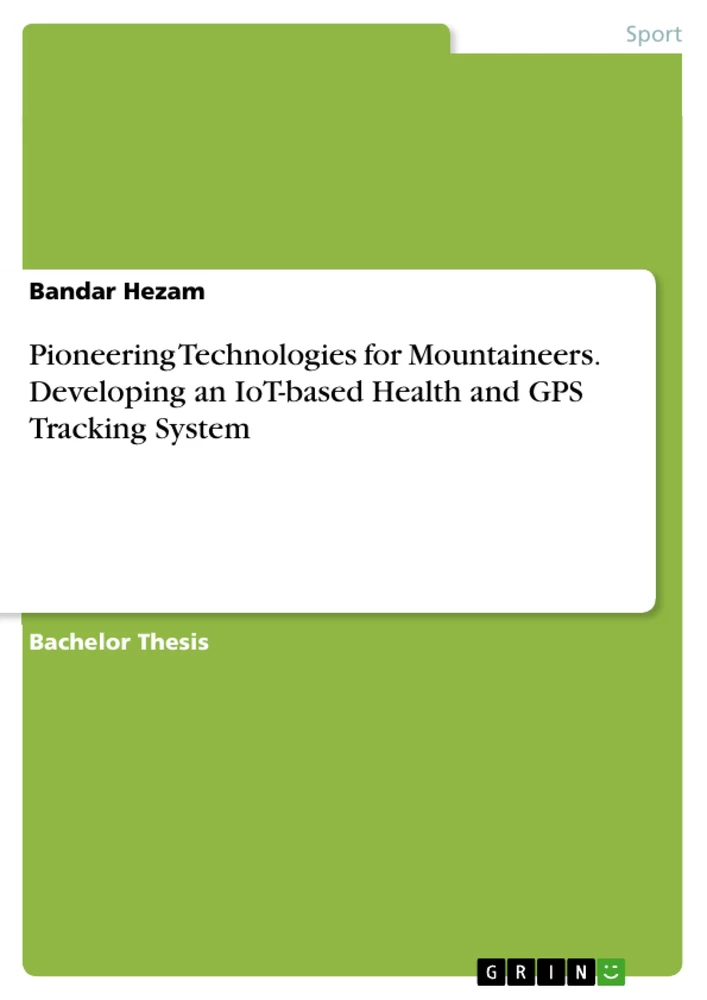
Table of Contents
CHAPTER 1: INTRODUCTION
1.1 Introduction
1.2 Problem Statement
1.2 Aim and Objective of the Study
1.2.1 Aim of the study
1.2.2 Objectives of the study
1.3 Scope and Limitations
1.3.1 Scope
1.3.2 Limitations
1.4 Justification for the research
1.5 Remaining Chapters Outline
1.6 Summary
CHAPTER 2: LITERATURE REVIEW
2.0 Introduction
2.1 Literature review
2.1.1 Review of GPS Tracking Systems
2.1.2 Review of Sensor Technologies for Health Monitoring
2.1.3 Review of Mobile and Web-Based Interfaces for Health Monitoring
2.1.4 The drawbacks and disadvantages of the existing methods
2.2 Similar systems
2.2.1 Title: IOT Based Soldier Navigation and Health Monitoring System
2.2.2 Title: Healthcare monitoring of mountaineers by low power Wireless Sensor
2.2.3 Title: Wearable Sensors in Intelligent Clothing for Human Activity Monitoring
2.2 Summary
CHAPTER 3
CONCEPT DESIGN AND RESEARCH METHODOLOGY
3.1 Introduction
3.2 Investigation on materials and components selections
3.2.1 Pre-processing
3.2.2 Software selection
3.3 Proposed methodology
3.4 Concept design based on fundamental engineering principles.
3.4.1 Introduction
3.4.2 Sensor Inputs
3.4.3 Arduino
3.4.4 Wi-Fi Module
3.4.5 Web Application
3.4.6 Programming
3.5 Proposed System’s Initial Approach
3.6 Proposed
3.7 Professional Engineering Practices
3.8 Project management, Finance and Entrepreneurship
3.9 Summary
Research Objectives and Themes
This project aims to develop a reliable and lightweight IoT-based wearable device to monitor the health and location of mountain climbers in real-time. By leveraging various sensor technologies and GPS, the system seeks to address the critical gaps in safety for mountaineers in remote, high-altitude environments, where traditional tracking and health monitoring methods are often ineffective or unavailable.
- Real-time monitoring of vital signs (heart rate, blood pressure, oxygen saturation).
- GPS-based location tracking for navigation and emergency rescue assistance.
- Development of a user-friendly interface via web platforms for guides and emergency teams.
- Design of a lightweight, durable wearable device suitable for harsh outdoor conditions.
Excerpt from the Book
1.1 Introduction
Mountain climbing is an adventurous sport which attracts enthusiasts globally and according to Ruban and Ermolaev (2020) it is one of the most exciting sports which gathers people from all around the world to explore challenging hikes across the world. Mountain climbing, also known as mountaineering, involves the climbing of mountains which can also be very steep and consisting of scaling rocky terrain, and the activity can usually be for long hours or even days and is considered as one requiring physical fitness, endurance, and mental toughness. However, mountaineering is also perceived as being risky, as mountain climbers can face various health hazards (Gatterer et al., 2021) such as “altitude sickness, dehydration, hypothermia, and frostbite”, among others. Therefore, monitoring the health of mountain climbers is not only important for tracking but for health and safety reasons as well.
Mountaineering requires the enthusiasts to carry multiple equipment with them such as rope, harness, helmet, boots, camping items, ice axes along with wearing gloves and other tools depending on the mountains and the locations for example, rocky mountains or snow mountains and hence for health monitoring system to be proposed in this paper, the functionality and the deliverability has to be such that the wearable device does not be of an extra weight on the climber.
The system proposed in this paper has for title IOT based Mountain Climber Health Monitoring GPS Tracker and is one which aims at developing a solution for the monitoring of the health of mountain climbers in real-time using the Internet of Things (IoT) and GPS technology. This project discusses the context and rationale for the research, the importance of monitoring the health of mountain climbers, and the potential benefits of using IoT and GPS technology in devising a system which has to be technical, outweighing physical limitations as well as lightweight and durable in terms of wearability.
Summary of Chapters
CHAPTER 1: INTRODUCTION: This chapter introduces the problem of ineffective health monitoring for mountain climbers and presents the research rationale for an IoT-based GPS tracker.
CHAPTER 2: LITERATURE REVIEW: This chapter evaluates existing research on IoT health monitoring and GPS tracking, highlighting technological trends and existing gaps in the field.
CHAPTER 3: CONCEPT DESIGN AND RESEARCH METHODOLOGY: This chapter defines the materials, sensor components, and design methodologies used to construct the proposed system, including the hardware setup and software integration.
Keywords
Internet of Things (IoT), GPS Tracking, Mountain Climbing, Health Monitoring, Wearable Technology, Sensor Technology, Real-time Data, Altitude Sickness, Emergency Response, Microcontroller, Arduino, Web Application, Data Transmission, Mountaineering Safety, Vital Signs.
Frequently Asked Questions
What is the core focus of this research?
The research focuses on the design and development of an IoT-based wearable system specifically engineered to monitor the real-time health and location of mountain climbers in harsh, remote environments.
What are the primary themes addressed in the study?
Key themes include the integration of physiological sensors (heart rate, oxygen, etc.), GPS for navigation, reliable data transmission at high altitudes, and the design of a user-friendly web platform for emergency intervention.
What is the main objective of this study?
The objective is to create a functional, durable, and lightweight wearable device that can bridge the safety gap in mountaineering by reporting vital signs and tracking climber locations automatically.
Which scientific methods were employed?
The study utilizes a concept design approach using fundamental engineering principles, supported by a literature review, component selection criteria, power estimation calculations, and prototyping via simulation.
What does the main body of the work cover?
The main body covers the identification of necessary sensors, the selection of hardware (such as the Arduino Mega), the software architecture, power consumption analysis, and the logic behind the system's proposed data flow.
Which keywords characterize this document?
The essential terms include IoT, GPS, wearable technology, mountain climbing safety, physiological monitoring, and sensor integration.
Why is an Arduino Mega preferred over an Arduino Uno?
The Arduino Mega is chosen because it offers more flash memory, expanded RAM, and a significantly higher number of I/O pins, which are necessary to manage the complexity of multiple sensor inputs required for the system.
What defines the web application's role in this project?
The web application acts as the central interface for data visualization, user alerts, and emergency response, allowing rescue teams to monitor the climber's status via a synchronized database.
How does the system handle emergencies?
Upon the detection of abnormal sensor values or critical health indicators, the system triggers alerts through the integrated Wi-Fi module, notifying emergency response teams through the web platform.
Ende der Leseprobe aus 50 Seiten
- nach oben
- Arbeit zitieren
- Bandar Hezam (Autor:in), 2023, Pioneering Technologies for Mountaineers. Developing an IoT-based Health and GPS Tracking System, München, Page::Imprint:: GRINVerlagOHG, https://www.diplomarbeiten24.de/document/1393004

neugierig - aktuell - relevant
Entdecken Sie hilfreiche Tipps und Tricks rund ums Studium!

Entdecken Sie hilfreiche Tipps und Tricks rund ums Studium!
Ihre Hausarbeit / Abschlussarbeit:

- - Publikation als E-Book und Buch
- - Hohes Honorar auf die Verkäufe
- - Für Sie komplett kostenlos - mit ISBN
- - Es dauert nur 5 Minuten
- - Jede Arbeit findet Leser

- © GRIN Publishing GmbH.
- Alle Inhalte urheberrechtlich geschützt. Kopieren und verbreiten untersagt.
- info@grin.com
- AGB
- Open Publishing
Der GRIN Verlag hat sich seit 1998 auf die Veröffentlichung akademischer eBooks und Bücher spezialisiert. Der GRIN Verlag steht damit als erstes Unternehmen für User Generated Quality Content. Die Verlagsseiten GRIN.com, Hausarbeiten.de und Diplomarbeiten24 bieten für Hochschullehrer, Absolventen und Studenten die ideale Plattform, wissenschaftliche Texte wie Hausarbeiten, Referate, Bachelorarbeiten, Masterarbeiten, Diplomarbeiten, Dissertationen und wissenschaftliche Aufsätze einem breiten Publikum zu präsentieren.
Kostenfreie Veröffentlichung: Hausarbeit, Bachelorarbeit, Diplomarbeit, Dissertation, Masterarbeit, Interpretation oder Referat jetzt veröffentlichen!
Folgen Sie GRIN auf


- GRIN Verlag GmbH
-
- Nymphenburger Str. 86
- 80636
- Munich, Deutschland
- +49 89-550559-0
- +49 89-550559-10
- info@grin.com
-
