
präsentiert von

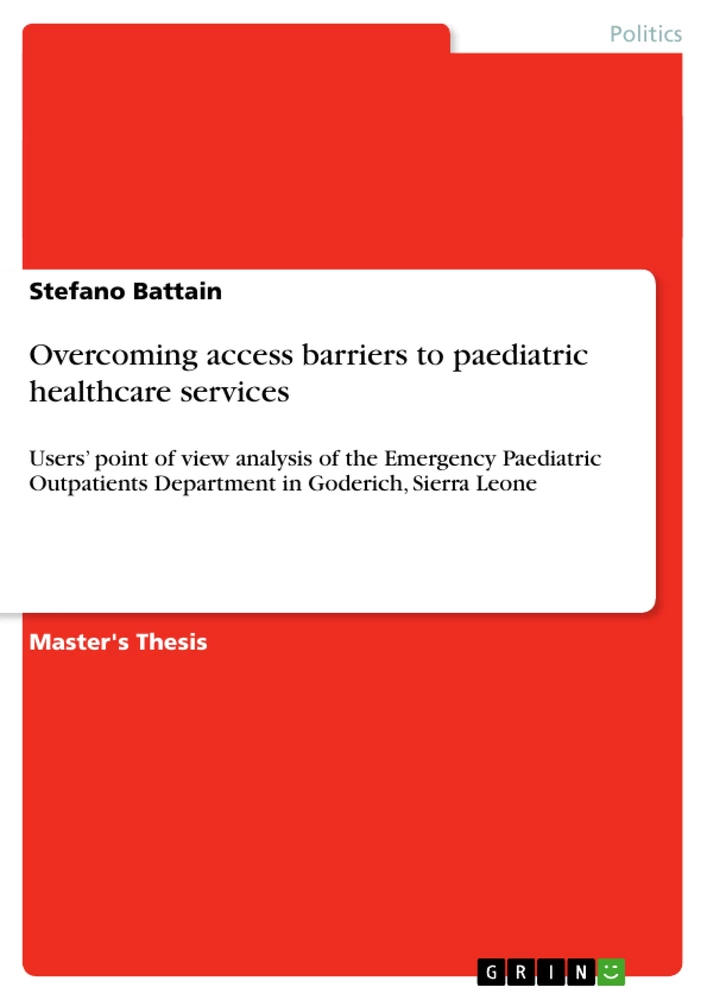
Table of Contents
1. Introduction
1.1 Rationale of the study and research objectives
1.2 Outline of the dissertation
2. Literature review
2.1 Gender and household
2.2 Human capital approach to health and care-seeking strategies
2.3 Access and barriers to healthcare services
2.3.1 Demand side barriers
2.3.2 Demand and supply-demand interaction barriers
2.4 Conclusion
3. Background
3.1 Sierra Leone – poverty and healthcare profile
3.2 Emergency in Sierra Leone
4. Methodology
4.1 Data collection methods and process
4.2 Ethical issues, study limitations and bias
5. Findings and analysis
5.1 Provider choice and demand side barriers
5.1.1 Demand side barriers at the individual level
5.1.2 Demand side barrier at the household level
5.1.3 Demand side barriers at the community level
5.2 Demand-supply interaction and supply side barriers
5.3 Conclusion
6. Conclusion
6.1 Conclusion
6.2 Recommendations
Objectives and Research Themes
This dissertation aims to examine the barriers that prevent or discourage individuals, specifically women, from utilizing the paediatric healthcare services provided by the NGO Emergency in Goderich, Sierra Leone. It explores the interplay between socio-economic conditions, gender dynamics, and institutional factors to address the core research question regarding which barriers affect access to this service and how they are influenced by diverse socio-cultural and systemic factors.
- The role of gender and household dynamics in healthcare decision-making.
- Demand-side barriers, including individual, household, and community-level factors.
- Supply-side barriers and the interaction between service providers and users.
- The impact of poverty and social marginalization on health-seeking behavior.
- Strategic recommendations for improving access and service quality.
Excerpt from the Book
5.1.1 Demand side barriers at the individual level
At the individual level, the most important barriers to accessing the Emergency OPD are the indirect costs related to the opportunity cost of accessing healthcare. Almost all of the women who are using or have used the Emergency service, declared that visiting the Emergency hospital is made harder by the long waiting time. Indeed, obtaining access to the service requires waking up early in the morning, usually around four or five o'clock, queuing until opening time and then patiently waiting in turn. That means that the last patients have to wait until four in the afternoon. Spending one day at the hospital it means losing a whole day of work and consequent income, often the only way to finance children's healthcare. Indeed it appears from the interviews that most of the women need a partner's or relative's help to pay for their children's healthcare. Also opening hours can enhance the opportunity cost of using the service and therefore constitute a strong barrier, for example Ramatu, a teacher, said:
“If I wants to take my child to the Emergency hospital I need to be there at five in the morning, therefore I need to ask the permission to the headmaster of my school and to take an entire day off, renouncing to a day of wage.”
Summary of Chapters
Chapter one: Introduction: Outlines the rationale for the study, focusing on the human right to healthcare and the specific challenges of infant mortality in Sierra Leone.
Chapter two: Literature review: Examines theoretical frameworks, including the gender and development approach and the human capital theory, to categorize barriers to healthcare access.
Chapter three: Background: Provides context on the poverty and healthcare landscape in Sierra Leone and the activities of the NGO Emergency in Goderich.
Chapter four: Methodology: Details the qualitative research process, specifically the use of semi-structured interviews and the challenges encountered during fieldwork.
Chapter five: Findings and analysis: Presents the analysis of demand-side barriers, provider choice, and supply-side interactions based on the gathered empirical data.
Chapter six: Conclusion: Concludes the study by summarizing the identified barriers and offering recommendations for improving the delivery of paediatric healthcare.
Keywords
Healthcare access, paediatric services, Sierra Leone, Emergency NGO, demand-side barriers, human capital, gender roles, household decision-making, infant mortality, indirect costs, waiting time, traditional medicine, supply-side barriers, poverty, qualitative analysis.
Frequently Asked Questions
What is the primary focus of this research?
The research focuses on identifying and analyzing the various barriers that prevent or discourage local users from accessing the paediatric healthcare services provided by the NGO Emergency in Goderich, Sierra Leone.
What are the main thematic fields covered in this study?
The study covers themes including the human capital approach to health, gender and household power dynamics, demand-side and supply-side barriers to healthcare, and the socio-economic context of Sierra Leone.
What is the core objective of the dissertation?
The primary objective is to investigate which specific barriers affect access to the Emergency Paediatric OPD and to determine the factors that influence these barriers in order to suggest improvements.
Which scientific methodology was employed?
The study utilizes a qualitative research methodology, primarily through semi-structured interviews with mothers and key informants to gain an in-depth understanding of the users' perspectives.
What does the main body of the work address?
The main body examines literature on healthcare access, the specific socio-political context of Sierra Leone, and presents an analysis of fieldwork findings regarding individual, household, and community-level barriers.
Which keywords best characterize this work?
Key terms include healthcare access, paediatric services, demand-side barriers, Sierra Leone, human capital, and poverty.
How does gender impact healthcare access according to the study?
The study finds that gender roles significantly influence decision-making; women are often the primary caregivers but may lack the financial autonomy or time due to the "triple role" (productive, reproductive, and community work) to access services easily.
What role do "indirect costs" play in the findings?
Indirect costs, such as the opportunity cost of lost working time and long waiting times at the clinic, are identified as major barriers that prevent women from using the free services provided by the hospital.
How does the staff's attitude affect the service usage?
The findings indicate that aggressive behavior and verbal abuse from national medical staff act as a supply-side barrier, causing some users to avoid the facility despite the high quality of care provided by the organization.
Are traditional beliefs a major obstacle to the service?
While traditional beliefs exist, the study concludes that for most interviewees, they are not a primary barrier to accessing modern healthcare, but rather function as a secondary or fallback option for specific ailments.
Ende der Leseprobe aus 57 Seiten
- nach oben
- Arbeit zitieren
- Stefano Battain (Autor:in), 2008, Overcoming access barriers to paediatric healthcare services, München, Page::Imprint:: GRINVerlagOHG, https://www.diplomarbeiten24.de/document/139389

neugierig - aktuell - relevant
Entdecken Sie hilfreiche Tipps und Tricks rund ums Studium!

Entdecken Sie hilfreiche Tipps und Tricks rund ums Studium!
Ihre Hausarbeit / Abschlussarbeit:

- - Publikation als E-Book und Buch
- - Hohes Honorar auf die Verkäufe
- - Für Sie komplett kostenlos - mit ISBN
- - Es dauert nur 5 Minuten
- - Jede Arbeit findet Leser

- © GRIN Publishing GmbH.
- Alle Inhalte urheberrechtlich geschützt. Kopieren und verbreiten untersagt.
- info@grin.com
- AGB
- Open Publishing
Der GRIN Verlag hat sich seit 1998 auf die Veröffentlichung akademischer eBooks und Bücher spezialisiert. Der GRIN Verlag steht damit als erstes Unternehmen für User Generated Quality Content. Die Verlagsseiten GRIN.com, Hausarbeiten.de und Diplomarbeiten24 bieten für Hochschullehrer, Absolventen und Studenten die ideale Plattform, wissenschaftliche Texte wie Hausarbeiten, Referate, Bachelorarbeiten, Masterarbeiten, Diplomarbeiten, Dissertationen und wissenschaftliche Aufsätze einem breiten Publikum zu präsentieren.
Kostenfreie Veröffentlichung: Hausarbeit, Bachelorarbeit, Diplomarbeit, Dissertation, Masterarbeit, Interpretation oder Referat jetzt veröffentlichen!
Folgen Sie GRIN auf


- GRIN Verlag GmbH
-
- Nymphenburger Str. 86
- 80636
- Munich, Deutschland
- +49 89-550559-0
- +49 89-550559-10
- info@grin.com
-
