
präsentiert von

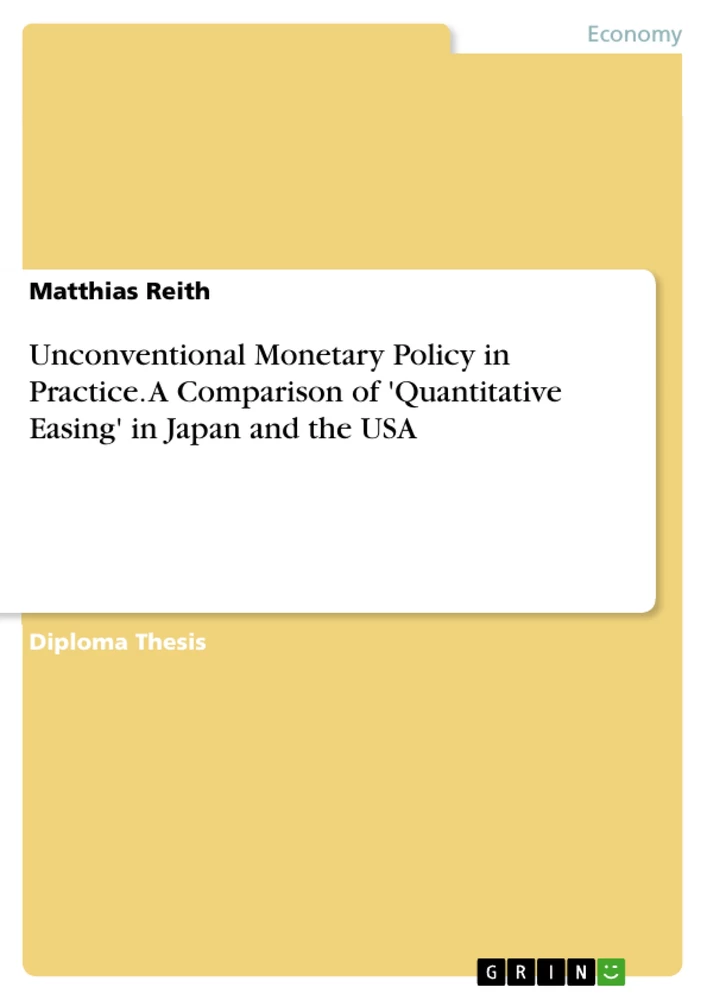
Table of Contents
1. Introduction
2. “Conventional” Monetary Policy Instruments
2.1. Open Market Operations
2.1.1. Outright Transactions
2.1.1.1. USA
2.1.1.2. Japan
2.1.2. (Reverse) Repurchase Agreements
2.1.2.1. USA
2.1.2.2. Japan
2.2. Standing Facilities
2.2.1. USA
2.2.2. Japan
2.3. Reserve Requirements
2.3.1. USA
2.3.2. Japan
3. The Macroeconomic and Financial Conditions prior to the Introduction of Quantitative Easing
3.1. USA
3.2. Japan
4. Preparing the Path for Quantitative Easing: The Ineffectiveness of “Conventional” Monetary Policy
4.1. USA
4.2. Japan
4.3. The Way Out: Quantitative Easing and Other “Unconventional” Measures
4.3.1. Shaping Expectations
4.3.2. Changing the Composition of the Balance Sheet
4.3.3. Increasing the Size of the Balance Sheet: Quantitative Easing
5. Quantitative Easing in Practice: Commonalities and Differences of Two “Unconventional” Monetary Policy Approaches
5.1. Introduction of QE
5.1.1. Japan
5.1.2. USA
5.2. Active QE
5.2.1. Japan
5.2.2. USA
5.3. Passive QE
5.3.1. Japan
5.3.2. USA
5.4. Direct Lending to Borrowers and Investors
5.5. Effects/ Success of QE
5.5.1. Balance Sheet
5.5.1.1. Japan
5.5.1.2. USA
5.5.2. Long-Term Interest Rates (Yield Curve), Money Market Developments and Inflation
5.5.2.1. Japan
5.5.2.2. USA
6. Conclusion
Objectives & Research Topics
The primary objective of this diploma thesis is to examine and compare the "unconventional" monetary policy regimes, specifically Quantitative Easing (QE), implemented by the Bank of Japan between 2001 and 2006 and the United States Federal Reserve since 2007, identifying key differences in their approaches and effectiveness.
- Comparison of macroeconomic and financial conditions preceding the implementation of QE in both nations.
- Distinction between "active" and "passive" QE and the Fed’s "Credit Easing" approach.
- Analysis of the operational targets and the transition from short-term interest rate targeting to balance sheet management.
- Evaluation of the impact of unconventional measures on central bank balance sheet expansion and market liquidity.
- Assessment of the exit strategies and the overall efficacy of QE in addressing deflation versus systemic financial strains.
Excerpt from the Book
1. Introduction
The current economic and financial crisis is considered to be the worst recession since the “Great Depression” in the 1930s. Some argue that it is even worse than that. Not only that many economies around the globe experience negative GDP growth rates, but also large parts of the banking system came into severe difficulties thereby causing a threat for the stability of the overall financial system. Under these circumstances, central banks in most industrial countries have lowered their key short-term interest rate targets to nearly zero.
However, as it turned out, in these extraordinary times “traditional” monetary policy responses in terms of variations of interest rate targets might not be sufficient in order to successfully master the current challenges. As a consequence, many central banks introduced so called “unconventional” monetary policy measures, which are generally summarized under the term “Quantitative Easing (QE)”. The concrete actions attributable to QE can be subdivided into “active” and “passive” QE. Active QE, which is at the discretion of the central bank, refers to outright purchases of government securities or other assets. Passive QE, on the other hand, is at the discretion of the central bank’s counterparty and means that counterparties can approach the central bank to obtain funds, given their ability to provide eligible collateral. Both have in common that aim to achieve certain – often country specific – targets by increasing the overall liquidity in the banking system.
Summary of Chapters
1. Introduction: Outlines the severity of the current financial crisis and the necessity for central banks to adopt unconventional monetary policy measures when traditional interest rate targeting becomes ineffective.
2. “Conventional” Monetary Policy Instruments: Reviews the traditional toolkits used by the Fed and the BoJ, including open market operations, standing facilities, and reserve requirements, to maintain control over short-term interest rates.
3. The Macroeconomic and Financial Conditions prior to the Introduction of Quantitative Easing: Examines the specific economic environments, asset bubbles, and recessions in the US and Japan that necessitated the shift toward unconventional policy.
4. Preparing the Path for Quantitative Easing: The Ineffectiveness of “Conventional” Monetary Policy: Discusses the limits of traditional policy and explores theoretical unconventional strategies, such as shaping expectations and altering balance sheet composition.
5. Quantitative Easing in Practice: Commonalities and Differences of Two “Unconventional” Monetary Policy Approaches: Conducts a detailed comparative analysis of the specific QE implementations in Japan and the US, evaluating the differences in target, instruments, and outcomes.
6. Conclusion: Summarizes the fundamental differences between the Japanese and US approaches, highlighting that while both faced severe crises, their primary motivations (deflation vs. banking system strains) shaped their distinct policy responses.
Keywords
Quantitative Easing, QE, Credit Easing, Federal Reserve, Bank of Japan, Monetary Policy, Deflation, Financial Crisis, Open Market Operations, Balance Sheet, Liquidity, Interest Rates, Subprime Crisis, Central Bank, Macroeconomics
Frequently Asked Questions
What is the core focus of this diploma thesis?
This thesis investigates and compares the implementation of unconventional monetary policies, specifically Quantitative Easing, by the Bank of Japan and the US Federal Reserve during their respective financial crises.
What are the central themes covered?
The work covers central bank tools, macroeconomic triggers for policy changes, the distinction between active and passive monetary easing, and the impact of these policies on financial markets and central bank balance sheets.
What is the primary research goal?
The primary goal is to determine how the two central banks adjusted their tools when traditional interest rate policy failed, and how their specific goals—fighting deflation versus stabilizing the banking system—influenced their unique QE approaches.
Which scientific method is employed?
The research primarily utilizes a comparative, descriptive analytical method to evaluate the implementation and effects of monetary policies, drawing on institutional reports, central bank data, and existing literature.
What does the main body discuss?
The main body breaks down traditional versus unconventional monetary instruments, the economic preconditions for QE, and a detailed, chapter-by-chapter comparison of how the Bank of Japan and the Federal Reserve structured and executed their policies.
Which keywords best characterize the work?
Quantitative Easing, Monetary Policy, Central Bank, Deflation, Financial Crisis, and Balance Sheet management are the most essential terms for this study.
How does the "Credit Easing" of the Fed differ from the Bank of Japan's "Quantitative Easing"?
The Fed’s approach, termed "Credit Easing" by Chairman Bernanke, focuses on the composition of assets and direct lending to credit markets to address systemic bank strains, whereas the Bank of Japan’s QE focused primarily on targeting total bank reserves to combat prolonged deflation.
What was the role of the "liquidity trap" in this research?
The research explores the concept of the liquidity trap as a state where nominal interest rates are near zero and traditional monetary policy loses its transmission mechanism, forcing central banks to look toward unconventional measures like balance sheet expansion.
How significant was the impact on the respective central bank balance sheets?
The research finds that while the Japanese balance sheet grew by 35% during its QE period, the US Federal Reserve’s balance sheet expanded more aggressively (by 126%) over a significantly shorter timeframe due to the severity of the financial market disruptions.
Ende der Leseprobe aus 105 Seiten
- nach oben
- Arbeit zitieren
- Matthias Reith (Autor:in), 2009, Unconventional Monetary Policy in Practice. A Comparison of 'Quantitative Easing' in Japan and the USA, München, Page::Imprint:: GRINVerlagOHG, https://www.diplomarbeiten24.de/document/139627

neugierig - aktuell - relevant
Entdecken Sie hilfreiche Tipps und Tricks rund ums Studium!

Entdecken Sie hilfreiche Tipps und Tricks rund ums Studium!
Ihre Hausarbeit / Abschlussarbeit:

- - Publikation als E-Book und Buch
- - Hohes Honorar auf die Verkäufe
- - Für Sie komplett kostenlos - mit ISBN
- - Es dauert nur 5 Minuten
- - Jede Arbeit findet Leser

- © GRIN Publishing GmbH.
- Alle Inhalte urheberrechtlich geschützt. Kopieren und verbreiten untersagt.
- info@grin.com
- AGB
- Open Publishing
Der GRIN Verlag hat sich seit 1998 auf die Veröffentlichung akademischer eBooks und Bücher spezialisiert. Der GRIN Verlag steht damit als erstes Unternehmen für User Generated Quality Content. Die Verlagsseiten GRIN.com, Hausarbeiten.de und Diplomarbeiten24 bieten für Hochschullehrer, Absolventen und Studenten die ideale Plattform, wissenschaftliche Texte wie Hausarbeiten, Referate, Bachelorarbeiten, Masterarbeiten, Diplomarbeiten, Dissertationen und wissenschaftliche Aufsätze einem breiten Publikum zu präsentieren.
Kostenfreie Veröffentlichung: Hausarbeit, Bachelorarbeit, Diplomarbeit, Dissertation, Masterarbeit, Interpretation oder Referat jetzt veröffentlichen!
Folgen Sie GRIN auf


- GRIN Verlag GmbH
-
- Nymphenburger Str. 86
- 80636
- Munich, Deutschland
- +49 89-550559-0
- +49 89-550559-10
- info@grin.com
-
