
präsentiert von

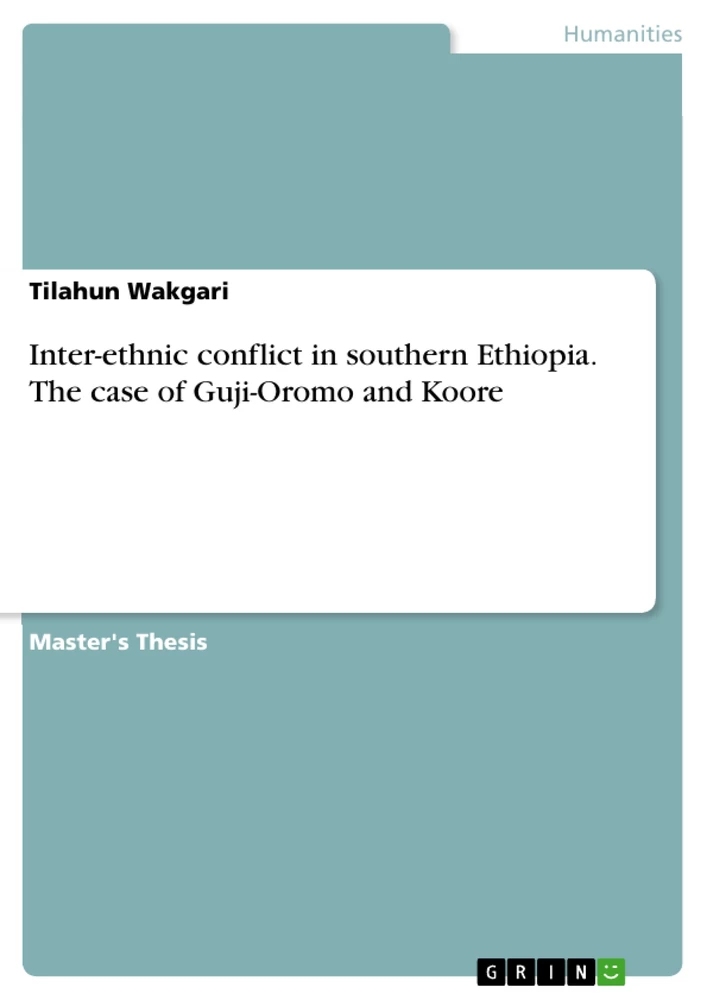
Table of Contents
CHAPTER ONE
Introduction
1.1. Background of the Study
1.2. Statement of the problem
1.3. Objectives of the Study
1.3.1. General Objective
1.3.2. Specific objectives
1.4. Research Questions
1.5. Significance of the Study
1.6. Scope of the Study
1.7. Limitations of the Study
1.8. Organization of the study
CHAPTER TWO
REVIEW OF RELATED LITERATURE
Introduction
2.1 Conceptual Literature Review
2.1.1 Definitions and Concepts of Ethnicity, Ethnic Identity, Conflict and Ethnic-Conflicts
2.2 Theoretical Framework
2.2.1. The Instrumentalist Approach
2.2.2. The Constructivist Approach
2.3. The Empirical Review
2.3.1 The General Overview: Causes of Inter-Ethnic Conflict
2.3.2 The Ethiopian Causes of Inter-Ethnic Conflicts
2.4. Mechanism of Conflict Management: General Overview
2.5. Inter-Ethnic Conflict Management: The Ethiopian Experience
2.6. Effects of Inter-Ethnic Conflict
CHAPTER THREE
RESEARCH METHODOLOGY
3.1. Introduction
3.2. Description of the Study Area
3.3. Research Methods
3.4. Research Design
3.5. Sources of Data
3.6. Instruments of Data Collection
3.6.1. In-depth interview
3.6.2. Focus group discussions (FGDs)
3.6.3. Written Documents
3.7. Sampling technique and sample size determination
3.8. Method of Data Analysis and Interpretation
3.9. Ethical Considerations
CHAPTER FOUR
DATA PRESENTATION AND ANALYSIS
4.1. The Relations of the Guji-Oromo and Koore: Peaceful relations
4.1.1. Everyday Peace in Guji-Koore Relations
4.1.2. Economic Interdependence: Local Markets and Trade
4.1.3. Socio-Cultural Practices: Inter-Marriage Relations, Shared food and Shared Language
4.2 Conflictual Relations
4.3. The Causes of the Inter-Ethnic Conflict in Guji-Koore
4.3.1. The structural (root) causes
4.3.2. Contributing Factors
4.4. Actors and their Interests
4.5. Effects of the Guji-Koore inter-ethnic conflict
4.5.1. Social Effects
4.5.2. Economic Effects
4.5.3. Political Effects
4.6. The Dynamics of Guji-Koore Inter-Ethnic Conflict
4.7. Conflict Management and Peace Building Efforts
4.7.1. Traditional Mechanisms of Conflict Resolution
4.7.2. Formal Conflict Resolution and Peace Building Attempts
4.8. Obstacles to Sustainable Peace between Guji and Koore Ethnic Groups
CHAPTER FIVE
SUMMARY, CONCLUSION AND RECOMMENDATIONS
5.1. Summary and Conclusion
5.2. Recommendations
Research Objectives and Themes
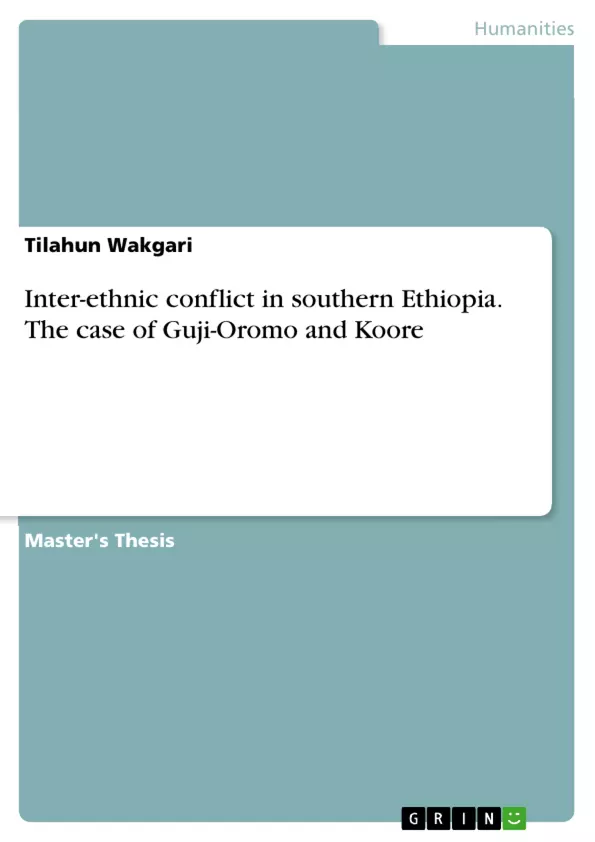
This thesis examines the inter-ethnic conflict between the Guji and Koore ethnic groups in Southern Ethiopia, aiming to identify the underlying causes, contributing factors, central actors, and socio-economic and political impacts of these conflicts within an exploratory, qualitative, and thematic research framework.
- Causes and structural factors of the Guji-Koore conflict.
- Roles of primary and secondary conflict actors.
- Economic and social consequences of land-related clashes.
- Effectiveness of contemporary and traditional conflict resolution mechanisms.
Excerpt from the Book
The Causes of the Inter-Ethnic Conflict in Guji-Koore
The nature and causes of conflicts are multiple; most researchers agree that the causes of conflict are diverse. Ethiopia has experienced inter-ethnic conflict for different reasons. There are multidimensional and complex causes. As was attempted to mention in the previous part of the study, conflicts sometimes have historical, political, economic, social and cultural dimensions (Teferi, 2012). The conflict in the study area is a result of various variables that cut across economic, political, social and cultural factors. On both sides of ethnic groups, FGD participants and other informants indicated that the above factor causes the inter-ethnic conflict between Guji and Koore. The researcher gathered information from the informants about the structural causes and contributing factors of conflict in the study area based on the degree of their contribution to the recurrence as well as the intensity of the conflict.
Summary of Chapters
CHAPTER ONE: Introduces the background, problem statement, and objectives of the research regarding the conflict between the Guji and Koore ethnic groups.
CHAPTER TWO: Provides a comprehensive literature review covering conceptual definitions of ethnicity, conflict, and theoretical frameworks, alongside an empirical review of inter-ethnic conflicts.
CHAPTER THREE: Outlines the qualitative research design, data collection methods including in-depth interviews and FGDs, and the methodological approach used.
CHAPTER FOUR: Presents a detailed analysis of findings, focusing on peaceful vs. conflictual relations, causes, actors, impacts, and conflict management efforts.
CHAPTER FIVE: Synthesizes the study findings into final conclusions and offers evidence-based recommendations for sustainable peacebuilding.
Keywords
Ethnicity, ethnic conflict, Guji, Koore, everyday peace, land resources, conflict management, Ethiopia, traditional resolution, socio-cultural, political actors, inter-marriage, economic interdependence, displacement.
Frequently Asked Questions
What is the primary focus of this research?
The thesis investigates the inter-ethnic conflict between the Guji-Oromo and Koore ethnic groups in Southern Ethiopia.
What are the major themes explored?
The work explores causes of conflict, the involvement of diverse social and political actors, the impacts on peaceful everyday relations, and the limitations of both formal and traditional conflict resolution efforts.
What is the central research question?
The study seeks to identify the underlying causes, contributing factors, key actors, dynamics, and the socio-economic and political impacts of the conflict between these two groups.
Which research method does the author employ?
The researcher uses a qualitative research approach with an exploratory design, relying on both primary data (in-depth interviews, focus group discussions) and secondary data (literature, documents).
What is the core subject of the final chapter?
The final chapter provides a summary of findings, concludes on the nature of the conflict, and presents specific recommendations to improve local governance and conflict resolution.
What are the characterizing keywords of this study?
The study is characterized by concepts like "Everyday peace," "Ethnic federalism," "Resource competition," and the role of "Political elites."
How does the creation of Nech Sar National Park impact the conflict?
Informants point to the park as a source of grievance and land disputes, as it displaced local populations and created unfair boundary demarcations.
What role do traditional conflict resolution systems like "Gondoro" and "Nohe" play?
These traditional institutions are deeply rooted in the culture and are intended to settle disputes; however, the study finds their effectiveness has been eroded by local political interference.
How has the 1991 regime change influenced the conflict?
The implementation of ethnic federalism has, according to the research, politicized ethnic identities and introduced new, complex dynamics related to land ownership and self-administration.
Ende der Leseprobe aus 77 Seiten
- nach oben
- Arbeit zitieren
- Tilahun Wakgari (Autor:in), 2023, Inter-ethnic conflict in southern Ethiopia. The case of Guji-Oromo and Koore, München, Page::Imprint:: GRINVerlagOHG, https://www.diplomarbeiten24.de/document/1407978

neugierig - aktuell - relevant
Entdecken Sie hilfreiche Tipps und Tricks rund ums Studium!

Entdecken Sie hilfreiche Tipps und Tricks rund ums Studium!
Ihre Hausarbeit / Abschlussarbeit:

- - Publikation als E-Book und Buch
- - Hohes Honorar auf die Verkäufe
- - Für Sie komplett kostenlos - mit ISBN
- - Es dauert nur 5 Minuten
- - Jede Arbeit findet Leser

- © GRIN Publishing GmbH.
- Alle Inhalte urheberrechtlich geschützt. Kopieren und verbreiten untersagt.
- info@grin.com
- AGB
- Open Publishing
Der GRIN Verlag hat sich seit 1998 auf die Veröffentlichung akademischer eBooks und Bücher spezialisiert. Der GRIN Verlag steht damit als erstes Unternehmen für User Generated Quality Content. Die Verlagsseiten GRIN.com, Hausarbeiten.de und Diplomarbeiten24 bieten für Hochschullehrer, Absolventen und Studenten die ideale Plattform, wissenschaftliche Texte wie Hausarbeiten, Referate, Bachelorarbeiten, Masterarbeiten, Diplomarbeiten, Dissertationen und wissenschaftliche Aufsätze einem breiten Publikum zu präsentieren.
Kostenfreie Veröffentlichung: Hausarbeit, Bachelorarbeit, Diplomarbeit, Dissertation, Masterarbeit, Interpretation oder Referat jetzt veröffentlichen!
Folgen Sie GRIN auf


- GRIN Verlag GmbH
-
- Nymphenburger Str. 86
- 80636
- Munich, Deutschland
- +49 89-550559-0
- +49 89-550559-10
- info@grin.com
-
