
präsentiert von

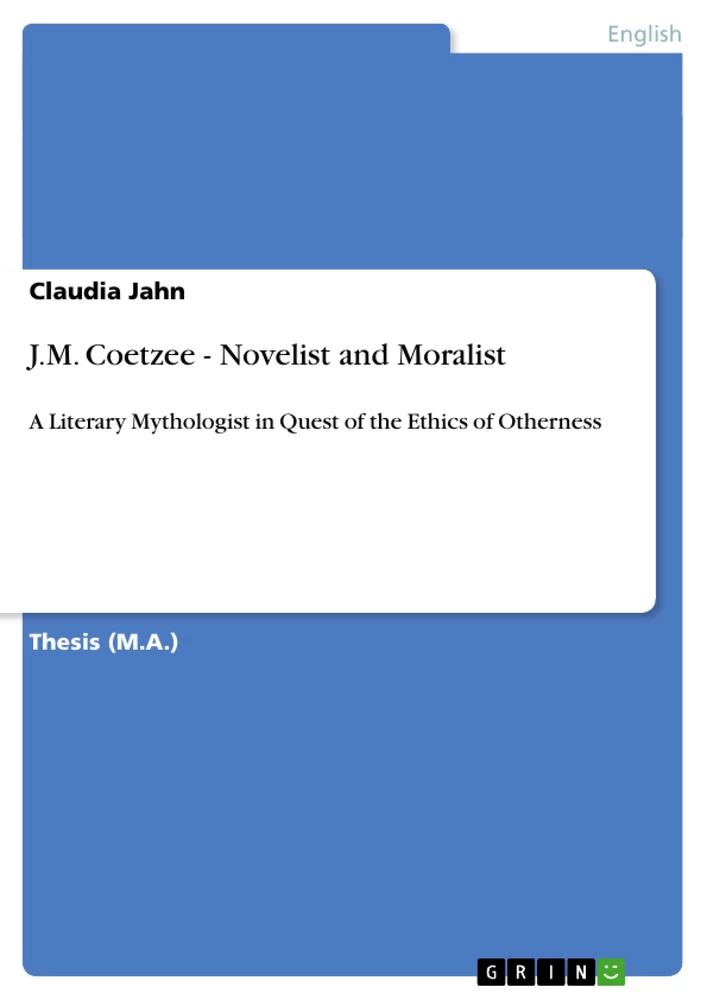
Table of Contents
1 Introduction
2 Social Casework
2.1 The Principle(s) of Civilisation
2.2 The Mechanisms of Civilisation
2.3 State Order
3 The Morality of Myth
3.1 Another Image
3.1.1 Christian Mythology
3.1.2 Greek Mythology
3.2 The Real Myth
3.2.1 An Individual Perspective
3.2.2 Accepting the Other
3.3 The Real Thing
3.3.1 A Variety of Realities
3.3.2 The Writing of History
3.3.3 Establishing Historical Consciousness
3.3.4 Avoiding Myth
4 Conscious Writing
4.1 Denominating the Demon
4.2 The Writer’s Commitment – The Exorcism of the Demon
4.2.1 Writing of Literature
4.2.2 The Reader’s Share
4.2.3 The Languorous Linguist
5 Conclusion
Objectives & Core Themes
The primary objective of this work is to explore the ethical dilemmas and power dynamics within J. M. Coetzee’s literature, focusing on the representation of the "other" and the moral responsibilities of the author. The research examines how Coetzee’s characters and literary structures challenge societal myths, hierarchical power structures, and the perceived neutrality of language and history.
- The relationship between the self and the other in postcolonial contexts.
- The role of myth and history as constructs of power and social control.
- The ethical imperative of the "writer of otherness" in balancing didactic obligations with the avoidance of totalizing representations.
- The function of language, naming, and number systems as tools for both reinforcing and challenging reality.
- The significance of interpretation and the reader's role in the "ethics of otherness."
Excerpt from the Book
3.1 Another Image
Roland Barthes introduces in his acclaimed book Mythologies the idea of myth as a social construct, thereby linking linguistics and cultural theory. Barthes claims that a sign consist of a formative, the signifier, which is linked to a concept, the signified. He further argues that this sign is embedded in a cultural context. According to Barthes, this leads to the construction of another sign, the myth, in which the formerly complex linguistic sign now is reduced to being the pure formative, representing not only a concept, but also embedding it into society. Because the idea represented by the sign now is part of a myth, it is propped with a meaning and a purpose. The linguistic sign is furnished with an intention. But since this is achieved by imitating the seemingly natural relationship between signifier and signified, the reader of myth does not react with suspicion, but accepts myth as a natural, a given fact. In Barthes’ words, “any semiological system is a system of values; now the myth-consumer takes the signification for a system of facts: myth is read as a factual system, whereas it is but a semiological system” (Mythologies 131).
In Waiting for the Barbarians, Empire stands in opposition to the barbarians. This term is used both to describe the nomadic tribes and to label the barbarians “enemy”, to put them into a cultural relation with empire. The sign “barbarians” has become a myth upon which Empire constructs itself.
Summary of Chapters
1 Introduction: This chapter sets the stage by discussing Coetzee’s reclusive nature, the impact of South African history on his writing, and his preoccupation with representing otherness ethically.
2 Social Casework: Explores how civilization uses reason, necessity, and nature as moral paradigms to justify hierarchical structures and state order.
3 The Morality of Myth: Analyzes how myths, including Christian and Greek influences, act as social constructs that categorize reality and how Coetzee uses them to highlight the complexity of the self and other.
4 Conscious Writing: Examines the author's struggle to avoid imposing subjective views on reality while attempting to communicate moral ethics, specifically through the subversion of language and literary structures.
5 Conclusion: Synthesizes the findings, arguing that Coetzee uses literature to enact the "ethics of otherness" by maintaining a state of productive ambiguity rather than providing final moral lessons.
Keywords
J.M. Coetzee, Ethics of Otherness, Myth, Postcolonialism, Representation, Social Construct, Roland Barthes, Literary Ethics, Language, Reality, History, Identity, Power Dynamics, Authorial Responsibility, Subjectivity.
Frequently Asked Questions
What is the core focus of this academic work?
The work focuses on the moral and ethical dimensions of J. M. Coetzee’s novels, specifically how he navigates the representation of "the other" within established social, historical, and linguistic power structures.
What are the central themes explored?
The central themes include the critique of civilizational norms, the destabilization of myth, the relationship between the author and the reader, and the struggle to achieve an ethical stance that respects individual identity without resorting to totalizing ideologies.
What is the primary research question?
The research asks how Coetzee’s literature can be both morally instructive and fundamentally open, balancing the author's duty to represent reality with the ethical requirement to avoid defining and controlling the "other."
Which scientific methods are employed?
The work utilizes literary analysis, cultural theory, and the application of philosophical concepts—most notably those of Roland Barthes regarding myth and Jacques Derrida regarding the "arrivant"—to deconstruct Coetzee’s narratives.
What is covered in the main body?
The main body examines the use of institutional mechanisms in Coetzee’s society, the deconstruction of traditional mythological narratives, the critique of the "writing of history," and the self-reflective role of the author as a participant in power dynamics.
How would you define the keywords characterizing this work?
Keywords include postcolonial ethics, the "other," myth deconstruction, narrative authority, literary iconoclasm, and social identity.
How does Coetzee perceive the role of the reader in his novels?
Coetzee assigns the reader a crucial role as an active interpreter. By creating texts that are resistant to single, simple interpretations, he forces the reader to confront their own interpretive biases, thereby preventing a fixed, authoritative reading.
What role does the "Master of Petersburg" play in the author’s critique of history?
In this novel, the author uses the historical figure of Dostoevsky to explore how writers can rival the authority of history. By creating a fiction that acknowledges its own artifice, the text exposes history’s own myth-making processes.
Why is the concept of "un-settlement" significant for Anya in "Diary of a Bad Year"?
"Un-settlement" describes the process by which Anya begins to distrust her static, rigid understanding of her partner, Alan, and becomes open to the ambiguity of the "other," moving away from fixed social perceptions.
How does water function as a metaphor in this study?
Water is interpreted as a symbol for the impermeability of death and the unrepresentable nature of the other, illustrating how human consciousness and language struggle to grasp things that exist beyond their control.
Ende der Leseprobe aus 91 Seiten
- nach oben
- Arbeit zitieren
- M.A. Claudia Jahn (Autor:in), 2007, J.M. Coetzee - Novelist and Moralist, München, Page::Imprint:: GRINVerlagOHG, https://www.diplomarbeiten24.de/document/141654

neugierig - aktuell - relevant
Entdecken Sie hilfreiche Tipps und Tricks rund ums Studium!

Entdecken Sie hilfreiche Tipps und Tricks rund ums Studium!
Ihre Hausarbeit / Abschlussarbeit:

- - Publikation als E-Book und Buch
- - Hohes Honorar auf die Verkäufe
- - Für Sie komplett kostenlos - mit ISBN
- - Es dauert nur 5 Minuten
- - Jede Arbeit findet Leser

- © GRIN Publishing GmbH.
- Alle Inhalte urheberrechtlich geschützt. Kopieren und verbreiten untersagt.
- info@grin.com
- AGB
- Open Publishing
Der GRIN Verlag hat sich seit 1998 auf die Veröffentlichung akademischer eBooks und Bücher spezialisiert. Der GRIN Verlag steht damit als erstes Unternehmen für User Generated Quality Content. Die Verlagsseiten GRIN.com, Hausarbeiten.de und Diplomarbeiten24 bieten für Hochschullehrer, Absolventen und Studenten die ideale Plattform, wissenschaftliche Texte wie Hausarbeiten, Referate, Bachelorarbeiten, Masterarbeiten, Diplomarbeiten, Dissertationen und wissenschaftliche Aufsätze einem breiten Publikum zu präsentieren.
Kostenfreie Veröffentlichung: Hausarbeit, Bachelorarbeit, Diplomarbeit, Dissertation, Masterarbeit, Interpretation oder Referat jetzt veröffentlichen!
Folgen Sie GRIN auf


- GRIN Verlag GmbH
-
- Nymphenburger Str. 86
- 80636
- Munich, Deutschland
- +49 89-550559-0
- +49 89-550559-10
- info@grin.com
-
