
präsentiert von

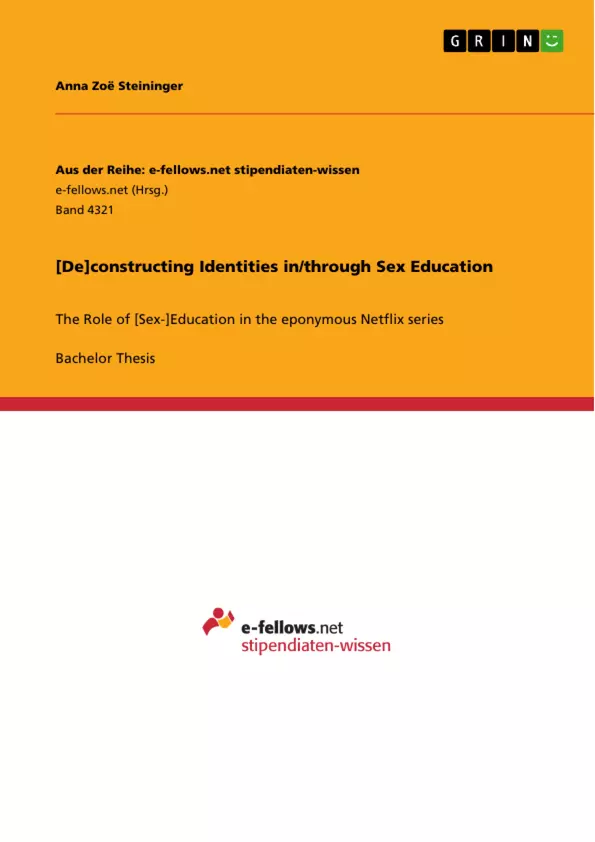
![Titel: [De]constructing Identities in/through Sex Education](https://cdn.openpublishing.com/thumbnail/products/1420158/large.webp)
Table of Content
1. Introduction
2. Classic forms of education in the series – Ideological state apparatuses in Sex Education
2.1 School
2.2 Therapy
2.3 Family
2.4 Popular culture
2.4.1 The role of popular culture as an educational tool
2.4.2 An intertextual approach: How Sex Education makes the history of queer popular culture visible
2.4.3 Transgressing normativity – Comic writing and aliens as form of escapism
2.4.4 The binary choice of one’s sexuality: “A match between equals. Only one can survive.”
2.4.5 Teenagers as producers and consumers of porn
3. The Sex Clinic – A hybrid between school and therapy
3.1 School’s deficiency: “Fit-for-purpose school-delivered information”
3.2 Education between school and therapy
3.3 Labelling – Blessing or curse?
3.4 Knowledge does not mean you’re safe – What it takes to be a “normal teenager”
4. Who educates who? – Educational hierarchies reversed
4.1 Child/Parents
4.1.1 Parentification – “Would you rather I told them that mum’s a junkie and that dad fucked off?”
4.1.2 When a mother therapizes her child
4.1.3 Imprisonment through normative education – The fear of not being the “real mum”
4.1.4 Like father, like son
4.2 Students teaching their teachers
4.3 The sufferer transforming his bully – An obsolete narrative?
4.4 “Make kin!”: Extending notions of family
5. [De-]constructing the spectator’s identity through [sex-] education
6. Conclusion
Research Objectives and Thematic Scope
This thesis examines the British comedy-drama series Sex Education to determine how the show uses its narrative to deconstruct and reconstruct identities through various forms of education. It investigates how educational structures—such as school, therapy, and family—are portrayed and subverted to educate spectators about sexuality, gender, and societal norms.
- Analysis of ideological state apparatuses within the series.
- Deconstruction of traditional educational hierarchies between parents, teachers, and students.
- Exploration of how popular culture serves as an educational tool for identity formation.
- Examination of queer representation and the subversion of heteronormative binaries.
- Investigation of how the series impacts spectator identity perception and discourse.
Excerpt from the Book
3.1 School’s deficiency: “Fit-for-purpose school-delivered information”
Otis’s advice to and engagement with other students at Moordale Secondary School around sexual knowledge highlights the challenges posed by misinformation, misunderstanding and misconstruction of the conventional sex education curriculum. For instance, the first episode of season two shows students wearing masks to prevent transmission of chlamydia, clearly showcasing an extreme form of misinformation regarding a common sexually transmitted disease (also comp. Dudek, Woodley & Green, 2021, p.503). With their concept Otis and Maeve attempt to address the lack of fit-for-purpose school-delivered information. Jean Milburn, Otis’ mother, confronts the headmaster and parents and thus reveals the weaknesses of the curriculum at an emergency parents’ assembly after the pseudo chlamydia outbreak (S2E1).
Jean: How will you be re-educating them on safer sex?
Mr. Groff: Well, by re-educating them on safer sex...
Jean: I believe what we’re dealing with here is an outbreak of STI hysteria, rather than an outbreak of Chlamydia. You cannot catch this disease through breathing. It is spread through genital fluids, exchange during unprotected sex. However, it is the misinformation about the disease, that’s hugely problematic. It comes shrouded in shame and misunderstanding. And is precisely how this kind of hysteria is spread. So, how will you be addressing that?
Mr. Groff: We will be returning to our tried and tested sex education curriculum.
Jean: Well, with all due respect, sir. Your curriculum isn’t working. As a sexual health professional, may I suggest that you look into tailoring your program to give our teenagers the correct tools to be able to free themselves from this unwarranted stigma?
Mr. Groff: And what exactly are those tools?
Jean: The three Ts. Trust, Talking and Truth.
Chapter Summaries
1. Introduction: This chapter introduces the series Sex Education and outlines the research goal of exploring how the show acts as a unique educational framework that deconstructs traditional narratives.
2. Classic forms of education in the series – Ideological state apparatuses in Sex Education: This section utilizes Althusser’s theory of Ideological State Apparatuses to analyze how social institutions like school, therapy, and family function within the show.
3. The Sex Clinic – A hybrid between school and therapy: This chapter focuses on the Sex Clinic as a site of subversion that replaces ineffective school curricula with student-led, practical sexual information.
4. Who educates who? – Educational hierarchies reversed: This section examines the reversal of power dynamics, demonstrating how students often educate their parents and teachers in complex family and academic settings.
5. [De-]constructing the spectator’s identity through [sex-] education: This chapter analyzes the metatextual impact of the series on its audience, exploring how it challenges the viewer to rethink their own preconceived notions of identity.
6. Conclusion: The concluding chapter summarizes how Sex Education functions as an educational tool that continuously deconstructs and reconstructs identities throughout the series.
Keywords
Sex Education, identity formation, educational hierarchies, ideological state apparatuses, queer identity, popular culture, teen drama, sexual health, performance, coming-of-age, subversion, social norms, media studies, Netflix, gender performance.
Frequently Asked Questions
What is the core subject of this thesis?
The thesis explores the representation of education and identity formation in the Netflix series Sex Education, focusing on how the show subverts traditional educational structures.
Which central thematic fields are covered?
The study covers the influence of ideology, the role of popular culture in identity building, and the shifting power dynamics between teenagers, parents, and school authorities.
What is the primary research goal?
The goal is to determine how the series serves as a "sex-educational" tool that encourages viewers to deconstruct heteronormative conventions and re-evaluate personal identity.
Which scientific methods are employed?
The work employs a qualitative analysis of the series using conceptual frameworks from theorists such as Louis Althusser, Judith Butler, Kimberley Crenshaw, and Donna Haraway.
What is the focus of the main body?
The main body systematically analyzes institutions like the school, the "Sex Clinic," the family environment, and the specific impact of media (pornography and popular culture) on the series' characters.
What are the key descriptive characteristics of this work?
The work is characterized by terms such as deconstruction, educational hierarchies, subversion, sexuality, and intersectional identity formation.
How does the series portray parental roles compared to traditional teen shows?
The series presents parents, such as Jean Milburn, as complex individuals with their own issues, often reversing traditional power structures where the child becomes the educator.
What significance does the "Sex Clinic" hold for the show's narrative?
The Sex Clinic acts as a hybrid space that fills the deficit left by formal school education, providing students with necessary information in a safe, non-judgmental environment.
Ende der Leseprobe aus 60 Seiten
- nach oben
- Arbeit zitieren
- Anna Zoë Steininger (Autor:in), 2023, [De]constructing Identities in/through Sex Education, München, Page::Imprint:: GRINVerlagOHG, https://www.diplomarbeiten24.de/document/1420158

neugierig - aktuell - relevant
Entdecken Sie hilfreiche Tipps und Tricks rund ums Studium!

Entdecken Sie hilfreiche Tipps und Tricks rund ums Studium!
Ihre Hausarbeit / Abschlussarbeit:

- - Publikation als E-Book und Buch
- - Hohes Honorar auf die Verkäufe
- - Für Sie komplett kostenlos - mit ISBN
- - Es dauert nur 5 Minuten
- - Jede Arbeit findet Leser

- © GRIN Publishing GmbH.
- Alle Inhalte urheberrechtlich geschützt. Kopieren und verbreiten untersagt.
- info@grin.com
- AGB
- Open Publishing
Der GRIN Verlag hat sich seit 1998 auf die Veröffentlichung akademischer eBooks und Bücher spezialisiert. Der GRIN Verlag steht damit als erstes Unternehmen für User Generated Quality Content. Die Verlagsseiten GRIN.com, Hausarbeiten.de und Diplomarbeiten24 bieten für Hochschullehrer, Absolventen und Studenten die ideale Plattform, wissenschaftliche Texte wie Hausarbeiten, Referate, Bachelorarbeiten, Masterarbeiten, Diplomarbeiten, Dissertationen und wissenschaftliche Aufsätze einem breiten Publikum zu präsentieren.
Kostenfreie Veröffentlichung: Hausarbeit, Bachelorarbeit, Diplomarbeit, Dissertation, Masterarbeit, Interpretation oder Referat jetzt veröffentlichen!
Folgen Sie GRIN auf


- GRIN Verlag GmbH
-
- Nymphenburger Str. 86
- 80636
- Munich, Deutschland
- +49 89-550559-0
- +49 89-550559-10
- info@grin.com
-
