
präsentiert von

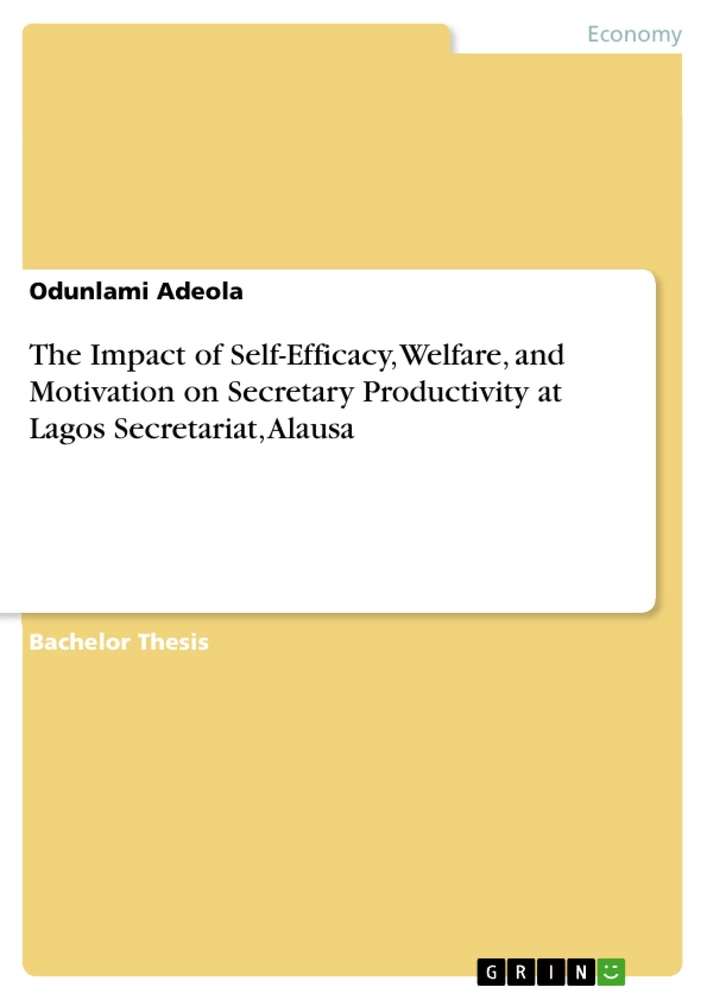
Table of Contents
1. Introduction
1.1 Background of the Study
1.2 Statement of the Problem
1.3 Objectives of the Study
1.4 Research Questions
1.5 Research Hypotheses
1.6 Significance of the Study
2. Literature Review
2.1 Theoretical Review
2.1.1 Maslow's Hierarchy of Needs
2.1.2 Organization Theory
2.1.3 Expectancy Theory
2.1.4 Classical Approach Theory
2.1.5 Self-Efficacy Theory
2.2 Conceptual Review
2.2.1 Self-Efficacy
2.2.1.1 Role of Self- Efficacy in organization
2.2.1.2 Techniques through which Self-Efficacy can improve Secretary Productivity
2.2.2 Concept of Welfare
2.2.2.1 Types of Welfare
2.2.3 Motivation
2.2.3.1 Types of Motivation
2.3 Empirical Review
3. Research Methodology
3.0 Introduction
3.1 Research Design
3.2 Population of the Study
3.3 Sample and Sampling Technique
3.4 Instrumentation
3.5 Validity and Reliability of Instrument
3.6 Procedure for Data Collection
3.7 Method of Data Collection
4. Data Analysis and Interpretation
4.0 Preamble
4.1 Demographic Distribution of Respondents
4.2 Test of Hypothesis
4.2.1 Hypothesis one
4.2.2 Hypothesis two
4.2.3 Hypothesis three
4.2.4 Hypothesis four
4.3 Discussion of Findings
5. Summary, Conclusion and Recommendation
5.1 Summary
5.2 Conclusion
5.3 Recommendations
Objectives and Topics
This study aims to examine how factors such as self-efficacy, employee welfare, and motivation influence the productivity of secretaries operating within the Lagos Secretariat. It explores the relationship between these psychological and environmental determinants and job performance to provide evidence-based strategies for organizational management.
- Impact of self-efficacy on secretary performance.
- Role of economic and recreational welfare on productivity.
- Influence of intrinsic and extrinsic motivation on workforce output.
- Analysis of organizational management practices in the Lagos Secretariat.
- Evidence-based recommendations for improving secretarial job satisfaction.
Excerpt from the Book
1.1 BACKGROUND OF THE STUDY
In today's fast-paced and competitive business environment, organizations strive for efficiency and productivity to maintain a competitive edge. One crucial component of organizational success is the productivity of its employees, particularly those in administrative roles. Among these employees, secretaries play a vital role in ensuring the smooth functioning of an organization. Their effectiveness and productivity can significantly impact the overall performance and success of the organization.
The effectiveness and productivity of secretaries are influenced by various factors, including their self-efficacy, welfare, and motivation. Self-efficacy refers to an individual's belief in their ability to perform specific tasks or accomplish goals.
Self-efficacy has been popular in Organisational. Virtually every area in organisational research has made use of self-efficacy. The area of utilisation include performance evaluation, training, career choice, coping with difficult career-related tasks. Given its successful application in many domains where individuals have autonomy, self-efficacy appears to be particularly well suited for industrial work organisations context (both profit and non-profit oriented) (Kozlowski, Gully, Brown, Salas, Smith, & Nason, 2020).
Summary of Chapters
1. Introduction: Outlines the importance of secretarial roles and sets the research objectives regarding self-efficacy, welfare, and motivation.
2. Literature Review: Provides a theoretical and conceptual foundation by discussing models like Maslow’s Hierarchy, Expectancy Theory, and the core concepts of Self-Efficacy and Employee Welfare.
3. Research Methodology: Details the descriptive research design, sampling techniques, and instrumentation used to gather data from the Lagos Secretariat.
4. Data Analysis and Interpretation: Presents the statistical findings and tests the hypotheses regarding the impact of self-efficacy, welfare, and motivation on productivity.
5. Summary, Conclusion and Recommendation: Synthesizes the research findings, concludes on the significant impact of the studied factors, and suggests practical improvements for organizational management.
Keywords
Self-efficacy, Secretary Productivity, Employee Welfare, Motivation, Lagos Secretariat, Job Performance, Organisational Success, Economic Packages, Recreational Facilities, Human Resource Management, Work Environment, Goal-Setting, Professional Development, Employee Engagement, Incentive Schemes.
Frequently Asked Questions
What is the primary focus of this research?
The research investigates the influence of self-efficacy, welfare programs, and employee motivation on the productivity of secretaries working specifically at the Lagos Secretariat in Alausa.
What are the central thematic pillars of the study?
The core themes are self-efficacy (an individual's confidence in their task performance), employee welfare (monetary and non-monetary services), and motivation (strategies to enhance commitment and output).
Which scientific methodology is employed?
The study utilizes a descriptive research design, employing structured questionnaires for data collection and simple linear regression analysis executed via SPSS to test research hypotheses.
How does welfare specifically influence productivity according to the study?
The study indicates that comprehensive welfare packages—including both economic incentives and recreational services—boost morale, increase job satisfaction, and lead to better overall performance and efficiency.
What does the literature review cover?
It provides an academic overview of organizational behavior theories, Bandura’s social cognition theories, and existing empirical studies on the relationship between psychological capital and worker productivity.
Which key findings were reported regarding self-efficacy?
The analysis tests whether higher levels of self-efficacy correlate with effective task management and goal attainment, ultimately linking them to higher professional productivity.
How were the respondents selected?
The study targeted a sample of 123 secretaries from the Lagos Secretariat in Alausa, representing 50% of the relevant population at the time of the research.
What practical recommendations are offered to administrators?
The author suggests regular salary reviews, clear incentive/bonus structures for high performance, and the implementation of formal recognition programs to sustain motivation.
Are the results statistically significant?
Yes, the statistical analysis in the fourth chapter shows that the measured variables (Efficacy, Motivation, Welfare) have a statistically significant relationship with secretarial productivity at the 0.05 level.
What is the main conclusion of the study?
The study concludes that a combination of high self-efficacy, adequate welfare, and strong motivation is essential for maximizing the output and job satisfaction of secretariat staff.
Ende der Leseprobe aus 40 Seiten
- nach oben
- Arbeit zitieren
- Odunlami Adeola (Autor:in), 2024, The Impact of Self-Efficacy, Welfare, and Motivation on Secretary Productivity at Lagos Secretariat, Alausa, München, Page::Imprint:: GRINVerlagOHG, https://www.diplomarbeiten24.de/document/1440829

neugierig - aktuell - relevant
Entdecken Sie hilfreiche Tipps und Tricks rund ums Studium!

Entdecken Sie hilfreiche Tipps und Tricks rund ums Studium!
Ihre Hausarbeit / Abschlussarbeit:

- - Publikation als E-Book und Buch
- - Hohes Honorar auf die Verkäufe
- - Für Sie komplett kostenlos - mit ISBN
- - Es dauert nur 5 Minuten
- - Jede Arbeit findet Leser

- © GRIN Publishing GmbH.
- Alle Inhalte urheberrechtlich geschützt. Kopieren und verbreiten untersagt.
- info@grin.com
- AGB
- Open Publishing
Der GRIN Verlag hat sich seit 1998 auf die Veröffentlichung akademischer eBooks und Bücher spezialisiert. Der GRIN Verlag steht damit als erstes Unternehmen für User Generated Quality Content. Die Verlagsseiten GRIN.com, Hausarbeiten.de und Diplomarbeiten24 bieten für Hochschullehrer, Absolventen und Studenten die ideale Plattform, wissenschaftliche Texte wie Hausarbeiten, Referate, Bachelorarbeiten, Masterarbeiten, Diplomarbeiten, Dissertationen und wissenschaftliche Aufsätze einem breiten Publikum zu präsentieren.
Kostenfreie Veröffentlichung: Hausarbeit, Bachelorarbeit, Diplomarbeit, Dissertation, Masterarbeit, Interpretation oder Referat jetzt veröffentlichen!
Folgen Sie GRIN auf


- GRIN Verlag GmbH
-
- Nymphenburger Str. 86
- 80636
- Munich, Deutschland
- +49 89-550559-0
- +49 89-550559-10
- info@grin.com
-
