
präsentiert von

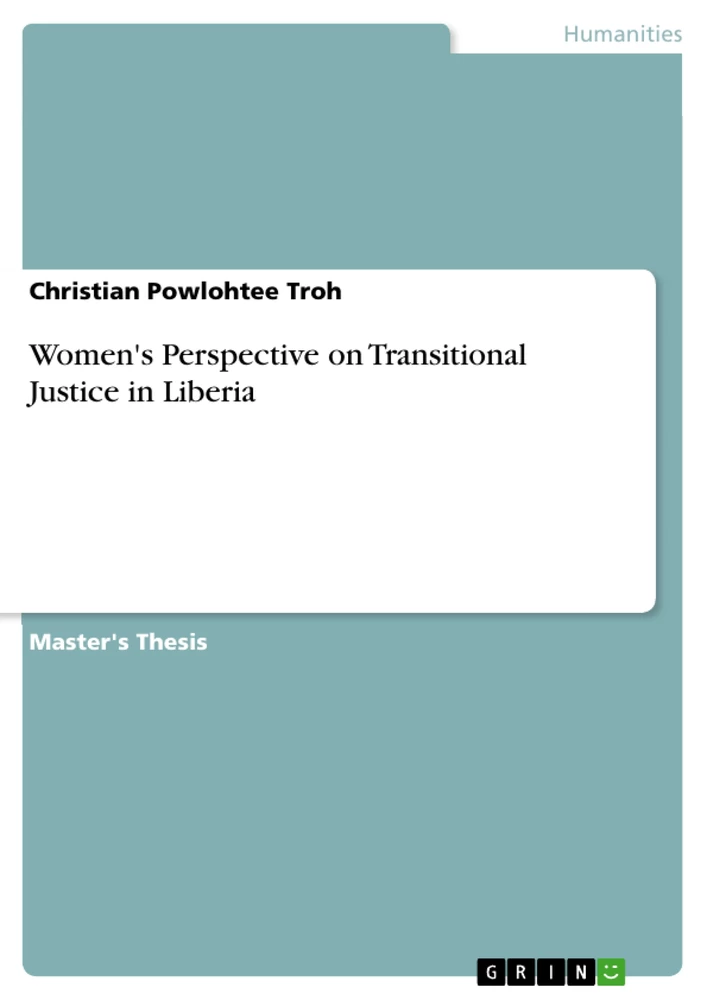
Table of Contents
Chapter I: Introduction
1.1 Motivation to do this study
1.2 Research Aim
1.3 Research Questions
Chapter II: Background
2.1 Women, war and transitional justice in Liberia
2.2 The transitional justice process and status of women in Liberia
Chapter III: Theoretical approach
3.1 Application of critical feminist theory
3.2 Understanding transitional justice
3.3 Transnational justice and the role of women
3.4 Analytical framework
Chapter IV: Research methodology
4.1 Research type and design
4.2 Data collection through interviews : Interview methods
4.3 Selection of research subjects
4.4 Ethics and positionality
4.4 Data analysis
4.5 Limitations of the study
Chapter V: Results and discussion
5.1 Impact of war on women, and how women understand the changed role of women more broadly in the country
5.2 Women's experience of the transitional justice and peacebuilding process
Chapter VI: Conclusion
Chapter VII: Future scope and prospects
Research Aim and Thematic Focus
This master's thesis investigates the role and lived experiences of women in Monrovia, Liberia, within the context of post-conflict transitional justice and peacebuilding initiatives implemented after 2003.
- The impact of war-related violence and systemic inequality on women in Liberia.
- The effectiveness and inclusivity of transitional justice mechanisms (such as the Truth and Reconciliation Commission) from a gender-sensitive perspective.
- The evolving roles of women in Liberia's post-war society, leadership, and peacebuilding efforts.
- The application of critical feminist theory to contextualize gender dynamics and political power structures.
Excerpt from the book
1. Introduction
Transitional justice (TJ) is a systematic approach to massive violations of human rights, which demand to be addressed in order to prevent new violence and give remedy to the victims (Kastner 2020). TJ is applied when there is acknowledgement that the human rights of the citizens have been violated and there is a need of restorative justice (Mieszkalski and Zyla 2021). Through this readdress it is possible to enhance the opportunities for a holistic transformation of the political system, minimise conflicts, and improve the conditions in the post-violence era by identification and elimination of the root cause of the major problems (Clark 2021 p. 232; Shaw and Waldorf 2021). In its history, Liberia has been impacted by civil war where more than two million people lost their lives (Clark 2021). This was also associated with a massive collapse of the state structure and migration and displacement of the population.
Summary of Chapters
Chapter I: Introduction: Provides an overview of the role of transitional justice in addressing human rights violations and outlines the scope of the study within Liberia.
Chapter II: Background: Offers essential historical context regarding the civil wars in Liberia and the subsequent emergence of accountability and truth-seeking mechanisms.
Chapter III: Theoretical approach: Frames the empirical research using critical feminist theory to analyze gender roles, power dynamics, and the impact of conflict on women.
Chapter IV: Research methodology: Details the qualitative research design, specifically the use of purposive sampling and semi-structured interviews with 22 participants.
Chapter V: Results and discussion: Examines women's specific experiences of war-time violence and their evolving roles in post-conflict peacebuilding processes.
Chapter VI: Conclusion: Synthesizes the core findings and addresses the shortcomings of existing transitional justice frameworks regarding gender inclusivity.
Chapter VII: Future scope and prospects: Proposes directions for future research to achieve a more robust and equitable representation for women in Liberian policy-making.
Keywords
Transitional justice, Liberia, women's empowerment, peacebuilding, critical feminist theory, civil war, restorative justice, human rights, gender violence, leadership, post-conflict reconstruction, social transformation, qualitative research, political participation.
Frequently Asked Questions
What is this research primarily about?
This thesis explores the experiences and viewpoints of women in Monrovia, Liberia, regarding how transitional justice mechanisms have addressed their specific needs and roles after the civil war.
What are the central themes of the study?
The core themes include the impact of organized violence on women, the role of women in peacebuilding, gender dynamics in the post-war economy, and the effectiveness of judicial and non-judicial processes in Liberia.
What is the primary objective of the work?
The goal is to understand how top-down transitional justice processes have impacted women's social and political standing, while identifying opportunities for more inclusive and robust reforms.
Which methodology was chosen for this study?
The author employed a qualitative research design, utilizing purposive sampling to conduct 22 semi-structured interviews with women categorized as upper middle-class in Monrovia, Liberia.
What does the main body of the work cover?
It covers the historical background of Liberia's conflicts, the theoretical application of critical feminist theory to these specific cases, and an analysis of interview data regarding women's empowerment and political representation.
How can this study be characterized by keywords?
The study is defined by terms such as transitional justice, Liberia, feminist theory, peacebuilding, and gender inequality.
How did the war affect women's social position in Liberia?
The war resulted in forced displacement, sexual violence, and systemic marginalization, forcing women into roles as central household caretakers while largely excluding them from formal post-war power structures.
What conclusion leads to the future perspective for transitional justice?
The author concludes that while initiatives like the Truth and Reconciliation Commission (TRC) provided some foundation, they largely failed to reach the disadvantaged masses, necessitating a more holistic approach that specifically integrates rural and marginalized women.
Ende der Leseprobe aus 48 Seiten
- nach oben
- Arbeit zitieren
- Christian Powlohtee Troh (Autor:in), 2022, Women's Perspective on Transitional Justice in Liberia, München, Page::Imprint:: GRINVerlagOHG, https://www.diplomarbeiten24.de/document/1442619

neugierig - aktuell - relevant
Entdecken Sie hilfreiche Tipps und Tricks rund ums Studium!

Entdecken Sie hilfreiche Tipps und Tricks rund ums Studium!
Ihre Hausarbeit / Abschlussarbeit:

- - Publikation als E-Book und Buch
- - Hohes Honorar auf die Verkäufe
- - Für Sie komplett kostenlos - mit ISBN
- - Es dauert nur 5 Minuten
- - Jede Arbeit findet Leser

- © GRIN Publishing GmbH.
- Alle Inhalte urheberrechtlich geschützt. Kopieren und verbreiten untersagt.
- info@grin.com
- AGB
- Open Publishing
Der GRIN Verlag hat sich seit 1998 auf die Veröffentlichung akademischer eBooks und Bücher spezialisiert. Der GRIN Verlag steht damit als erstes Unternehmen für User Generated Quality Content. Die Verlagsseiten GRIN.com, Hausarbeiten.de und Diplomarbeiten24 bieten für Hochschullehrer, Absolventen und Studenten die ideale Plattform, wissenschaftliche Texte wie Hausarbeiten, Referate, Bachelorarbeiten, Masterarbeiten, Diplomarbeiten, Dissertationen und wissenschaftliche Aufsätze einem breiten Publikum zu präsentieren.
Kostenfreie Veröffentlichung: Hausarbeit, Bachelorarbeit, Diplomarbeit, Dissertation, Masterarbeit, Interpretation oder Referat jetzt veröffentlichen!
Folgen Sie GRIN auf


- GRIN Verlag GmbH
-
- Nymphenburger Str. 86
- 80636
- Munich, Deutschland
- +49 89-550559-0
- +49 89-550559-10
- info@grin.com
-
