
präsentiert von

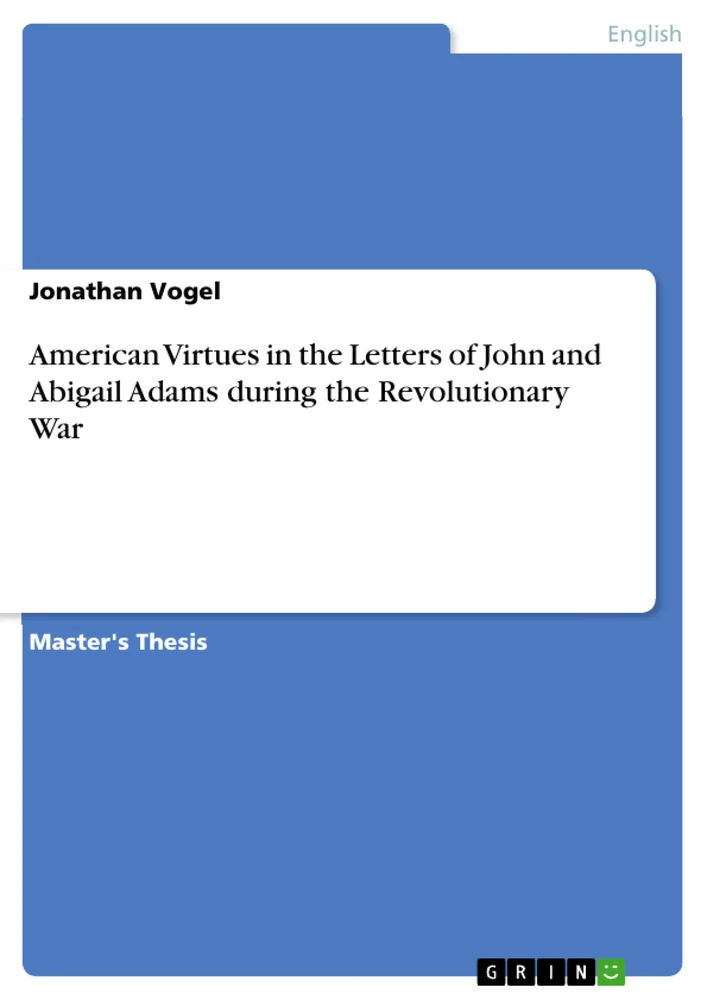
Table of Contents
1. Introduction
1.1 The Revolutionary War
1.2 Letters as a Source
1.3 American Virtues
2. Biographical Background
2.1 John Adams
2.1.1 A Son of His Time
2.1.2 A Striver for Virtue
2.1.3 A Rebel in the Making
2.1.4 A Man of Principles
2.2 Abigail Adams
2.2.1 Pride and Principles
2.2.2 Responsibility and Resolve
3 Republicanism
4 Analysis of Virtues in the Correspondence
4.1 Introduction to the Correspondence of John and Abigail Adams
4.2 Identification and Explanation of Virtues Expressed in the Letters
4.3 Patriotism, Patience and Perseverance
4.4 Treason and Treachery
4.5 Independence, Integrity and Industry
4.6 Licentiousness and Laziness
5 Influence of the Letters and “American” Virtues today
6 Conclusion
Objectives & Themes
This thesis examines the role of virtue in the correspondence of John and Abigail Adams during the American Revolutionary War. It explores how their personal moral principles were intertwined with the broader political ideals of American republicanism, providing a foundation for their service and sacrifice during a period of national upheaval.
- The biographical development of John and Abigail Adams' moral frameworks.
- The influence of Puritan heritage and Enlightenment thought on the couple's values.
- The role of letters as a medium for expressing and maintaining intimate and public virtues.
- The juxtaposition of patriotic ideals against instances of treason and personal moral failings.
Auszug aus dem Buch
4.4 Treason and Treachery
What does a patriot hate more than anything else? Treason and Treachery. If you dedicate your whole life to a cause, or more precisely to a country, then any action against the good of that country is a mortal sin. In their letters, John and Abigail express quite explicitly what they think of individuals who were once committed to patriotic virtues but have now exposed themselves as turncoats. Two examples, one from the early days of the revolution and a later one, are intended to show the extent to which the Adams saw the virtues violated by this.
One of the earliest and best-known personalities to switch sides in the War of Independence was Benjamin Church. Him being the grandson of a Mayflower descendent and raised in Boston as well as graduating one year before John Adams from Harvard University (cf. Kiracofe 446), could lead to the assumption that both enjoyed a similar upbringing and accordingly held comparable values. In the beginning of the Revolution, Samuel Adams, a hot-blooded patriot and John’s second cousin, saw much potential in Church and “recruited him for the patriot cause and favored him as political protégé” (Kiracofe 448). John once mentioned that he himself had benefited from the doctor’s skills when his eyes were in bad condition (cf. 71). In July 1775, Benjamin Church even became the first surgeon general of the Continental Army (cf. Dupuy & Hammerman 69). At the same time, although “deeply involved in the patriotic cause” (Kiracofe 449), he wrote a coded letter to a British officer in Boston, which ended up in the hands of George Washington some time later.
Summary of Chapters
1. Introduction: Presents the letters as a complex literary corpus and contextualizes the Revolutionary War period as the backdrop for the study.
2. Biographical Background: Explores the lives and moral upbringing of John and Abigail Adams, tracing the roots of their principles.
3. Republicanism: Defines the political-ideological concept of republican virtue that guided the Adams couple and their contemporaries.
4. Analysis of Virtues in the Correspondence: Investigates how specific virtues such as patriotism, integrity, and industry were expressed and tested within the letters through case studies of war experiences.
5. Influence of the Letters and “American” Virtues today: Discusses the lasting legacy of the Adams' value system and its relevance to contemporary American political life.
6. Conclusion: Synthesizes findings on how the Adams' principles shaped their worldview and served as a moral foundation during the challenges of the American Revolution.
Keywords
John Adams, Abigail Adams, American Revolution, Virtue, Republicanism, Correspondence, Patriotism, Independence, Integrity, Puritanism, Enlightenment, Treason, Fiduciary, Morality, American History
Frequently Asked Questions
What is the primary focus of this work?
This thesis focuses on the significance of "virtue" as both a personal and public standard for John and Abigail Adams within the context of the American Revolutionary War.
What are the central themes discussed in the thesis?
The central themes include the influence of religious and Enlightenment history on the Adamses, the role of correspondence as an intimate medium of communication, and the contrast between virtuous patriotism and perceived moral failures like treason and licentiousness.
What is the core research goal?
The goal is to explore how the virtues expressed by the couple in their letters helped them navigate the crises of the revolution and how these values defined their perspective on a nascent America.
Which methodology is employed in this research?
The thesis utilizes a qualitative analysis of primary source material, specifically the collected letters of John and Abigail Adams, contrasted with contemporary biographical and historical scholarship.
What topics are covered in the main body?
The main body treats the biographical history of the couple, the theory of republicanism, the practical application of virtues such as patriotism and perseverance in wartime, and critical case studies of figures like Benjamin Church and Benedict Arnold.
How are the key terms characterized?
Key terms center around republican ideals, personal integrity, the "Puritan-Enlightenment" synthesis in American thought, and the concept of "virtuous" leadership as a foundational element of the nation.
How does the author evaluate Benjamin Franklin’s role?
Benjamin Franklin is evaluated critically by the author; John Adams perceived Franklin's behavior as "licentious" and "lazy," viewing it as a harmful contradiction to the austere and virtuous path required for the survival of the American nation.
Why are Benjamin Church and Benedict Arnold discussed?
They are discussed as "negative examples" used by the Adamses to reinforce the necessity of virtue; their betrayal is cited as evidence that without steadfast integrity, even talented leaders can pose a moral and existential threat to the American cause.
Ende der Leseprobe aus 57 Seiten
- nach oben
- Arbeit zitieren
- Jonathan Vogel (Autor:in), 2023, American Virtues in the Letters of John and Abigail Adams during the Revolutionary War, München, Page::Imprint:: GRINVerlagOHG, https://www.diplomarbeiten24.de/document/1459253

neugierig - aktuell - relevant
Entdecken Sie hilfreiche Tipps und Tricks rund ums Studium!

Entdecken Sie hilfreiche Tipps und Tricks rund ums Studium!
Ihre Hausarbeit / Abschlussarbeit:

- - Publikation als E-Book und Buch
- - Hohes Honorar auf die Verkäufe
- - Für Sie komplett kostenlos - mit ISBN
- - Es dauert nur 5 Minuten
- - Jede Arbeit findet Leser

- © GRIN Publishing GmbH.
- Alle Inhalte urheberrechtlich geschützt. Kopieren und verbreiten untersagt.
- info@grin.com
- AGB
- Open Publishing
Der GRIN Verlag hat sich seit 1998 auf die Veröffentlichung akademischer eBooks und Bücher spezialisiert. Der GRIN Verlag steht damit als erstes Unternehmen für User Generated Quality Content. Die Verlagsseiten GRIN.com, Hausarbeiten.de und Diplomarbeiten24 bieten für Hochschullehrer, Absolventen und Studenten die ideale Plattform, wissenschaftliche Texte wie Hausarbeiten, Referate, Bachelorarbeiten, Masterarbeiten, Diplomarbeiten, Dissertationen und wissenschaftliche Aufsätze einem breiten Publikum zu präsentieren.
Kostenfreie Veröffentlichung: Hausarbeit, Bachelorarbeit, Diplomarbeit, Dissertation, Masterarbeit, Interpretation oder Referat jetzt veröffentlichen!
Folgen Sie GRIN auf


- GRIN Verlag GmbH
-
- Nymphenburger Str. 86
- 80636
- Munich, Deutschland
- +49 89-550559-0
- +49 89-550559-10
- info@grin.com
-
