
präsentiert von

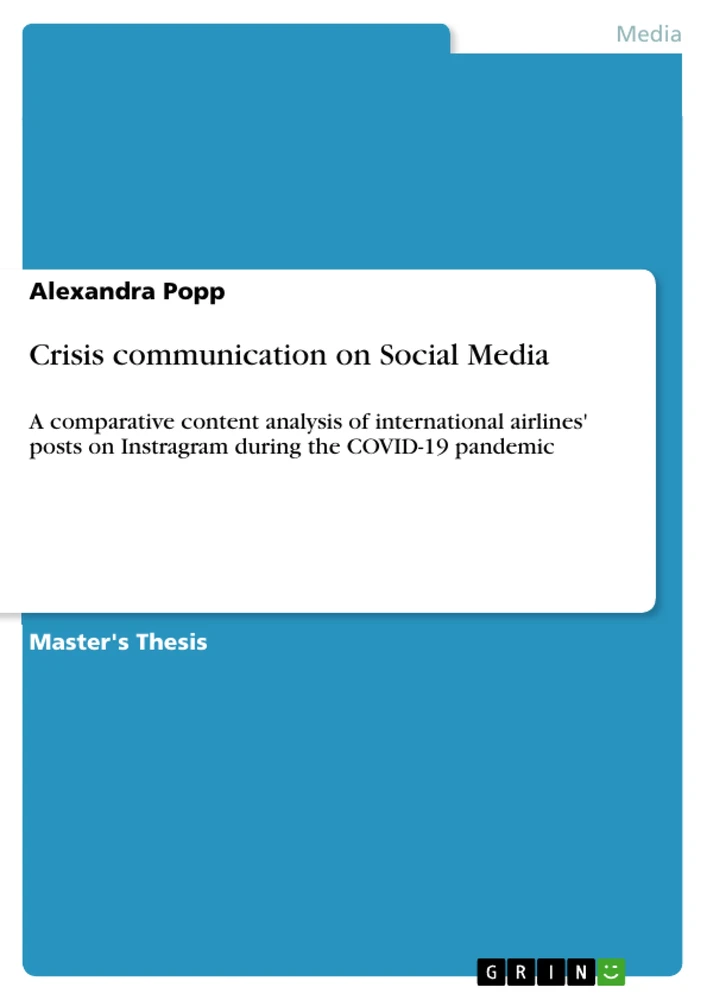
Table of Contents
1 Introduction
1.1 Research problem
1.2 Aim and structure of the study
2 Theoretical background and literature review
2.1 Crisis, crisis management and crisis communication
2.1.1 Definition organizational crisis
2.1.2 Crisis typologies
2.1.3 Crisis phases
2.1.4 Crisis management
2.1.5 Crisis communication
2.1.6 Crisis communication theories and strategies
2.2 Social media and the social network Instagram
2.2.1 Definition social media
2.2.2 Goals and success factors of social media for organizations
2.2.3 Airlines and the use of social media
2.2.4 Instagram as a corporate communication channel
2.3 Social media and crisis communication
2.3.1 Opportunities and risks of social media in crisis communication
2.3.2 Elements of successful crisis communication on social media
2.4 Crisis communication in the airline industry
2.4.1 Particularities
2.4.2 Best and worst practice examples
2.5 The COVID-19 pandemic and the aviation industry
2.5.1 The difference between the COVID-19 pandemic and other crises
2.5.2 The impact of COVID-19 on the aviation industry
3 Empirical study – the content analysis
3.1 State of the art and research gap
3.2 Research question and hypotheses
3.3 Methodology and approach
3.4 Pre- and re-test
3.5 Data sample and analysis process
4 Results of the content analysis and discussion
4.1 Crisis response strategies used by the airlines
4.2 Communication strategy by posting frequencies
4.3 Communication strategy by content type
4.4 Communication strategy by message type
4.4.1 Informative, emotional, promotional, or entertaining
4.4.2 Reference to COVID-19 or no reference
5 Conclusion
5.1 Implications and recommendations for the airline industry
5.2 Limitations and further research
Research Objectives and Themes
This master's thesis examines the crisis communication of international airlines on Instagram during the COVID-19 pandemic. The primary aim is to analyze how airlines used social media to effectively engage with their stakeholders during this global health crisis, focusing on specific communication strategies, publication frequencies, and content types.
- Analysis of crisis response strategies according to Coombs' Situational Crisis Communication Theory (SCCT).
- Evaluation of the impact of posting frequencies on audience popularity and engagement.
- Comparison of the effectiveness of different content types (image vs. video/animation).
- Assessment of message types (informative, emotional, promotional, or entertaining) and their influence on interactions.
- Examination of the efficacy of referencing COVID-19 versus not referencing the pandemic in social media posts.
Excerpt from the Book
2.5.2 The impact of COVID-19 on the aviation industry
The first outbreak of COVID-19, a novel respiratory coronavirus, originated in Wuhan, China in December 2019, creating new challenges for the whole world, and specifically air traffic. The virus is highly infectious, can spread to animals as well as humans, and is transmitted through droplets. With the disease expanding across countries and continents, the WHO declared the COVID-19 virus a pandemic on March 11, 2020. Since people from different nations come together very close during air travel and at airports, there is an increased risk of infection and further spread. Due to this reason, many countries have established strict rules to protect their citizens, e.g. mandatory masking, social distancing, travel restrictions, quarantines, and border closures to prevent further infections and to maintain the effectiveness of national healthcare systems. All of the 217 global destinations had introduced restrictions, with 72 percent having implemented complete closures of their borders to international tourists as of April 2020. This, combined with mandatory reduction of available seats on aircrafts, mandatory quarantines and fear among travelers, has caused a significant decrease in passenger traffic from mid-March 2020, when lockdowns and border closures started to be the dominant policy response across Europe and America.
In the early stages of the pandemic, airlines had to reduce operations to cut costs and protect their interests, resulting in permanent fleet retirements, especially of the large wide-body long-haul aircrafts such es the Airbus A380, in the reduction of network coverage and staff numbers (at airlines, airports, manufacturers, and air traffic management) or in airlines seeking financial support from governments. Overall, there was a reduction of 60 percent in air passengers for international and domestic destinations in 2020 compared to 2019. International travel has mostly stayed unchanged, whereas domestic travel has slowly recovered.
Summary of Chapters
1 Introduction: Provides an overview of the research problem regarding airline crisis communication during the pandemic and establishes the study's aim.
2 Theoretical background and literature review: Establishes foundations for crisis management and communication, social media usage, and the unique situation of the aviation industry.
3 Empirical study – the content analysis: Explains the methodology used for the content analysis, including the research design, data sample selection, and hypotheses formulation.
4 Results of the content analysis and discussion: Presents the empirical findings and analyzes airline performance regarding strategies, frequencies, content types, and message impacts.
5 Conclusion: Summarizes the study’s findings, offers practical implications and recommendations for the airline industry, and suggests areas for future research.
Keywords
Crisis communication, COVID-19, Aviation industry, Social media, Instagram, Content analysis, Situational Crisis Communication Theory, Stakeholder engagement, Crisis management, Airline marketing, Digital communication, Content strategy.
Frequently Asked Questions
What is the core focus of this research?
The research focuses on analyzing the effectiveness of international airlines' crisis communication on Instagram during the height of the COVID-19 pandemic (March to May 2020).
Which specific airlines were examined?
The study analyzed six major full-service carriers: KLM Royal Dutch Airlines, Swiss International Air Lines, Delta Air Lines, Air Canada, Singapore Airlines, and Cathay Pacific.
What is the central research question?
The study explores how international airlines can use social media for effective crisis communication during global health crises like the COVID-19 pandemic.
Which scientific framework is applied to evaluate communication?
The research primarily utilizes Timothy Coombs’ Situational Crisis Communication Theory (SCCT) as the analytical framework for categorizing and understanding crisis response strategies.
What kind of content does the empirical section cover?
The empirical section covers findings related to crisis response strategies, posting frequencies, content formats (image vs. video), and message types (emotional, informative, etc.) based on a sample of 156 Instagram posts.
What are the characterizing keywords for this study?
Key terms include crisis communication, COVID-19, aviation industry, social media, Instagram, content analysis, and stakeholder engagement.
Did the study find that video content is more effective on Instagram?
Interestingly, the study found that content containing pictures was generally more effective than video or animation content in terms of popularity and engagement during the studied period.
What was the airlines' primary response strategy?
The research identified that airlines predominantly used secondary crisis strategies, specifically ingratiation (bolstering) from the SCCT framework, to praise stakeholders and maintain community spirit during the crisis.
Ende der Leseprobe aus 115 Seiten
- nach oben
- Arbeit zitieren
- Alexandra Popp (Autor:in), 2023, Crisis communication on Social Media, München, Page::Imprint:: GRINVerlagOHG, https://www.diplomarbeiten24.de/document/1488593

neugierig - aktuell - relevant
Entdecken Sie hilfreiche Tipps und Tricks rund ums Studium!

Entdecken Sie hilfreiche Tipps und Tricks rund ums Studium!
Ihre Hausarbeit / Abschlussarbeit:

- - Publikation als E-Book und Buch
- - Hohes Honorar auf die Verkäufe
- - Für Sie komplett kostenlos - mit ISBN
- - Es dauert nur 5 Minuten
- - Jede Arbeit findet Leser

- © GRIN Publishing GmbH.
- Alle Inhalte urheberrechtlich geschützt. Kopieren und verbreiten untersagt.
- info@grin.com
- AGB
- Open Publishing
Der GRIN Verlag hat sich seit 1998 auf die Veröffentlichung akademischer eBooks und Bücher spezialisiert. Der GRIN Verlag steht damit als erstes Unternehmen für User Generated Quality Content. Die Verlagsseiten GRIN.com, Hausarbeiten.de und Diplomarbeiten24 bieten für Hochschullehrer, Absolventen und Studenten die ideale Plattform, wissenschaftliche Texte wie Hausarbeiten, Referate, Bachelorarbeiten, Masterarbeiten, Diplomarbeiten, Dissertationen und wissenschaftliche Aufsätze einem breiten Publikum zu präsentieren.
Kostenfreie Veröffentlichung: Hausarbeit, Bachelorarbeit, Diplomarbeit, Dissertation, Masterarbeit, Interpretation oder Referat jetzt veröffentlichen!
Folgen Sie GRIN auf


- GRIN Verlag GmbH
-
- Nymphenburger Str. 86
- 80636
- Munich, Deutschland
- +49 89-550559-0
- +49 89-550559-10
- info@grin.com
-
