
präsentiert von

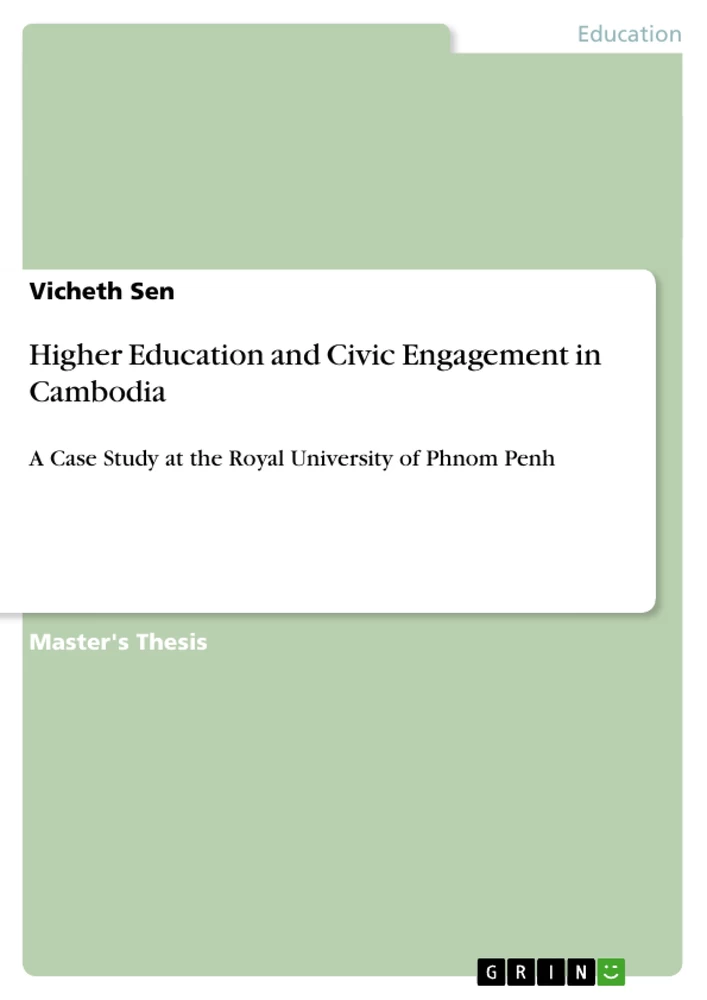
Table of Contents
CHAPTER ONE: INTRODUCTION
1.1 HISTORICAL BACKGROUND
1.2 PROBLEM STATEMENT
1.3 RESEARCH OBJECTIVES
1.4 RATIONALES FOR AND SIGNIFICANCE OF THE STUDY
1.5 SCOPE AND LIMITATIONS OF THE STUDY
1.6 FRAMEWORK OF THE PAPER
CHAPTER TWO: LITERATURE REVIEW
2.1 DEFINITIONS OF KEY TERMS
2.1.1 WHAT IS “HIGHER EDUCATION”?
2.1.2 HOW IS “CIVIC ENGAGEMENT” DEFINED?
2.1.3 WHAT IS “VOLUNTEERISM”?
2.2 VOLUNTEERISM IN CAMBODIA
2.3 HIGHER EDUCATION AND CIVIC ENGAGEMENT
2.4 INDICATORS OF CIVIC ENGAGEMENT USED IN THE STUDY
CHAPTER THREE: RESEARCH METHODOLOGY
3.1 SAMPLING DESIGN
3.2 SAMPLE SIZE
3.3 DATA COLLECTION
3.3.1 QUESTIONNAIRE
3.3.2 SECONDARY DATA
3.4 ETHICAL ISSUES
CHAPTER FOUR: THE CASE STUDY
4.1 BACKGROUND OF THE ROYAL UNIVERSITY OF PHNOM PENH
4.2 VISION AND MISSION
4.3 FACULTIES
4.3.1 FACULTY OF SCIENCE
4.3.2 FACULTY OF SOCIAL SCIENCES AND HUMANITIES
4.3.3 INSTITUTE OF FOREIGN LANGUAGES (IFL)
4.4 SUPPORT SERVICES AND RECREATION
4.4.1 STUDENTS’ ASSOCIATION
4.4.2 CAREERS ADVISING OFFICE
4.4.3 ACADEMIC ADVISING CENTER
4.4.4 COUNSELING SERVICE
4.4.5 MEDICAL CENTER
4.4.6 IFL DEBATE CLUB
4.4.7 IFL DANCE CLUB
4.4.8 SPORTING ACTIVITIES
4.5 LINKAGES WITH OVERSEAS UNIVERSITIES AND INTERNATIONAL ORGANIZATIONS
CHAPTER FIVE: RESULTS AND DISCUSSION
5.1 RESULTS
5.1.1 GENDER
5.1.2 AGE
5.1.3 FACULTY
5.1.4 CIVIC ACTIVITIES
5.1.4.1 PERCEPTIONS ABOUT CIVIC ACTIVITIES
5.1.5 ELECTORAL ACTIVITIES
5.1.6 ACTIVITIES FOR POLITICAL VOICE
5.1.6.1 ATTENTIVENESS TO POLITICS/GOVERNMENT
5.2 DISCUSSION
5.2.1 CIVIC ACTIVITIES
5.2.1.1 COMMUNITY PROBLEM SOLVING
5.2.1.2 VOLUNTEERISM
5.2.2 ELECTORAL ACTIVITIES
5.2.2.1 VOTING IN THE COMMUNE OR NATIONAL ELECTIONS
5.2.2.2 OTHER ELECTORAL ACTIVITIES
5.2.3 ACTIVITIES FOR POLITICAL VOICE
5.2.3.1 THE “ACTIVE” ACTIVITIES
5.2.3.2 THE “PASSIVE” ACTIVITIES
5.2.4 THE COLLAPSE OF TWO FUNDAMENTAL SOCIAL INSTITUTIONS?
5.2.4.1 THE FAMILY
5.2.4.2 THE EDUCATION
CHAPTER SIX: CONCLUSION AND RECOMMENDATIONS
6.1 SUMMARY AND KEY FINDINGS
6.1.1 SUMMARY
6.1.2 KEY FINDINGS
6.1.2.1 EGOISM
6.1.2.2 WEAKENING ROLES OF TWO MAJOR SOCIAL INSTITUTIONS—FAMILY AND EDUCATION
6.1.2.3 “PERCEPTION” VERSUS “ACTION”
6.1.2.4 PLAYING ON THE SAFE SIDE
6.2 RECOMMENDATIONS
6.3 SUGGESTIONS FOR FURTHER RESEARCH
6.4 CONCLUDING REMARKS
Research Objectives and Themes
This study aims to evaluate the levels of civic engagement among senior students at the Royal University of Phnom Penh and to determine whether higher education significantly influences the fostering of these civic activities. The core objective is to understand how Cambodian university students participate in civic life, what motivates them, and what barriers exist in a transitional democratic context.
- Levels and aspects of civic engagement among university students
- Role of higher education in fostering civic involvement
- Categorization of civic participation (Civic, Electoral, Political Voice)
- Socio-political context of student engagement in Cambodia
- Motivations for volunteerism and barriers to political participation
Excerpt from the Book
1.1 Historical background
Although not much work has been done on civic engagement, it is not a new concept in Cambodia. Different forms of civic engagement have been in existence and practiced in this country for decades. The levels and forms of civic engagement are varied in different regimes. The following is a brief history of civic engagement in Cambodia starting from the Sihanouk Sangkum Reastr Niyum Regime of the 1950s until the current Cambodian government.
During the Sihanouk Sangkum Reastr Niyum period (1953-1970), civic engagement was present in Cambodia, although it took varied forms. For instance, people participated in national elections, which is a form of civic participation. Civic activism was also reflected in the ways that students took part in different demonstrations and the establishment of student associations (Chandler, 1993). As Bit (1991) stated, Prince Sihanouk “organized associations of special categories, such as youth, women, men and school children.” However, these organizations in existence during the time were only established to serve “the political party’s goals and were supervised closely by cadres” (Bit, 1991, p. 49). This may, therefore, not show that the people were aware of their civic duties and gathered together for a common purpose.
Summary of Chapters
CHAPTER ONE: INTRODUCTION: This chapter establishes the historical context of civic engagement in Cambodia and outlines the problem statement, research objectives, and the scope of the study.
CHAPTER TWO: LITERATURE REVIEW: This chapter defines core terms like higher education and civic engagement, and reviews existing literature on volunteerism and the correlation between higher education and civic participation.
CHAPTER THREE: RESEARCH METHODOLOGY: This section details the research design, including sampling methods and data collection via questionnaires to measure civic involvement.
CHAPTER FOUR: THE CASE STUDY: This chapter provides a background of the Royal University of Phnom Penh, its mission, faculties, and the support services available to students.
CHAPTER FIVE: RESULTS AND DISCUSSION: This chapter presents the empirical findings from the survey and analyzes the respondents' engagement levels across three main categories, while discussing social barriers.
CHAPTER SIX: CONCLUSION AND RECOMMENDATIONS: The final chapter summarizes the research findings, notes the gap between perception and action among students, and provides recommendations for improving civic education.
Keywords
Higher Education, Civic Engagement, Cambodia, Royal University of Phnom Penh, Volunteerism, Student Activism, Democracy, Political Participation, Electoral Activities, Socio-Political Development, Citizenship Education, Community Service, Khmer Culture, Educational Reform, Tertiary Education.
Frequently Asked Questions
What is the primary focus of this research paper?
This paper investigates the levels and aspects of civic engagement among senior students at the Royal University of Phnom Penh and explores whether higher education plays a role in fostering such engagement.
What categories are used to measure civic engagement?
The study utilizes three main categories: civic activities (e.g., volunteering), electoral activities (e.g., voting), and activities for expressing political voice.
What was the primary research method used?
The researcher employed a survey method using questionnaires distributed to 200 senior undergraduate students at the Royal University of Phnom Penh.
What is the core finding regarding the impact of higher education?
The findings indicate that higher education and family, as fundamental institutions, appear to have no significant role in building civically engaged citizens, suggesting a discrepancy between curriculum goals and practical outcomes.
What role does the historical context play in the results?
The study concludes that Cambodia’s history, including various regimes and civil war, significantly shaped current social attitudes, influencing why students are often hesitant to engage in active political participation.
Which keywords best characterize this work?
Key terms include Higher Education, Civic Engagement, Cambodia, Volunteerism, Political Participation, and Democratic Development.
How does the author define "volunteerism" in the Cambodian context?
The author notes that while Western views emphasize non-paid work, in Cambodia, volunteerism is often defined as an effort that can be "at times paid," focusing on gaining experience and helping the community.
What specific institutional barrier do students face regarding political activism?
Students face a strong social hierarchy and a university environment where political activities are often strictly prohibited, leading to a "playing on the safe side" mentality.
Ende der Leseprobe aus 91 Seiten
- nach oben
- Arbeit zitieren
- Vicheth Sen (Autor:in), 2008, Higher Education and Civic Engagement in Cambodia, München, Page::Imprint:: GRINVerlagOHG, https://www.diplomarbeiten24.de/document/149269

neugierig - aktuell - relevant
Entdecken Sie hilfreiche Tipps und Tricks rund ums Studium!

Entdecken Sie hilfreiche Tipps und Tricks rund ums Studium!
Ihre Hausarbeit / Abschlussarbeit:

- - Publikation als E-Book und Buch
- - Hohes Honorar auf die Verkäufe
- - Für Sie komplett kostenlos - mit ISBN
- - Es dauert nur 5 Minuten
- - Jede Arbeit findet Leser

- © GRIN Publishing GmbH.
- Alle Inhalte urheberrechtlich geschützt. Kopieren und verbreiten untersagt.
- info@grin.com
- AGB
- Open Publishing
Der GRIN Verlag hat sich seit 1998 auf die Veröffentlichung akademischer eBooks und Bücher spezialisiert. Der GRIN Verlag steht damit als erstes Unternehmen für User Generated Quality Content. Die Verlagsseiten GRIN.com, Hausarbeiten.de und Diplomarbeiten24 bieten für Hochschullehrer, Absolventen und Studenten die ideale Plattform, wissenschaftliche Texte wie Hausarbeiten, Referate, Bachelorarbeiten, Masterarbeiten, Diplomarbeiten, Dissertationen und wissenschaftliche Aufsätze einem breiten Publikum zu präsentieren.
Kostenfreie Veröffentlichung: Hausarbeit, Bachelorarbeit, Diplomarbeit, Dissertation, Masterarbeit, Interpretation oder Referat jetzt veröffentlichen!
Folgen Sie GRIN auf


- GRIN Verlag GmbH
-
- Nymphenburger Str. 86
- 80636
- Munich, Deutschland
- +49 89-550559-0
- +49 89-550559-10
- info@grin.com
-
