
präsentiert von

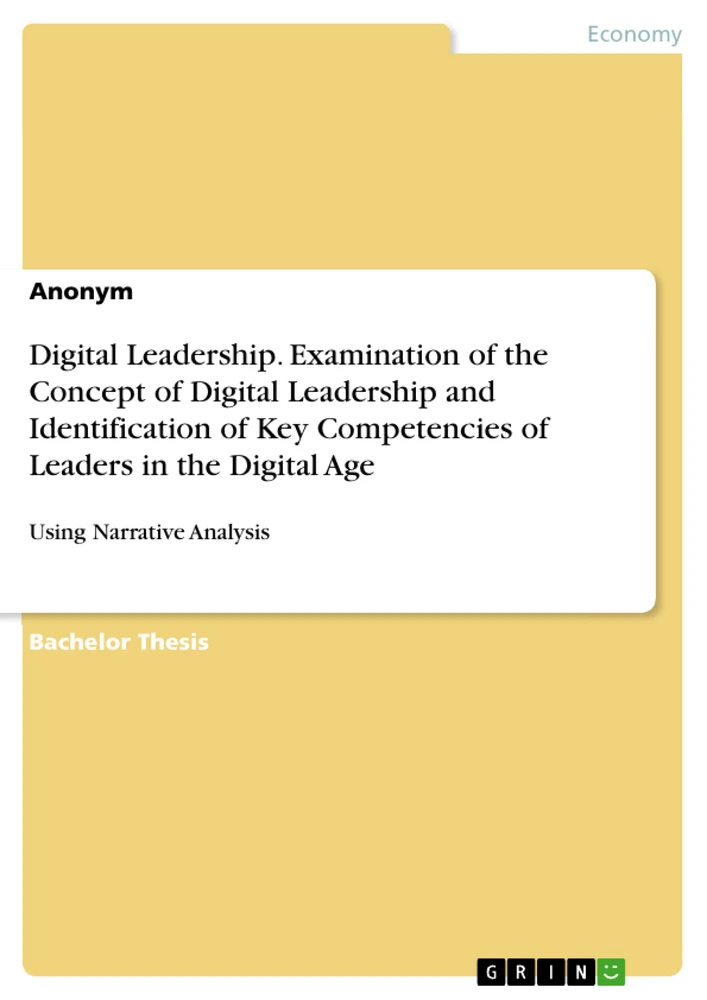
Table of Contents
1 INTRODUCTION
2 LITERATURE REVIEW
2.1 Definition of Leadership
2.2 Definition of Digital Leadership
2.3 Competencies of Digital Leaders
3 METHODOLOGY
3.1 Identification of the Research Question
3.2 Methodological Approach
3.3 Data Selection and Collection
3.4 Data Analysis
4 RESEARCH FINDINGS
4.1 Attitude Towards Leadership
4.2 Understanding of Digital Leadership
4.3 Determination of Competencies of Leaders in the Digital Age
5 CONCLUSION
6 REFERENCES
7 APPENDICES
7.1 Interview Guide
Research Objectives and Topics
The primary objective of this thesis is to examine the concept of digital leadership, explore its practical significance, and identify the essential competencies that leaders require to navigate the challenges of the digital age effectively.
- Analysis of traditional vs. digital leadership definitions.
- Investigation of required leadership competencies in a VUCA environment.
- Empirical study through semi-structured expert interviews.
- Identification of the gap between leadership theory and practical application.
- Exploration of the "digital mindset" and its role in organizational transformation.
Excerpt from the Book
4.1 Attitude Towards Leadership
Following the literature review, most leaders indicated that leadership for them means giving direction to their employees, including setting measurable goals and objectives and communicating a clear mission and vision that employees believe in and want to follow. Herein, L7 contrasted the leadership of employees with a football match:
DE: Ich versuche es immer mit Sport zu vergleichen. Wenn beim Fußball die linke Seite eben schlechter ist, muss ich halt schauen, dass die Leute da aushelfen. Und genauso ist es in einem Team; man führt ähnlich. Jeder hat seine Stärken und Schwächen; man muss diese ausbalancieren und die verschiedene Charaktere auf einen Nenner bringen und in eine Richtung lenken.
EN: I always try to compare it with sports. If the left wing is worse in football, I have to ensure people help out there. And it is the same in a team; you lead in a similar way. Everyone has their strengths and weaknesses; you have to balance them, bring the different characters together, and steer them in one direction.
The metaphor used by L7 to compare leadership to a football match illustrates the paramount significance of understanding team dynamics and using this knowledge to develop an effective strategy to achieve the same goal. Moreover, it was strongly accentuated that a leader must create the right environment for teams to collaborate to achieve the common goal and remove as many obstacles as possible. Accordingly, it is a leader's responsibility to enable each team member to use their talents to contribute to the overall goal and ensure that everyone has the resources and access to certain things needed to accomplish the desired objective.
Summary of Chapters
1 INTRODUCTION: This chapter highlights the impact of digital transformation on business environments and clarifies the necessity for leaders to adapt to these changes.
2 LITERATURE REVIEW: This chapter reviews academic definitions of leadership and current research on digital leadership, identifying key competencies and the theoretical landscape.
3 METHODOLOGY: This chapter details the qualitative research design, justifying the use of semi-structured interviews and narrative analysis to investigate the research question.
4 RESEARCH FINDINGS: This chapter presents and interprets the empirical data gathered from expert interviews, focusing on leadership attitudes and the actual understanding of digital leadership.
5 CONCLUSION: This chapter synthesizes the study's results, discusses limitations, and offers recommendations for future research and practice regarding digital leadership.
6 REFERENCES: This chapter lists all academic sources and literature used in the composition of this thesis.
7 APPENDICES: This chapter provides supplementary materials, specifically the interview guide used for the expert inquiries.
Keywords
Digital Leadership, Leadership Competencies, Digital Transformation, VUCA, Narrative Analysis, Digital Mindset, Organizational Change, Management, Human Resources, Strategy, Employee Engagement, Technological Change, Communication, Ambidexterity.
Frequently Asked Questions
What is the core focus of this thesis?
This thesis examines the evolving concept of digital leadership and seeks to identify the key competencies required for leaders to successfully guide organizations through digital transformation.
What are the main thematic fields covered?
The work covers leadership theory, the definition of digital leadership, the identification of necessary skill sets in the digital age, and the role of leadership in navigating organizational change.
What is the primary research goal?
The main goal is to explore how leaders perceive the concept of digital leadership in practice and to clarify which competencies are currently considered most essential.
Which scientific methodology is applied?
A qualitative research approach is used, relying on a literature review and semi-structured expert interviews conducted with eight leaders, followed by narrative analysis of the interview data.
What subjects are addressed in the main body of the work?
The main body treats theoretical frameworks of leadership, analyzes expert perspectives on current leadership demands, and investigates the gap between academic definitions and practical execution.
Which keywords best characterize this research?
Key terms include Digital Leadership, Competencies, Digital Mindset, VUCA environment, and organizational transformation.
Does the study confirm the need for a new 'Digital Leadership' style?
The findings suggest that most interviewees do not see digital leadership as a fundamentally new style, but rather as modern leadership that adapts to current technological and organizational requirements.
What role does the 'Digital Mindset' play?
According to the researcher and the interviewees, the digital mindset serves as a starting point for transformation, encompassing openness towards new technologies, continuous learning, and adaptability.
Ende der Leseprobe aus 39 Seiten
- nach oben
- Arbeit zitieren
- Anonym (Autor:in), 2023, Digital Leadership. Examination of the Concept of Digital Leadership and Identification of Key Competencies of Leaders in the Digital Age, München, Page::Imprint:: GRINVerlagOHG, https://www.diplomarbeiten24.de/document/1504201

neugierig - aktuell - relevant
Entdecken Sie hilfreiche Tipps und Tricks rund ums Studium!

Entdecken Sie hilfreiche Tipps und Tricks rund ums Studium!
Ihre Hausarbeit / Abschlussarbeit:

- - Publikation als E-Book und Buch
- - Hohes Honorar auf die Verkäufe
- - Für Sie komplett kostenlos - mit ISBN
- - Es dauert nur 5 Minuten
- - Jede Arbeit findet Leser

- © GRIN Publishing GmbH.
- Alle Inhalte urheberrechtlich geschützt. Kopieren und verbreiten untersagt.
- info@grin.com
- AGB
- Open Publishing
Der GRIN Verlag hat sich seit 1998 auf die Veröffentlichung akademischer eBooks und Bücher spezialisiert. Der GRIN Verlag steht damit als erstes Unternehmen für User Generated Quality Content. Die Verlagsseiten GRIN.com, Hausarbeiten.de und Diplomarbeiten24 bieten für Hochschullehrer, Absolventen und Studenten die ideale Plattform, wissenschaftliche Texte wie Hausarbeiten, Referate, Bachelorarbeiten, Masterarbeiten, Diplomarbeiten, Dissertationen und wissenschaftliche Aufsätze einem breiten Publikum zu präsentieren.
Kostenfreie Veröffentlichung: Hausarbeit, Bachelorarbeit, Diplomarbeit, Dissertation, Masterarbeit, Interpretation oder Referat jetzt veröffentlichen!
Folgen Sie GRIN auf


- GRIN Verlag GmbH
-
- Nymphenburger Str. 86
- 80636
- Munich, Deutschland
- +49 89-550559-0
- +49 89-550559-10
- info@grin.com
-
