
präsentiert von

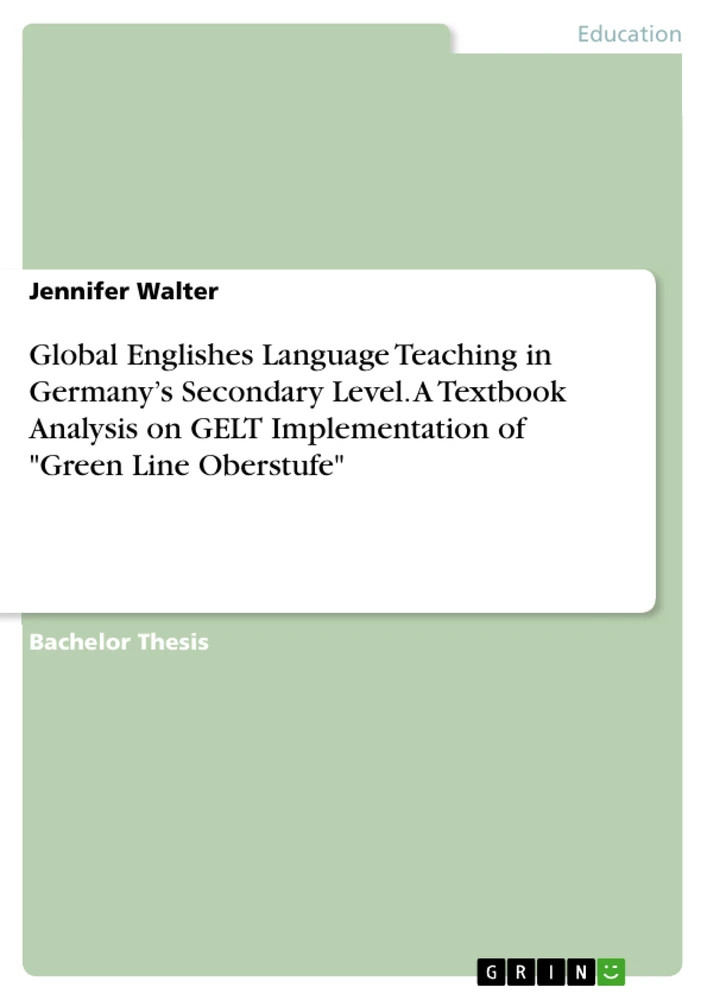
Table of Contents
1. Introduction
2. The Inclusive Paradigm: Global Englishes Language Teaching
2.1. The Native Speaker Episteme and Ownership of English
2.2. World Englishes
2.3. English as a Lingua Franca
2.4. (Teaching) English as an International Language
2.5. An Umbrella Approach
3. The Global Approach: Teaching English Revised
3.1. GELT in the German Context
3.2. GELT on the Classroom Level
4. The Role of Textbooks in the Digital Transformation
5. Methodological Approach and Selection of Teaching Material
5.1. Sample
5.2. Instrument
5.3. Procedure
6. Results
7. Discussion
7.1. Diversity
7.2. Cultures
7.3. Language Habitus
7.4. Ownership of the English Language
7.5. Contexts of English Usage
7.6. Language Awareness
7.7. Competences Orientation
8. Limits and Challenges
9. Conclusion
Research Objectives & Key Themes
The primary aim of this thesis is to investigate how Global Englishes Language Teaching (GELT) principles are implemented within the German upper-secondary school English textbook Green Line Oberstufe. The study addresses the research question of how contemporary sociolinguistic dynamics, specifically the inclusive paradigm of GELT, are reflected and realized in the selected teaching material.
- Theoretical foundation of Global Englishes, English as a Lingua Franca, and English as an International Language.
- Evaluation of the inclusive GELT paradigm and its "epistemic break" in English Language Teaching.
- Analysis of the textbook Green Line Oberstufe using a Qualitative Content Analysis (QCA) approach.
- Assessment of how Green Line Oberstufe incorporates diverse linguistic varieties and cultural perspectives.
- Reflection on the role of digital transformation and traditional textbooks in modern English classrooms.
Excerpt from the Book
1. Introduction
There is no doubt that English serves as the Lingua Franca in today’s globalized world. English has achieved the status of a global language due to the dominant position of its speakers. Approximately 2 billion people use English daily, as they connect in different domains within and across national borders. Only four percent of these conversations involve native speakers of English, and the number of non-native speakers of English worldwide exceeds that of native speakers. With the declining number of the native speaker on the global stage, Global Englishes Language Teaching (GELT) redefines the target interlocutor of the future as a non-native speaker. Consequently, English must no longer be learned solely for communication with native speakers, but for interactions with users from diverse, cultural backgrounds who use English in addition to their own, linguistic repertoire. Thus, English should be understood as a creative tool while “constantly in [...] flux”.
This shift challenges fundamental assumptions of English Language Teaching and the way English must be used today. GELT scholars advocate for a liberation from norm-oriented English language learning and the question the ownership of English. GELT was introduced as an “epistemic break” to answer these changes emerging in the sociolinguistic landscape of English. It is a growing research corpus with the aim to connect scholarship of the interrelated fields of World Englishes, English as a Lingua Franca and English as an International Language, each exploring the use of English in todays globalized world. Together, they form the inclusive paradigm of Global Englishes Language Teaching.
Summary of Chapters
1. Introduction: Presents the global status of English as a lingua franca and introduces the inclusive paradigm of Global Englishes Language Teaching (GELT) to address changing sociolinguistic realities.
2. The Inclusive Paradigm: Global Englishes Language Teaching: Defines the core concepts of GELT, including World Englishes, ELF, and EIL, framing them as a holistic, inclusive approach to English language education.
3. The Global Approach: Teaching English Revised: Examines how the principles of Global Englishes are theoretically adapted into the specific requirements of English language education in Germany.
4. The Role of Textbooks in the Digital Transformation: Analyzes the ongoing significance of printed textbooks in the face of digital learning tools and the need for innovation in instructional materials.
5. Methodological Approach and Selection of Teaching Material: Details the research methodology, specifically the Qualitative Content Analysis (QCA) used to evaluate the Green Line Oberstufe textbook.
6. Results: Reports the specific findings from the category-based content analysis of the textbook chapter "The Englishes".
7. Discussion: Critically evaluates the findings regarding diversity, cultural representation, language habitus, ownership, usage contexts, and competences within the analyzed material.
8. Limits and Challenges: Discusses the constraints of the study, such as the narrow focus on a single chapter, and the challenges for teachers in implementing GELT.
9. Conclusion: Summarizes the key insights, noting the ambivalent implementation of GELT and reflecting on the need for increased teacher awareness.
Keywords
Global Englishes, GELT, English as a Lingua Franca (ELF), World Englishes (WE), English as an International Language (EIL), Textbooks, Qualitative Content Analysis, Sociolinguistics, Language Awareness, Learner Attitudes, Linguistic Diversity, Communicative Competence, Higher Secondary Education, Cultural Learning, Ownership of English.
Frequently Asked Questions
What is the core focus of this thesis?
The thesis explores how the "Global Englishes" (GELT) paradigm is reflected and implemented in the German high school textbook Green Line Oberstufe.
What are the primary themes discussed in the work?
Key themes include the shift from native-speaker norms towards an inclusive, global perspective on English, the sociolinguistic realities of English as a lingua franca, and the role of textbooks in teaching these concepts.
What is the ultimate goal of the research?
The research aims to determine the extent to which the Green Line Oberstufe textbook fulfills the requirements of a norm-liberated, inclusive English language education.
Which scientific method is utilized in the study?
The author employs a Qualitative Content Analysis (QCA) based on Mayring's approach to analyze the specific textbook content systematically.
What topics are covered in the main section?
The main section investigates the theoretical foundations of GELT, analyzes the textbook "The Englishes" chapter, and evaluates how it handles cultural diversity and language ownership.
Which keywords best describe this study?
Global Englishes, GELT, ELF, textbook analysis, sociolinguistics, and learner competences.
How does the textbook handle the concept of "Standard English"?
The analysis reveals an ambivalent approach, where the book acknowledges diverse global varieties but occasionally reverts to promoting "standard" or "norm-oriented" English.
Does the textbook incorporate enough diverse English varieties?
The thesis notes that while the textbook includes diverse audio examples, it still shows a strong preference for standard British and American English models, overlooking some aspects of non-native speaker global usage.
Ende der Leseprobe aus 43 Seiten
- nach oben
- Arbeit zitieren
- Jennifer Walter (Autor:in), 2024, Global Englishes Language Teaching in Germany’s Secondary Level. A Textbook Analysis on GELT Implementation of "Green Line Oberstufe", München, Page::Imprint:: GRINVerlagOHG, https://www.diplomarbeiten24.de/document/1505952

neugierig - aktuell - relevant
Entdecken Sie hilfreiche Tipps und Tricks rund ums Studium!

Entdecken Sie hilfreiche Tipps und Tricks rund ums Studium!
Ihre Hausarbeit / Abschlussarbeit:

- - Publikation als E-Book und Buch
- - Hohes Honorar auf die Verkäufe
- - Für Sie komplett kostenlos - mit ISBN
- - Es dauert nur 5 Minuten
- - Jede Arbeit findet Leser

- © GRIN Publishing GmbH.
- Alle Inhalte urheberrechtlich geschützt. Kopieren und verbreiten untersagt.
- info@grin.com
- AGB
- Open Publishing
Der GRIN Verlag hat sich seit 1998 auf die Veröffentlichung akademischer eBooks und Bücher spezialisiert. Der GRIN Verlag steht damit als erstes Unternehmen für User Generated Quality Content. Die Verlagsseiten GRIN.com, Hausarbeiten.de und Diplomarbeiten24 bieten für Hochschullehrer, Absolventen und Studenten die ideale Plattform, wissenschaftliche Texte wie Hausarbeiten, Referate, Bachelorarbeiten, Masterarbeiten, Diplomarbeiten, Dissertationen und wissenschaftliche Aufsätze einem breiten Publikum zu präsentieren.
Kostenfreie Veröffentlichung: Hausarbeit, Bachelorarbeit, Diplomarbeit, Dissertation, Masterarbeit, Interpretation oder Referat jetzt veröffentlichen!
Folgen Sie GRIN auf


- GRIN Verlag GmbH
-
- Nymphenburger Str. 86
- 80636
- Munich, Deutschland
- +49 89-550559-0
- +49 89-550559-10
- info@grin.com
-
