
präsentiert von

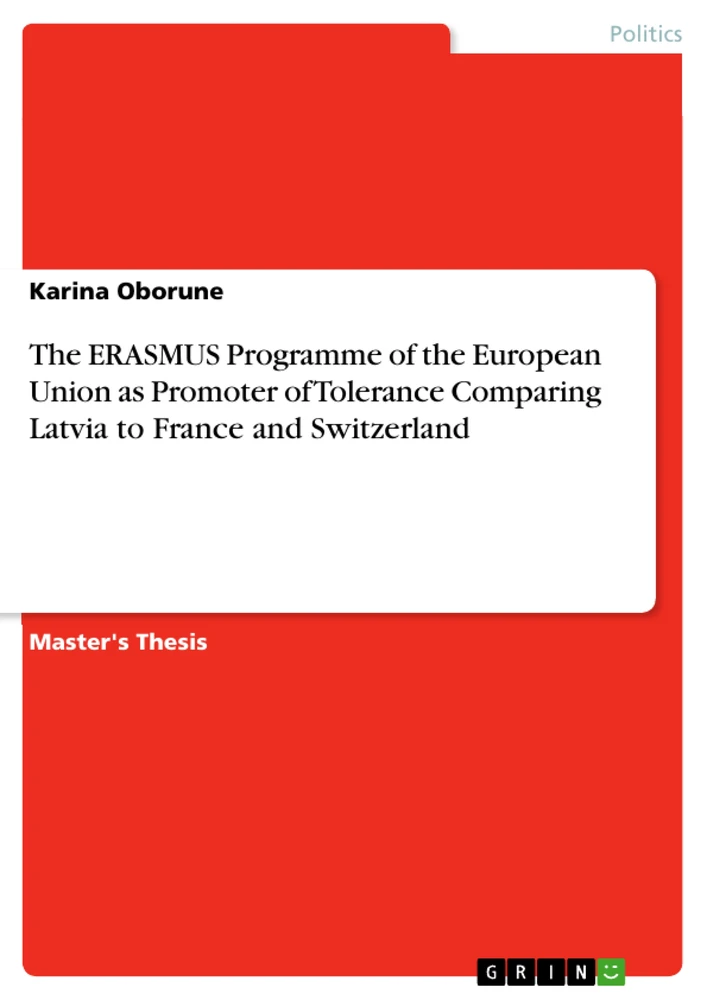
Table of Contents
INTRODUCTION
THEORETICAL (HISTORICAL) PART
1. ANALYSIS OF THE ERASMUS PROGRAMME 1969-1987
2. ANALYSIS OF THE ERASMUS PROGRAMME 1987-2009
THEORETICAL (CONCEPTUAL) PART
1. CONCEPT OF TOLERANCE
2. FACTORS, CRITERIA AND INDICATORS OF TOLERANCE
3. INTERCULTURAL EDUCATION
4. SOCIAL DISTANCE
5. STEREOTYPES AND PREJUDICES
EMPYRICAL PART
1. SURVEY
1.1. METHODOLOGY
1.2. RESULTS
1.3. ANALYSIS
2. INTERVIEWS
2.1. METHODOLOGY
2.2. RESULTS
2. 3. ANALYSIS
CONCLUSION
BIBLIOGRAPHY
ANNEX
Annex I: Historical Outline of the ERASMUS Programme 1957-2009
Annex II: Questionnaire (ENG)
Annex III: Questionnaire (FR)
Annex IV: Tables of Statistical Data of Survey
Annex V: Transcripts of Interviews with Experts of the ERASMUS Programme
Annex VI: Transcripts of Interviews with Experts of Tolerance
Research Objectives & Topics
This master's thesis examines whether the ERASMUS programme effectively promotes tolerance among European students. It explores the relationship between international academic mobility and the development of tolerant attitudes, focusing on the reduction of social distance and the breaking of stereotypes through intercultural experiences.
- The role of the ERASMUS Programme in fostering European identity and integration.
- Theoretical foundations of tolerance, social distance, and intercultural education.
- Empirical analysis of student attitudes through surveys in Latvia, France, and Switzerland.
- Expert perspectives on the effectiveness of mobility programmes in promoting social cohesion.
- Evaluation of intercultural communication and the breaking of ethnic stereotypes.
Excerpt from the Book
1. CONCEPT OF TOLERANCE
In political science tolerance is understood as an activity of not judging those whose beliefs or behaviours differ from the desirable (Avery, 2001:1). However, this concept is understood differently, for example, in the UNESCO official definitions a variety of explanations of tolerance can be found, especially in understanding of the term “different”. In turn, the similarity of definitions can be in objective: “to respect the rights of others” (Reardon, 2001: 32). The following aspects for defining tolerance: “respect”, “acceptance”, “understanding”, “openness”, “freedom of belief”, “pro-active attitude”, “duty” has been used in UNESCO Declaration of Principles on Tolerance (UNESCO: 1995). The author believes that while creating the definition of tolerance the above aspects should be taken into account.
Scholars of ethno-politics and cultural sociology have put forward different definitions of tolerance. Ilga Apine points out that the concept of tolerance has several synonyms, such as dialogue, openness to other cultures etc. (Apine, 2001: 83). Liesma Ose believes that tolerance is an active treatment based on human rights and fundamental freedoms (Ose, 2006: 9). Also Samuel Lowy indicates that in terms of tolerance, it must be remembered that it is a function and not just a passive receptive attitude (Lowy, 1999: 43). The concept of tolerance also includes a function of acquiring other cultural values. Tolerant relations between individuals are possible only if person adopts another individual regardless of cultural affiliation. Ose emphasizes that intolerant attitudes can also take the form of individual’s tolerance ratings - the subjective preferences for one or another tolerable group: “I hereby will tolerate them, but those are not acceptable because of their life style or culture”. As Ose expressed, the quality of personality together with the psychological readiness to change can promote interaction with other cultures beliefs and convictions (Ose, 2006: 9).
Summary of Chapters
INTRODUCTION: Presents the research background, hypothesis, and methodology concerning the ERASMUS Programme as a promoter of tolerance.
THEORETICAL (HISTORICAL) PART: Examines the development of the ERASMUS Programme from its initiation in the 1960s to its current status as a key European integration tool.
THEORETICAL (CONCEPTUAL) PART: Establishes definitions for tolerance, stereotypes, and prejudice, while discussing intercultural education and social distance.
EMPYRICAL PART: Details the findings from student surveys and expert interviews regarding the impact of student mobility on tolerant attitudes.
CONCLUSION: Synthesizes research findings and provides recommendations for enhancing the programme's capacity to promote tolerance.
Keywords
ERASMUS Programme, Tolerance, European Integration, Intercultural Education, Social Distance, Stereotypes, Prejudice, Student Mobility, European Identity, Multicultural Experience, Quantitative Research, Qualitative Interviews, Social Cohesion, Political Socialization, Cross-cultural communication.
Frequently Asked Questions
What is the core focus of this research?
The research explores the impact of the ERASMUS Programme on fostering tolerance among students, assessing whether mobility experiences contribute to a more open-minded European generation.
What are the primary thematic areas covered?
The thesis covers the historical development of the ERASMUS Programme, conceptual definitions of tolerance, the influence of intercultural contact on reducing social distance, and the role of stereotyping in student perceptions.
What is the main objective or research question?
The primary research question is whether the ERASMUS Programme successfully promotes tolerance among participants through multicultural exposure and intercultural education.
Which scientific methods are utilized?
The study employs a mixed-methods approach, combining quantitative surveys of 321 students from Latvia, France, and Switzerland with qualitative, semi-structured interviews of subject matter experts.
What does the main part of the work address?
The main body integrates historical analysis of European education policies with empirical evidence, validating the hypothesis that increased intergroup contact leads to the reduction of bias and the breaking of stereotypes.
Which keywords characterize the work?
The work is characterized by terms such as European integration, ERASMUS Programme, tolerance, social distance, intercultural education, and stereotype reduction.
Why is the role of university exchange considered a 'political tool'?
The author argues that the programme serves as a 'soft power' tool for the EU by fostering a sense of shared European identity among young mobile citizens.
What are the limitations of the programme according to the author?
The author notes that participants often represent a self-selecting group already inclined towards openness, and that socioeconomic barriers still prevent less privileged students from participating, limiting the programme's full reach.
Ende der Leseprobe aus 51 Seiten
- nach oben
- Arbeit zitieren
- Karina Oborune (Autor:in), 2009, The ERASMUS Programme of the European Union as Promoter of Tolerance Comparing Latvia to France and Switzerland, München, Page::Imprint:: GRINVerlagOHG, https://www.diplomarbeiten24.de/document/150617

neugierig - aktuell - relevant
Entdecken Sie hilfreiche Tipps und Tricks rund ums Studium!

Entdecken Sie hilfreiche Tipps und Tricks rund ums Studium!
Ihre Hausarbeit / Abschlussarbeit:

- - Publikation als E-Book und Buch
- - Hohes Honorar auf die Verkäufe
- - Für Sie komplett kostenlos - mit ISBN
- - Es dauert nur 5 Minuten
- - Jede Arbeit findet Leser

- © GRIN Publishing GmbH.
- Alle Inhalte urheberrechtlich geschützt. Kopieren und verbreiten untersagt.
- info@grin.com
- AGB
- Open Publishing
Der GRIN Verlag hat sich seit 1998 auf die Veröffentlichung akademischer eBooks und Bücher spezialisiert. Der GRIN Verlag steht damit als erstes Unternehmen für User Generated Quality Content. Die Verlagsseiten GRIN.com, Hausarbeiten.de und Diplomarbeiten24 bieten für Hochschullehrer, Absolventen und Studenten die ideale Plattform, wissenschaftliche Texte wie Hausarbeiten, Referate, Bachelorarbeiten, Masterarbeiten, Diplomarbeiten, Dissertationen und wissenschaftliche Aufsätze einem breiten Publikum zu präsentieren.
Kostenfreie Veröffentlichung: Hausarbeit, Bachelorarbeit, Diplomarbeit, Dissertation, Masterarbeit, Interpretation oder Referat jetzt veröffentlichen!
Folgen Sie GRIN auf


- GRIN Verlag GmbH
-
- Nymphenburger Str. 86
- 80636
- Munich, Deutschland
- +49 89-550559-0
- +49 89-550559-10
- info@grin.com
-
