
präsentiert von

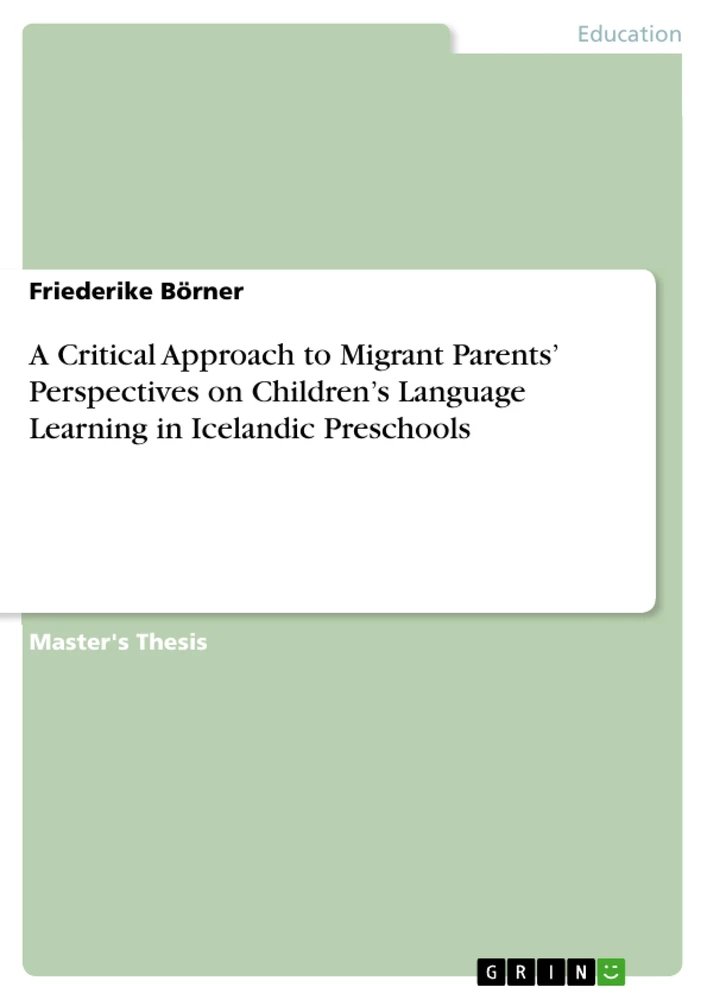
Table of Content
1. Introduction
1.1 The linguistic landscape in Iceland
1.2 A brief history of the Icelandic Language
1.3 Icelandic Preschools and the Icelandic National Curriculum
2. Theoretical Framework and Literature
2.1 Multilingual Education
2.2 Second Language Acquisition (SLA) and the benefits of multilingualism
2.3 Heritage language and mother tongue
2.4 Linguistic Human Rights (LHR)
2.5 Baseline Recommendations for MLE according to Skutnabb-Kangas
2.6 Recommendations for multilingual education to an Icelandic educational context
2.7 Critical Race Theory
2.8 Language policies
3. Methodology
3.1 Choice of location and participants
3.2 Interview Set-up
3.3 Narrative analysis & applying a CRT lens on my research data
3.4 Autoethnography
3.5 Conduction of interviews and challenges
3.6 Research Questions and Purpose of Research
3.7 Overview of participants
3.8 How interviews were conducted
3.9 Ethical issues and the authors positionality
4. Data Analysis & Findings
4.1 Multilingual Education in Iceland perceived by the parents
4.2 Findings from the interviews – General overview & comparison
4.3 Educational expectation of the parents
4.4 Language development supported by the Preschool
4.5 Lack of communication and information
4.5.1 Privileges of English-speaking parents
4.5.2 Language development concerns
4.6 Challenges with staffing at the preschool
4.7 The Icelandic language as majority language
5. More findings: Balancing Linguistic Diversity and the gap between policy and practice
5.1 Being a foreign preschool teacher in Iceland - an autoethnographic approach
5.2 Lack of communication
5.3 The curriculums focus on learning Icelandic
5.3.1 Communication with parents
5.4 Language skills of the parents and the impact on communication
5.5 Reliance on the educational system in Iceland to teach children Icelandic
6. Conclusion
6.1 Implementing Baseline Recommendations in Icelandic Preschools: Strategies for Application
6.2 Cummins’ recommendation for multilingual education in an Icelandic context
6.3 Outlook and further research
Research Objectives and Themes
This study investigates the experiences and perspectives of migrant parents regarding their children's language learning journeys within Icelandic preschools, aiming to identify discrepancies between national educational policies and the actual practices in these institutions.
- Multilingual education and heritage language maintenance
- Linguistic human rights and Critical Race Theory
- Challenges in parent-school communication
- Influence of Icelandic language dominance in preschool settings
- Autoethnographic reflections on preschool teaching
Auszug aus dem Buch
1. Introduction
There has been a long-standing interest in multilingualism in Icelandic preschools and the impact of the linguistically diverse upbringing of children in this country (Ólafsdóttir et al., 2018). Research has shown that young children who learn a new language in preschools highly benefit from maintaining their heritage language while getting support from educators (Ball, 2011; Cenoz & Gorter, 2011; Diamond, 2010; Okal, 2014). UNESCO has encouraged instructions in heritage languages around the world in early childhood education since 1953, however monolingualism is still dominant in most countries (Ball, 2011, Björklund & Björklund, 2013).
There is little research on migrant parents' experience and how they experience their child's language learning and how much support they receive from preschools in Iceland¹. Some of the research shows that children are doing overall academically well, but some parents experience lack of communication with educators, cultural differences between norms and values and the difference of expectations between their homes and the schools (Ragnarsdóttir, 2020). A recent study found that schools are unable to provide teaching and resources in the children's heritage language and the main focus is on teaching Icelandic as a second language (Ragnarsdóttir, 2020). However, we know by now that children would benefit more from a multilingual education (Cummins, 1986) and an understanding of diversity in the classroom. According to Skutnabb-Kangas (2009) the speakers of a country's dominant language also have the right to benefit from multilingualism and children should be able to use their heritage language as a linguistic human right. To establish learning environments that cater to the requirements of linguistically and culturally diverse students, schools must prioritize the implementation of socially just and inclusive practices. This involves acknowledging and leveraging students' prior knowledge while embracing their diverse backgrounds (Ragnarsdóttir, 2020).
Summary of Chapters
1. Introduction: Provides an overview of the interest in multilingualism and the role of heritage languages in early childhood education against the backdrop of Icelandic policy.
2. Theoretical Framework and Literature: Explores fundamental concepts including multilingual education, linguistic human rights, Critical Race Theory, and language policies.
3. Methodology: Details the research design, including interview processes, participant selection, and the application of an autoethnographic approach.
4. Data Analysis & Findings: Analyzes the gathered data, highlighting parent experiences with communication, expectations, preschool support, and the impact of Icelandic language dominance.
5. More findings: Balancing Linguistic Diversity and the gap between policy and practice: Discusses further findings from the perspective of staff, addressing preschool dynamics, communication hurdles, and curricular emphasis.
6. Conclusion: Summarizes key research findings, proposing strategies for implementing baseline recommendations and offering perspectives for future research.
Keywords
Multilingual Education, Heritage Language, Icelandic Preschools, Migrant Parents, Language Acquisition, Critical Race Theory, Linguistic Human Rights, Parent-School Communication, Educational Policy, Autoethnography, Inclusion, Social Justice, Language Dominance, Diversity, Second Language Acquisition.
Frequently Asked Questions
What is the core focus of this research?
The research examines the experiences and perspectives of migrant parents regarding their children's language learning in Icelandic preschools.
Which central thematic fields are addressed?
The study navigates themes of multilingualism, linguistic human rights, educational policy, parental involvement, and the challenges of cultural and linguistic diversity in schools.
What is the primary research question?
The study asks to what extent migrant parents of preschool-aged children in Reykjavik receive support for their children's language development and whether there are discrepancies between national curriculum guidelines and actual school practice.
Which scientific methodology is employed?
The research uses a qualitative methodological mix, including narrative analysis of interviews with six migrant parents, document analysis of educational policies, and autoethnographic study reflections.
What does the main part of the thesis cover?
The core segments analyze participant interviews concerning satisfaction, communication gaps with preschool staff, educational expectations, and reflections on the challenges of balancing heritage languages with the host-nation's curriculum.
Which keywords define this work?
Key terms include Multilingual Education, Heritage Language, Migrant Parents, Icelandic Preschools, and Critical Race Theory.
How does the author's own experience influence the research?
The author uses autoethnography, reflecting on their two-year tenure as a preschool department head in Reykjavik to gain insight into staffing, administrative, and teaching challenges from the perspective of staff.
What is the conclusion regarding parent-school communication?
The study finds a significant disconnect, where parents often feel uninformed, lack access to translations, and face difficulties navigating a system that relies heavily on oral communication in a language they may not fully master.
Ende der Leseprobe aus 78 Seiten
- nach oben
- Arbeit zitieren
- Friederike Börner (Autor:in), 2024, A Critical Approach to Migrant Parents’ Perspectives on Children’s Language Learning in Icelandic Preschools, München, Page::Imprint:: GRINVerlagOHG, https://www.diplomarbeiten24.de/document/1513216

neugierig - aktuell - relevant
Entdecken Sie hilfreiche Tipps und Tricks rund ums Studium!

Entdecken Sie hilfreiche Tipps und Tricks rund ums Studium!
Ihre Hausarbeit / Abschlussarbeit:

- - Publikation als E-Book und Buch
- - Hohes Honorar auf die Verkäufe
- - Für Sie komplett kostenlos - mit ISBN
- - Es dauert nur 5 Minuten
- - Jede Arbeit findet Leser

- © GRIN Publishing GmbH.
- Alle Inhalte urheberrechtlich geschützt. Kopieren und verbreiten untersagt.
- info@grin.com
- AGB
- Open Publishing
Der GRIN Verlag hat sich seit 1998 auf die Veröffentlichung akademischer eBooks und Bücher spezialisiert. Der GRIN Verlag steht damit als erstes Unternehmen für User Generated Quality Content. Die Verlagsseiten GRIN.com, Hausarbeiten.de und Diplomarbeiten24 bieten für Hochschullehrer, Absolventen und Studenten die ideale Plattform, wissenschaftliche Texte wie Hausarbeiten, Referate, Bachelorarbeiten, Masterarbeiten, Diplomarbeiten, Dissertationen und wissenschaftliche Aufsätze einem breiten Publikum zu präsentieren.
Kostenfreie Veröffentlichung: Hausarbeit, Bachelorarbeit, Diplomarbeit, Dissertation, Masterarbeit, Interpretation oder Referat jetzt veröffentlichen!
Folgen Sie GRIN auf


- GRIN Verlag GmbH
-
- Nymphenburger Str. 86
- 80636
- Munich, Deutschland
- +49 89-550559-0
- +49 89-550559-10
- info@grin.com
-
