
präsentiert von


Table of Contents
1 Introduction
2 Theory
2.1 Energy Systems Optimization
2.1.1 Mathematical Foundations of Optimization
2.1.2 Modeling Framework SecMOD
2.1.3 Multi-Objective Optimization
2.2 Literature Review on Heuristic Algorithms
2.2.1 Trajectory-based Methods
3 Implementation of Constraints
3.1 Technology Availabilities
3.1.1 Alpine PV
3.1.2 Wind Energy
3.1.3 Electrified Residential Heating
3.1.4 Carbon Capture and Storage
3.1.5 Hydrogen Storages
3.2 Demand-side Flexibilities
3.2.1 Electricity Demand Flexibility
3.2.2 Residential Heat Demand Flexibility
3.2.3 Mobility Demand Flexibility
3.2.4 Industrial Heat Storages
3.3 Market Integration Levels
3.3.1 Electricity Market
3.3.2 Hydrogen and Synthetic Gas Market
3.3.3 CO2 Compensation Abroad
3.4 Consideration of Measure Costs
4 Heuristic Algorithms
4.1 Considered Optimization Problem
4.2 Preparation of the Heuristic Algorithms
4.2.1 Total Cost Reduction Potential
4.2.2 Individual Cost Reduction Potentials
4.3 Heuristic Algorithm 1 – “The Intuitive”
4.4 Heuristic Algorithm 2 – “The Smart”
5 Case Study
5.1 Swiss Energy System Model
5.1.1 Spatial Aggregation
5.1.2 Model Setup
5.2 Model and Optimization Parametrization
5.3 Limited Resource Availabilities
6 Results and Discussion
6.1 Resulting Individual Cost Reduction Potentials
6.2 All-Conservative vs. All-Progressive
6.2.1 Cost Comparison
6.2.2 Utilization of Progressive Technology Availabilities
6.2.3 Carbon Balance
6.3 Heuristic Algorithms Results
6.3.1 “The Intuitive”
6.3.2 “The Smart”
6.4 Generation of Alternatives
6.5 Discussion
6.5.1 Interpretation
6.5.2 Limitations of our Study
7 Conclusion and Outlook
Research Objectives and Themes
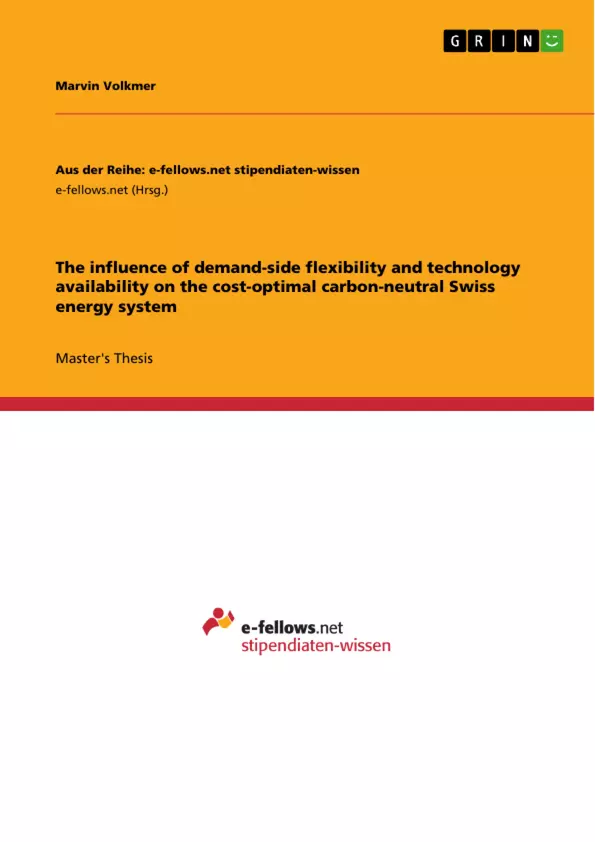
This thesis aims to identify cost-effective, smaller subsets of controversial measures that can support Switzerland’s transition to a carbon-neutral energy system by 2050. The research addresses the combinatorial optimization challenge of selecting the most beneficial combinations of technology, flexibility, and market integration measures from a predefined catalog.
- Development of model-specific heuristic optimization algorithms (“The Intuitive” and “The Smart”).
- Technical implementation and cost-analysis of controversial energy system measures.
- Analysis of synergistic effects when combining different energy policy measures.
- Minimization of total annualized system costs through targeted sector coupling (electricity, heat, and mobility).
Excerpt from the Book
3.2.1 Electricity Demand Flexibility
Within households, electricity demand flexibility is a well known demand-side measure, which is partly already made use of in Switzerland, e.g., by Ripple Control Receivers [63]. In the PATHFNDR project, the progressive assumption is made that 1 GW of electric power can be shifted, whereas the daily sum of shifted electric energy must not exceed 3 GW h within Switzerland [15]. According to a study undertaken by the B E T Suisse AG, there is a socio-technical demand-side flexibility potential of approximately 0.6 GW to 1 GW, not taking into account variances between switching loads off and on [63]. In our model, the domestic base demand for electricity equals approximately 44.098 TW h. Assuming a roughly equally distributed daily electricity demand of 120.82 GW h, our model would be allowed to shift 2.5 % of the overall electricity energy demand per day. The used model data consists of both private and industrial electricity demands and does not distinguish among those.
We implement the flexibility option by introducing a virtual storage (VES), as a similar approach can be found in literature [64]. The VES for electricity (VES-elec) has an efficiency of 1 and neither investment nor operational cost. To mathematically formulate the progressive assumption, we add the following equations to our model. We limit the withdrawn power Pout VES−elec,c,t,n from the VES-elec in all nodes for each time step t ∈ Tc in a typical day and for all typical days c ∈ C to 1 GW (Equation 3.1). Also, we limit the daily withdrawn energy from the VES-elec over all nodes to 3 GW h, by summing the storage power multiplied with the constant time step duration Δt = 1 h over all time steps (Equation 3.2). Moreover, the storage must show a daily cycle, hence does not represent flexibility from one day to another, in alignment with [15]. This is achieved by setting the inter-day storage level SOCinter VES−elec,n,d to 0 for each node n and for each day d in our investigated year (Equation 3.3). The code implementation of this measure can be found in Appendix B.5.5.
Summary of Chapters
1 Introduction: Provides background on the Swiss energy transition, defines the scope of controversial measures, and states the thesis objective to optimize the system cost-effectively.
2 Theory: Introduces mathematical principles of energy system optimization (MILP) and provides a literature review on heuristic algorithms.
3 Implementation of Constraints: Details the technical modeling of technology, demand-side, and market integration measures as constraints in SecMOD.
4 Heuristic Algorithms: Explains the conceptual development of the two custom heuristic algorithms, "The Intuitive" and "The Smart".
5 Case Study: Describes the Swiss energy system model configuration, the spatial grid aggregation, and the parameterization for the optimization.
6 Results and Discussion: Presents the findings regarding cost reduction potentials, compares conservative and progressive scenarios, and evaluates the performance of the generated alternatives.
7 Conclusion and Outlook: Summarizes the key findings and provides recommendations for future research directions in energy system modeling.
Keywords
Energy system optimization, carbon-neutrality, Switzerland, demand-side flexibility, heuristic algorithms, sector coupling, SecMOD, technology availability, cost-optimal design, energy policy, renewable energy, carbon capture and storage (CCS), grid aggregation, energy storage, system integration.
Frequently Asked Questions
What is the core focus of this Master’s thesis?
The work focuses on identifying cost-optimal combinations of "unpopular" energy policy measures to achieve a carbon-neutral Swiss energy system by 2050.
Which categories of measures are analyzed?
The measures are categorized into technology availability (e.g., Alpine PV, CCS), demand-side flexibilities (e.g., flexible charging for BEVs), and market integration levels (e.g., CO2 compensation abroad).
What is the primary objective of the optimization?
The primary objective is to minimize the total annualized cost (TAC) of the sector-coupled Swiss energy system while respecting carbon-neutrality constraints.
Which scientific methods are employed?
The thesis uses mixed-integer linear programming (MILP) within the SecMOD framework and develops two novel, model-tailored heuristic algorithms to solve the combinatorial optimization problem.
What is the main topic covered in the results section?
The results section evaluates the cost reduction potentials of individual measures, compares all-conservative against all-progressive scenarios, and discusses the performance and synergy effects generated by the proposed heuristic algorithms.
Which keywords categorize this research?
Key topics include energy system optimization, demand-side flexibility, heuristic algorithms, Swiss energy system, sector coupling, and carbon-neutrality.
How do "The Intuitive" and "The Smart" algorithms differ in their logic?
"The Intuitive" combines individually promising measures based on performance, whereas "The Smart" enforces combination constraints based on predefined categories to exploit synergistic effects between technologies.
What is the role of the "must-run" formulation for residential heat?
The must-run formulation ensures that all heat-generating technologies are operated in proportion to their installed capacity shares, preventing the model from exclusively favoring a single technology based on unrealistic merit-order principles.
Ende der Leseprobe aus 132 Seiten
- nach oben
- Arbeit zitieren
- Marvin Volkmer (Autor:in), 2024, The influence of demand-side flexibility and technology availability on the cost-optimal carbon-neutral Swiss energy system, München, Page::Imprint:: GRINVerlagOHG, https://www.diplomarbeiten24.de/document/1514014

neugierig - aktuell - relevant
Entdecken Sie hilfreiche Tipps und Tricks rund ums Studium!

Entdecken Sie hilfreiche Tipps und Tricks rund ums Studium!
Ihre Hausarbeit / Abschlussarbeit:

- - Publikation als E-Book und Buch
- - Hohes Honorar auf die Verkäufe
- - Für Sie komplett kostenlos - mit ISBN
- - Es dauert nur 5 Minuten
- - Jede Arbeit findet Leser

- © GRIN Publishing GmbH.
- Alle Inhalte urheberrechtlich geschützt. Kopieren und verbreiten untersagt.
- info@grin.com
- AGB
- Open Publishing
Der GRIN Verlag hat sich seit 1998 auf die Veröffentlichung akademischer eBooks und Bücher spezialisiert. Der GRIN Verlag steht damit als erstes Unternehmen für User Generated Quality Content. Die Verlagsseiten GRIN.com, Hausarbeiten.de und Diplomarbeiten24 bieten für Hochschullehrer, Absolventen und Studenten die ideale Plattform, wissenschaftliche Texte wie Hausarbeiten, Referate, Bachelorarbeiten, Masterarbeiten, Diplomarbeiten, Dissertationen und wissenschaftliche Aufsätze einem breiten Publikum zu präsentieren.
Kostenfreie Veröffentlichung: Hausarbeit, Bachelorarbeit, Diplomarbeit, Dissertation, Masterarbeit, Interpretation oder Referat jetzt veröffentlichen!
Folgen Sie GRIN auf


- GRIN Verlag GmbH
-
- Nymphenburger Str. 86
- 80636
- Munich, Deutschland
- +49 89-550559-0
- +49 89-550559-10
- info@grin.com
-
