
präsentiert von

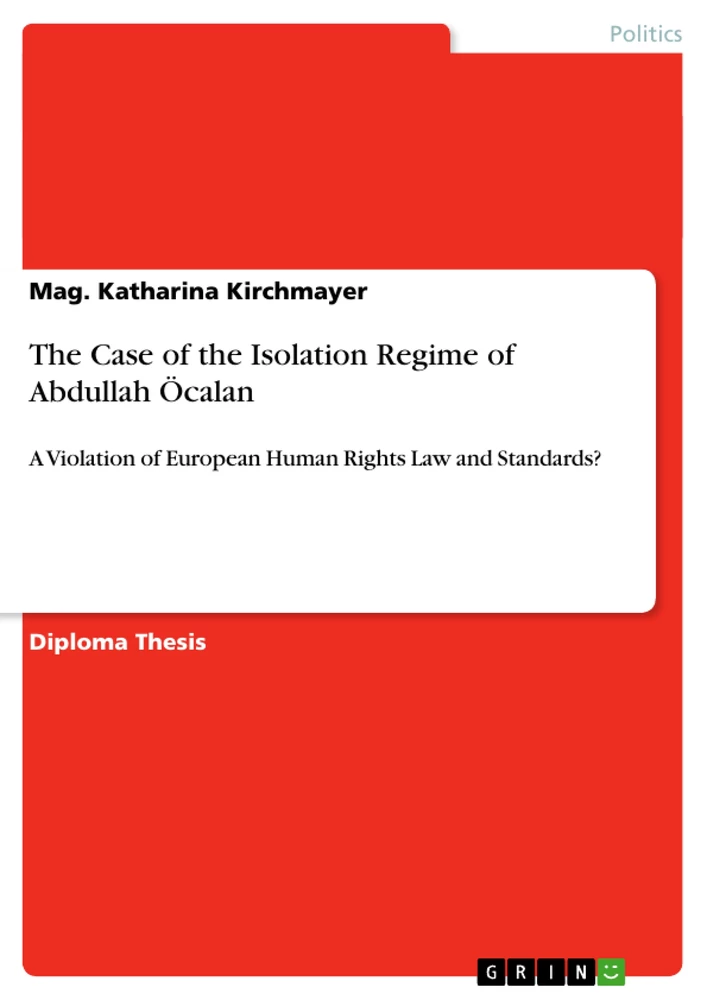
Table of Contents
A.INTRODUCTION
B.INVESTIGATION OF ART.3 ECHR
I.Scope of Protection of Article 3 ECHR
1.Torture
2.Inhuman Treatment
3.Degrading Treatment or Punishment
4.Detention Conditions
II.Functions of the two supervising organs: CPT and ECtHR
1.The European Committee for the Prevention of Torture and Inhuman or Degrading Treatment or Punishment (CPT)
a)The CPT's relation with other human rights bodies
b)The CPT Standards
2.The European Court of Human Rights (ECtHR)
a)The judgments and their binding force
b)Judgments in connection to isolation regimes
C.THE CASE OF ABDULLAH ÖCALAN
I. Historical Context: The Kurdish Question
II.Background Information, Political Career and Acts of Abdullah Öcalan
III.Arrest of Abdullah Öcalan and Imprisonment
IV.The Turkish Trials against Öcalan
V.Excursus: Abolition of the Death Penalty in Turkey
VI.Imprisonment in Imrali High Security Closed Prison
VII.Recent developments on the Kurdish Question and Abdullah Öcalan
D.THE MONITORING PROCEDURE OF THE CPT
I.Visit in 1999
1.Report of the CPT
2.Response of the Turkish Authorities
II.Visit in 2001
1.Preliminary Observations of the Committee
2.Reply of the Turkish Authorities
3.Report of the Committee
4.Response of the Turkish Authorities
III.Visit in 2003
1.Report of the Committee
2.Response of the Turkish Authorities
IV.Visit in 2007
1.Report of the Committee
2.Response of the Turkish Authorities
V.The End of the Isolation Regime and recent Developments
E.CONTROVERSIAL VIEW OF THE ISOLATION REGIME BY THE EUROPEAN COURT OF HUMAN RIGHTS
I.Judgment of 2003
II.Judgment of 2005
F.CONCLUSION
I.The 'Ongoing Dialogue' between the CPT and Turkey
II.The Standard-Setting role of the CPT in the light of Turkey's actions and reactions
G.BIBLIOGRAPHY
I.Articles and Books
II.CPT
III.ECtHR
IV.Other Sources
H.ANNEX
I.Important CPT Standards in respect to Detention Conditions/Isolation Regimes
II.Important provisions in respect to the Abolition of the Death Penalty in Turkey
1.Art.38 of the Constitution of the Republic of Turkey
2.Amendment to the legislation referring to the death penalty (Art.1 of the Law amending various laws) from August 2002
Research Objectives and Themes
The primary aim of this thesis is to investigate the detention conditions of Abdullah Öcalan at the Imrali High Security Prison and to analyze whether the isolation regime constituted a violation of Article 3 of the European Convention on Human Rights (ECHR), while highlighting the differing perspectives of the CPT and the ECtHR.
- The scope and interpretation of the prohibition of torture and inhuman or degrading treatment under Article 3 ECHR.
- The specific monitoring roles, standards, and preventive mechanisms of the CPT regarding detention conditions.
- The historical and political context of the Kurdish Question in Turkey and the background of Abdullah Öcalan.
- A detailed analysis of the CPT's monitoring procedure through periodic and ad hoc visits between 1999 and 2007.
- A comparative examination of the controversial judgments delivered by the ECtHR in 2003 and 2005 concerning the isolation of Öcalan.
Excerpt from the Book
1. Torture
The term "torture" is reserved for the most serious forms of violations of Art.3 ECHR. The difference between torture and inhuman treatment lies in the severity of the action. A measure can be seen as torture if there is a deliberate inhuman or degrading treatment that evokes serious and cruel suffering. In this context one can also refer to Art. 1 of the UN- Convention against Torture. To illustrate some cases in which the European Court of Human Rights assumed torture eg.: “Palestinian hanging”- a detainee was pulled up on a string with his hands bound together with the result that his arms were debilitated; rape of a female inmate by the police; exertion of mental pressure on a detainee by the police as well as causing physical pain.
Summary of Chapters
A.INTRODUCTION: Outlines the significance of the isolation of Abdullah Öcalan and the research objective of comparing the findings of the CPT and the ECtHR.
B.INVESTIGATION OF ART.3 ECHR: Dissects the legal provision of Article 3 ECHR and examines the respective roles of the CPT and the ECtHR in preventing and adjudicating human rights violations.
C.THE CASE OF ABDULLAH ÖCALAN: Provides a historical overview of the Kurdish Question and details the political trajectory and eventual imprisonment of Abdullah Öcalan.
D.THE MONITORING PROCEDURE OF THE CPT: Details the chronological dialogue, recommendations, and site visits conducted by the CPT at Imrali Prison between 1999 and 2007.
E.CONTROVERSIAL VIEW OF THE ISOLATION REGIME BY THE EUROPEAN COURT OF HUMAN RIGHTS: Analyzes the specific legal findings and justifications provided by the ECtHR in its 2003 and 2005 judgments.
F.CONCLUSION: Evaluates the effectiveness of the CPT's ongoing dialogue with Turkey and summarizes the role of human rights standards in the context of high-security detention.
G.BIBLIOGRAPHY: Lists the sources, books, legal documents, and official reports utilized in the thesis.
H.ANNEX: Compiles relevant CPT standards on detention and legislative amendments concerning the abolition of the death penalty in Turkey.
Key Keywords
Abdullah Öcalan, CPT, ECtHR, Article 3 ECHR, Isolation regime, Imrali Prison, Kurdish Question, Human rights, Detention conditions, Torture, Inhuman treatment, PKK, Standard-setting, Solitary confinement, Preventive mechanism
Frequently Asked Questions
What is the fundamental focus of this thesis?
The thesis focuses on the legal and socio-political implications of the isolation regime imposed on Abdullah Öcalan at the Imrali High Security Prison and its compatibility with European human rights standards.
Which organizations are central to this investigation?
The study primarily analyzes the roles of the European Committee for the Prevention of Torture (CPT) and the European Court of Human Rights (ECtHR).
What is the main research question?
The research seeks to determine whether the detention conditions under which Abdullah Öcalan was held violated Article 3 of the ECHR and explains the discrepancy between the CPT's preventive approach and the ECtHR's judicial findings.
Which scientific methodology is employed?
The thesis utilizes a legal-analytical approach, comparing international human rights standards, CPT reports, and ECtHR case law to assess the specific detention regime.
What topics are discussed in the main part of the work?
The main part covers the historical context of the Kurdish Question, the evolution of the PKK, the specific monitoring visits by the CPT, and a critical analysis of the legal reasoning in the 2003 and 2005 ECtHR judgments.
Which keywords best characterize the work?
Key terms include isolation, CPT, ECtHR, Article 3 ECHR, Abdullah Öcalan, detention conditions, and standard-setting.
How does the author explain the difference in opinion between the CPT and the ECtHR?
The author highlights that the CPT acts as a future-oriented, preventive body focusing on practical detention conditions, while the ECtHR functions as a past-oriented judicial body that must determine if a specific threshold of suffering has been reached to constitute a violation.
Why was the isolation regime considered problematic by the CPT?
The CPT viewed the long-term, solitary confinement as a potentially harmful isolation regime that could have devastating psychological effects on the detainee, regardless of the quality of the material conditions.
Ende der Leseprobe aus 99 Seiten
- nach oben
- Arbeit zitieren
- Mag. Katharina Kirchmayer (Autor:in), 2010, The Case of the Isolation Regime of Abdullah Öcalan, München, Page::Imprint:: GRINVerlagOHG, https://www.diplomarbeiten24.de/document/151592

neugierig - aktuell - relevant
Entdecken Sie hilfreiche Tipps und Tricks rund ums Studium!

Entdecken Sie hilfreiche Tipps und Tricks rund ums Studium!
Ihre Hausarbeit / Abschlussarbeit:

- - Publikation als E-Book und Buch
- - Hohes Honorar auf die Verkäufe
- - Für Sie komplett kostenlos - mit ISBN
- - Es dauert nur 5 Minuten
- - Jede Arbeit findet Leser

- © GRIN Publishing GmbH.
- Alle Inhalte urheberrechtlich geschützt. Kopieren und verbreiten untersagt.
- info@grin.com
- AGB
- Open Publishing
Der GRIN Verlag hat sich seit 1998 auf die Veröffentlichung akademischer eBooks und Bücher spezialisiert. Der GRIN Verlag steht damit als erstes Unternehmen für User Generated Quality Content. Die Verlagsseiten GRIN.com, Hausarbeiten.de und Diplomarbeiten24 bieten für Hochschullehrer, Absolventen und Studenten die ideale Plattform, wissenschaftliche Texte wie Hausarbeiten, Referate, Bachelorarbeiten, Masterarbeiten, Diplomarbeiten, Dissertationen und wissenschaftliche Aufsätze einem breiten Publikum zu präsentieren.
Kostenfreie Veröffentlichung: Hausarbeit, Bachelorarbeit, Diplomarbeit, Dissertation, Masterarbeit, Interpretation oder Referat jetzt veröffentlichen!
Folgen Sie GRIN auf


- GRIN Verlag GmbH
-
- Nymphenburger Str. 86
- 80636
- Munich, Deutschland
- +49 89-550559-0
- +49 89-550559-10
- info@grin.com
-
