
präsentiert von

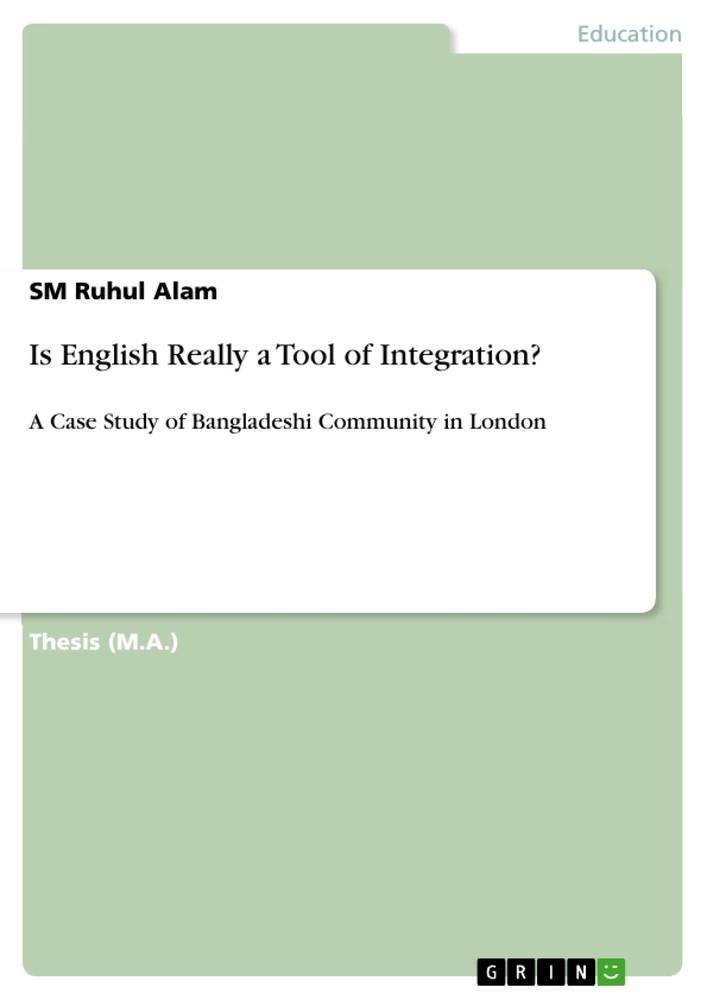
Table of Contents
1.1 Introduction
1.2 Research question
1.3 Study overview
1.4 Objective of research
2.1 Integration
2.2 What is integration?
2.3 Language as a tool of integration
2.4 Language Perceptions and Linguistic Adaptations and Integration
3.1 Sources of data
3.2 Site selection
3.3 Interview procedure
3.4 Interviewers
3.5 Data analysis
4.1 Historical background
Chapter 5: Integration and Bangladeshi community
Chapter 6: English as a tool of integration
6.1 Case study
Chapter 7: Survival without English
7.1 Case study
Chapter 8: Showing much interest in English
Chapter 9: Data Analysis
9.1 Integration from Bangladeshi perspective
9.2 English as a tool of integration
9.3 Maintaining Bangla in London
9.4 Showing interest to learn English
9.5 Language shift
10.1 What is ESOL?
10.2 Purpose
10.3 Obstacles
10.4 Approaches to teaching and learning
10.5 Measure
Chapter 11: Conclusion
Objectives and Research Focus
This study examines the role of English language proficiency as a primary tool for the social and economic integration of the Bangladeshi community living in London, exploring the tension between maintaining cultural identity and the necessity of linguistic adaptation in a multicultural UK society.
- The impact of English language skills on employment opportunities and economic independence for immigrants.
- The influence of demographic concentration (e.g., in Tower Hamlets) on language maintenance versus integration.
- Generational shifts in language usage and the role of schools in fostering English proficiency among the youth.
- Sociolinguistic factors including code-switching, language attitudes, and interethnic contact.
- Barriers to accessing ESOL (English for Speakers of Other Languages) services and motivation levels within the community.
Excerpt from the Book
Integration: a two way process
Many informants think that integration is a two way process in which both immigrants and host society are closely involved. This is a feature that is also supported by other research (Handbook on Integration: 2004). Some informants think they should perform some responsibilities to the host society. At the same time the host society should show willingness to accept immigrants in its society. Moreover; some respondents feel that they are parts and parcel of the British society. This sense of belonging is very essential for integration. For example:
I am very happy to work at a British social welfare organization where I have got some native British colleagues who are very friendly and helpful. Before coming to the UK, I heard that the British are very reserved and conservative but I think what I heard is not true. On the other hand, they are also very happy to find a worker like me. One day my boss told me ‘ ‘we are very grateful to you as by being a devoted worker, you are helping our country’’. Once I thought that I was a foreigner, but now I think I am a part of this country and I should do something for the UK as this country has already given me many things. Gradually I am realizing that the United Kingdom is becoming a part of my life along with Bangladesh.
Summary of Chapters
Chapter 1: Introduction outlines the study’s focus on immigration, research questions, and the objective of examining English as a tool for integration.
Chapter 2: Literature review discusses foundational concepts of integration, linguistic adaptation, and the role of dominant languages in host societies.
Chapter 3: Methodology describes the primary and secondary data collection techniques, including interviews in Tower Hamlets and participant observation.
Chapter 4: Profile of Bangladeshi community in London provides the historical background and demographic context of the community in East London.
Chapter 5: Integration and Bangladeshi community explores individual perspectives on the causes of migration and the meaning of integration.
Chapter 6: English as a tool of integration examines the relationship between English proficiency, financial success, and social integration through case studies.
Chapter 7: Survival without English investigates how individuals survive in the UK without English and the factors enabling this, such as communal living and translation services.
Chapter 8: Showing much interest in English analyzes the growing motivation for learning English to overcome daily challenges and pass life-in-the-UK tests.
Chapter 9: Data Analysis synthesizes findings on perspectives, language shift, and the empirical impact of English on integration.
Chapter 10: Recommendation suggests practical measures, including enhancing motivation and funding for ESOL programs to overcome current barriers.
Chapter 11: Conclusion summarizes the necessity of English for integration while highlighting the ongoing balance between maintaining Bangla and adopting English.
Keywords
Integration, Bangladeshi Community, London, English Proficiency, Sociolinguistics, Language Shift, ESOL, Bilingualism, Tower Hamlets, Social Inclusion, Immigrant Adjustment, Cultural Identity, Multiculturalsim, Labour Market, Chain Migration
Frequently Asked Questions
What is the core focus of this research project?
The research investigates whether English language skills serve as an effective tool for the social and economic integration of the Bangladeshi community living in London.
What are the central thematic areas of the study?
The study centers on language proficiency, immigration, social integration, economic factors, linguistic maintenance of Bangla, and the process of language shift among younger generations.
What is the primary research goal?
The goal is to determine how English language skills influence the integration process and to understand the community's attitudes toward learning English within a multicultural context.
Which methodology was used to conduct this research?
The study employed a mixed-methods approach involving literature reviews, household interviews, participant observation, and questionnaires among the Bangladeshi community, primarily in Tower Hamlets.
What topics are covered in the main body of the work?
The main sections cover historical background, case studies on employment and social participation, an analysis of survival without English, and recommendations for improving English language learning.
Which keywords best characterize this dissertation?
The work is best characterized by terms such as Integration, Bangladeshi Community, English Proficiency, Language Shift, and Multiculturalism.
How does the author define integration?
Drawing on sociological definitions, the author views integration as a two-way process where immigrants become functional parts of the host society while retaining a measure of their own cultural identity.
Why is the Tower Hamlets area significant for this study?
Tower Hamlets is selected because it houses a high concentration of the Bangladeshi population, allowing for a deep analysis of ethnic networks and the maintenance of the Bangla language.
How does the author differentiate between first and second-generation language usage?
The author observes that the first generation frequently uses code-mixing with English as the secondary element, whereas the second generation shifts toward English as their primary language, using Bangla words within English sentences.
What role does the 'Life in the UK' test play in the community's interest in English?
The test has acted as a catalyst, compelling many members of the Bangladeshi community to enroll in English courses to ensure they meet the language requirements for citizenship and residency.
Ende der Leseprobe aus 55 Seiten
- nach oben
- Arbeit zitieren
- SM Ruhul Alam (Autor:in), 2008, Is English Really a Tool of Integration?, München, Page::Imprint:: GRINVerlagOHG, https://www.diplomarbeiten24.de/document/152922

neugierig - aktuell - relevant
Entdecken Sie hilfreiche Tipps und Tricks rund ums Studium!

Entdecken Sie hilfreiche Tipps und Tricks rund ums Studium!
Ihre Hausarbeit / Abschlussarbeit:

- - Publikation als E-Book und Buch
- - Hohes Honorar auf die Verkäufe
- - Für Sie komplett kostenlos - mit ISBN
- - Es dauert nur 5 Minuten
- - Jede Arbeit findet Leser

- © GRIN Publishing GmbH.
- Alle Inhalte urheberrechtlich geschützt. Kopieren und verbreiten untersagt.
- info@grin.com
- AGB
- Open Publishing
Der GRIN Verlag hat sich seit 1998 auf die Veröffentlichung akademischer eBooks und Bücher spezialisiert. Der GRIN Verlag steht damit als erstes Unternehmen für User Generated Quality Content. Die Verlagsseiten GRIN.com, Hausarbeiten.de und Diplomarbeiten24 bieten für Hochschullehrer, Absolventen und Studenten die ideale Plattform, wissenschaftliche Texte wie Hausarbeiten, Referate, Bachelorarbeiten, Masterarbeiten, Diplomarbeiten, Dissertationen und wissenschaftliche Aufsätze einem breiten Publikum zu präsentieren.
Kostenfreie Veröffentlichung: Hausarbeit, Bachelorarbeit, Diplomarbeit, Dissertation, Masterarbeit, Interpretation oder Referat jetzt veröffentlichen!
Folgen Sie GRIN auf


- GRIN Verlag GmbH
-
- Nymphenburger Str. 86
- 80636
- Munich, Deutschland
- +49 89-550559-0
- +49 89-550559-10
- info@grin.com
-
