
präsentiert von

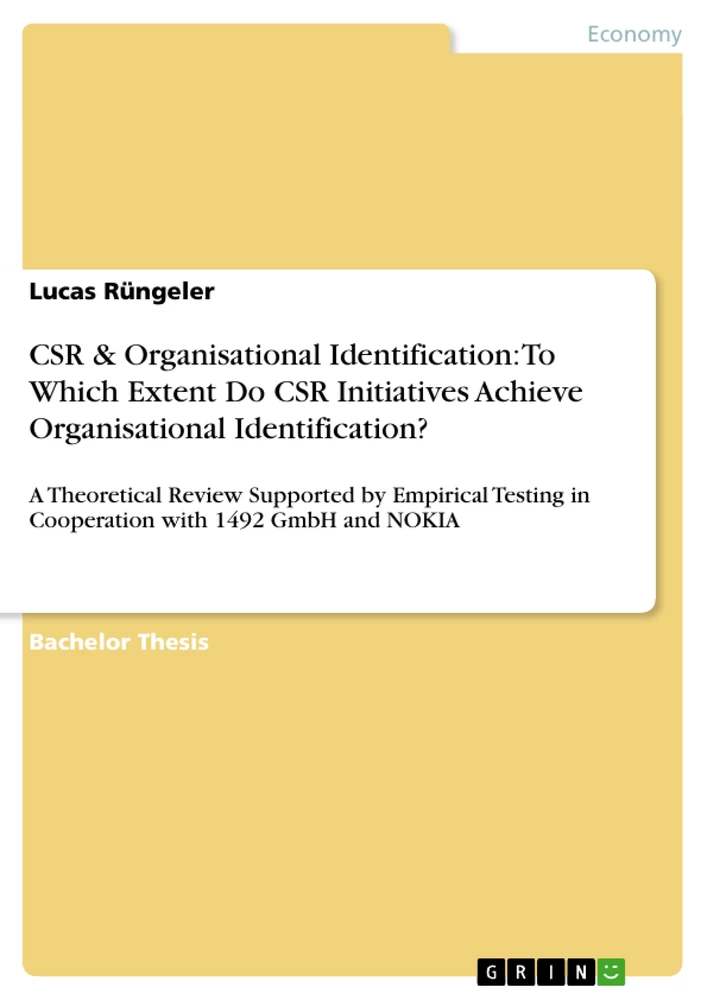
Table of Contents
1. Introduction
1.1 Question and Objectives
1.2 Methodology
2. Corporate Social Responsibility
2.1 History of Corporate Social Responsibility
2.2 Theoretical and Conceptual Framework of CSR Initiatives
2.2.1 Corporate Social Responsibility
2.2.2 Corporate Citizenship
2.2.3 CSR and CC as Basis for the Understanding of CSR Initiatives
2.3 The Usage of CSR Initiatives To Establish Lasting Stakeholder-Group Relationships With Employees
2.3.1 Basic Ideas of Stakeholder Theory & Stakeholder Management
2.3.2 Identification of Employees as First-Class-Stakeholder-Group
2.4 Intermediate Result
3. Organisational Identification of Employees
3.1 Theoretical and Conceptual Framework
3.1.1 The Emergence of the Concept of Organisational Identification
3.1.2 The Social Identity Approach as Theoretical Ground Work
3.2 The Social Identity Approach Applied to Organisations
3.2.1 Organisational Identification as Specific Form of Social Identification
3.2.2 Dimensions and Foci
3.2.3 Identity and Image of Organisations as Precondition for Organisational Identification
3.3 The Significance for Companies and Individuals
3.3.1 Reasoning for the Interest in Organisational Identification by Companies
3.3.2 Reasoning for the Interest in Organisational Identification by Individuals
3.4 Intermediate Result
4. Corporate Social Responsibility & Organisational Identification: To Which Extent Do CSR Initiatives Achieve Organisational Identification?
4.1 Functional Chain of Organisational Identification
4.2 Processes of the Emergence for Organisational Identification
4.2.1 Affinity
4.2.2 Emulation
4.2.3 Categorisation and Self-Enhancement
4.3 To Which Extent Do CSR Initiatives Achieve Organisational Identification?: Theoretical Reconstruction, Recent Developments in Scientific Research and Discussion
4.4 Intermediate Result
5. Empirical Testing: CSR & Organisational Identification in Terms of a Telecommunications Company
6. Summary and Outlook
Objectives and Core Topics
The primary objective of this thesis is to theoretically analyze and empirically test the correlation between Corporate Social Responsibility (CSR) initiatives and the Organisational Identification (OI) of employees, investigating to what extent such initiatives foster identification within a corporate setting.
- Theoretical link between CSR and employee identification
- Role of employees as a primary stakeholder group
- Social Identity Approach (SIA) as a framework for OI
- Empirical assessment of employee awareness and identification in a telecommunications company
Excerpt from the Book
3.1.1 The Emergence of the Concept of Organisational Identification
Among scientific literature the concept of OI is a relatively new concept, although it is related to terms such as identity or identification which were frequently discussed beforehand in the fields of psychology, sociology or social psychology. Early concepts of OI have primarily discussed identification merely in a work-related context in terms of job involvement or the intention of an employee to resign. One of the first to introduce a concept has been Foote, who posits that human beings tend to identify themselves to so called “fellow in groups”. According to Foote, group categorisations evoke certain behaviours and result into forms of commitment:
“These categorizations of experience motivate behaviour through the necessary commitment of individuals in all situations.”
Chapter Summaries
1. Introduction: This chapter introduces the significance of organisational identification and outlines the research objectives, which bridge theory and practice through an empirical survey.
2. Corporate Social Responsibility: This chapter provides a historical and conceptual overview of CSR and Corporate Citizenship, establishing why employees are critical stakeholders whose identification can be influenced by CSR initiatives.
3. Organisational Identification of Employees: This chapter establishes a theoretical framework for OI, drawing on the Social Identity Approach to explain how and why employees form bonds with their organizations.
4. Corporate Social Responsibility & Organisational Identification: To Which Extent Do CSR Initiatives Achieve Organisational Identification?: This chapter constructs a functional chain connecting CSR initiatives to OI, identifying affinity, emulation, and categorization as the key processes of this emergence.
5. Empirical Testing: CSR & Organisational Identification in Terms of a Telecommunications Company: This chapter presents an empirical study conducted at a telecommunications firm to test the hypothesis that employee identification is linked to their awareness of company CSR initiatives.
6. Summary and Outlook: This chapter summarizes the main findings and provides a final outlook on the future of research and practice regarding the interplay of CSR and organizational identification.
Keywords
Corporate Social Responsibility, CSR, Organisational Identification, Employee Identification, Stakeholder Theory, Social Identity Approach, Corporate Citizenship, Organisational Commitment, Employee Engagement, Internal Communication, Organizational Behavior, Corporate Image, Perceived Organisational Identity, Human Capital, Empirical Survey
Frequently Asked Questions
What is the primary focus of this research?
The research investigates the relationship between Corporate Social Responsibility (CSR) initiatives and the extent to which these initiatives foster Organizational Identification (OI) among employees.
Which theoretical frameworks support this work?
The study relies heavily on Stakeholder Theory to define the company-employee relationship and the Social Identity Approach (including Social Identity Theory and Self-Categorization Theory) to explain the psychological mechanisms behind organizational identification.
What is the core research question?
The central question is: To what extent do CSR initiatives contribute to achieving organizational identification among employees?
What methodology was used in this study?
The research combines a thorough theoretical literature review with an empirical survey conducted in cooperation with a consultancy and a telecommunications company.
How is the main body structured?
The thesis is structured into four main steps: defining the CSR concept, analyzing the concept of OI, theoretically reconstructing the link between the two, and testing this link through empirical survey data.
What are the characterizing keywords of this thesis?
Key terms include Corporate Social Responsibility (CSR), Organisational Identification (OI), Stakeholder Theory, Social Identity Approach, and employee engagement.
How did the survey measure employee identification?
The survey employed a Net Promoter Score (NPS) methodology, asking employees about their awareness of company CSR initiatives and their personal identification with the company community.
What are the findings regarding the link between CSR and identification?
The results indicate that while CSR initiatives have the potential to positively affect identification, the causal relationship is complex and influenced by other organizational factors, necessitating further research.
Ende der Leseprobe aus 73 Seiten
- nach oben
- Arbeit zitieren
- Lucas Rüngeler (Autor:in), 2009, CSR & Organisational Identification: To Which Extent Do CSR Initiatives Achieve Organisational Identification?, München, Page::Imprint:: GRINVerlagOHG, https://www.diplomarbeiten24.de/document/154235

neugierig - aktuell - relevant
Entdecken Sie hilfreiche Tipps und Tricks rund ums Studium!

Entdecken Sie hilfreiche Tipps und Tricks rund ums Studium!
Ihre Hausarbeit / Abschlussarbeit:

- - Publikation als E-Book und Buch
- - Hohes Honorar auf die Verkäufe
- - Für Sie komplett kostenlos - mit ISBN
- - Es dauert nur 5 Minuten
- - Jede Arbeit findet Leser

- © GRIN Publishing GmbH.
- Alle Inhalte urheberrechtlich geschützt. Kopieren und verbreiten untersagt.
- info@grin.com
- AGB
- Open Publishing
Der GRIN Verlag hat sich seit 1998 auf die Veröffentlichung akademischer eBooks und Bücher spezialisiert. Der GRIN Verlag steht damit als erstes Unternehmen für User Generated Quality Content. Die Verlagsseiten GRIN.com, Hausarbeiten.de und Diplomarbeiten24 bieten für Hochschullehrer, Absolventen und Studenten die ideale Plattform, wissenschaftliche Texte wie Hausarbeiten, Referate, Bachelorarbeiten, Masterarbeiten, Diplomarbeiten, Dissertationen und wissenschaftliche Aufsätze einem breiten Publikum zu präsentieren.
Kostenfreie Veröffentlichung: Hausarbeit, Bachelorarbeit, Diplomarbeit, Dissertation, Masterarbeit, Interpretation oder Referat jetzt veröffentlichen!
Folgen Sie GRIN auf


- GRIN Verlag GmbH
-
- Nymphenburger Str. 86
- 80636
- Munich, Deutschland
- +49 89-550559-0
- +49 89-550559-10
- info@grin.com
-
