
präsentiert von

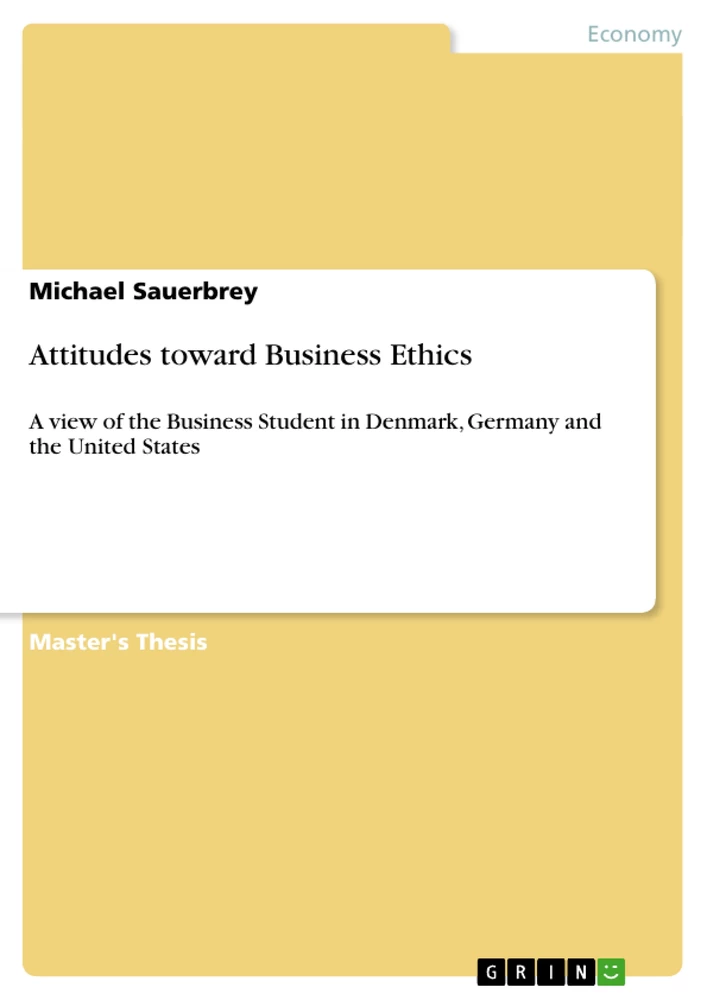
Table of Contents
1. INTRODUCTION
1.1 PROBLEM STATEMENT
1.2 OBJECTIVES
1.3 RESEARCH QUESTIONS
1.4 DELIMITATIONS
1.5 THESIS OUTLINE
2 PROLOGUE FOR BUSINESS ETHICS
2.1 MORALE, ETHICS, AND BUSINESS ETHICS
2.2 CRITIQUE OF ECONOMISM
2.3 BUSINESS : THE QUESTION OF MEANING
2.4 BUSINESS : THE QUESTION OF LEGITIMACY
3 ETHICAL THEORIES & BUSINESS ETHICS
3.1 TRADITIONAL THEORIES
3.2 CONTEMPORARY THEORIES
3.2.1 THE VIRTUE PERSPECTIVE
3.2.2 THE STAKEHOLDER PERSPECTIVE
3.2.3 THE SOCIAL CONTRACT PERSPECTIVE
3.2.4 THE INTEGRATIVE PERSPECTIVE
4 SOCIETY & BUSINESS ETHICS
4.1 THE CORPORATION AND THE INDIVIDUAL
4.1.1 CORPORATE SOCIAL RESPONSIBILITY
4.1.2 CORPORATE CITIZENSHIP
4.2 THE INDIVIDUAL AND THE CORPORATION
4.2.1 ETHICAL DECISION MAKING
4.2.2 ETHICAL LEADERSHIP
4.2.3 MORAL LEADER
4.2.4 INTEGRITY CULTURE & ETHICAL CORPORATE CONDUCT
4.3 SUMMARY
5 ATTITUDES OF BUSINESS STUDENTS
5.1 CULTURE
5.2 GENDER
5.3 ACADEMIC LEVEL & AGE
5.4 ETHICS COURSE
5.5 SUMMARY
6 METHODOLOGY
6.1 HYPOTHESES
6.2 RESEARCH APPROACH & DATA COLLECTION
6.3 QUESTIONNAIRE DESIGN
6.4 SAMPLE
6.5 ANALYTICAL APPROACH
7 RESULTS
7.1 MORAL DIMENSIONS
7.1.1 CULTURE
7.1.2 GENDER
7.1.3 ACADEMIC LEVEL
7.1.4 COURSE ATTENDANCE
7.1.5 GENDER * AGE
7.2 PRIMARY AND SOCIAL CORPORATE RESPONSIBILITIES
7.2.1 CULTURE
7.2.2 GENDER
7.2.3 ACADEMIC LEVEL
7.2.4 COURSE ATTENDANCE
7.2.5 GENDER * AGE
7.3 WELL-RUN COMPANY & JOB OFFER CRITERIA
7.3.1 CULTURE
7.3.2 GENDER
7.3.3 ACADEMIC LEVEL
7.3.4 COURSE ATTENDANCE
7.3.5 GENDER * AGE
7.4 SUMMARY: HYPOTHESES
8 DISCUSSION
9 CONCLUSION
9.1 KEY RESULTS
9.2 IMPLICATIONS
9.3 LIMITATIONS
9.4 FUTURE RESEARCH
Research Objectives and Themes
The primary objective of this master thesis is to investigate the moral mindset and attitudes toward business ethics among business students in Denmark, Germany, and the United States, and to develop a theoretical framework reflecting the role of business in society.
- Examination of business ethics theory regarding the relationship between business and society.
- Comparative analysis of attitudes among business students across three different cultural contexts.
- Investigation of demographic influences such as gender, academic level, age, and previous ethics education on students' moral mindsets.
- Identification of perceptions concerning corporate social responsibilities and career-related job offer criteria.
- Evaluation of business students' moral sensitivity and their readiness for ethical decision-making in future leadership roles.
Auszug aus dem Buch
1. INTRODUCTION
Taking a look at the world numerical table reveals a multitude of problems we are facing at present time. Regrettably, we must notice that business has an important stake in these developments. It seems as if the belief in the market that will provide for enough value if we just »let him do his good deed« (Thielemann 2009: 11) must be revisited. Consequently, we must critically admit that »after examining the good society that capitalism has created – the damage to the environment, the hunger and homelessness that exist even in wealthy areas of the world – can anyone today really believe that the pursuit of self interest has culminated in the common good?« (Freeman & Liedtka 1991: 93). It becomes evident that there is a link in the relation between business and society that is beyond mere profitability.
Even Friedman (1993) noted that even though business should »use its resources and engage in activities designed to increase its profits«, it should only act by »conforming to the rules of society, both those embodied in law and those embodied in ethical custom« (ibid: 56), that is »so long as it stays within the rules of the game« (ibid: 60).
Advocators of Friedman’s profit maximization position overlook that the societal rules of the game have changed over time. Economic and social responsibilities do not stand in an either-or relationship. In fact, the challenge for management today is that citizens of modern societies expect companies to achieve both aspects to a great extent (Andriof & MacIntosh 2001). We are seeing that »more and more people, individuals and groups call on all organizations, including business, to be economically, environmentally and socially sustainable; to be accountable and transparent; to be inclusive; to be ethical and more equitable« (Birch 2001: 53). In this sense, companies in their role as corporate citizens (Matten et al. 2003) have responsibilities toward society that go beyond the profit motive by reflecting »the social imperatives and social consequences of business success« (Matten & Moon 2008: 405). Thus, companies do not act in an amoral space, where business decisions are exclusively determined by economic factors of the market (Ulrich 2005). Rather, responsible business conduct is the essence of every good corporate citizen in fostering the public good (Birch 2001).
Summary of Chapters
1. INTRODUCTION: This chapter highlights the contemporary societal challenges and the crucial role of business, stating the research problem, objectives, and questions of this thesis.
2 PROLOGUE FOR BUSINESS ETHICS: This chapter explores fundamental concepts of morality, ethics, and ethos, and provides a critique of the economism paradigm.
3 ETHICAL THEORIES & BUSINESS ETHICS: This chapter reviews traditional and contemporary ethical theories, focusing on their relevance to the relationship between business and society.
4 SOCIETY & BUSINESS ETHICS: This chapter links business ethics theory to corporate management, specifically covering corporate social responsibility, citizenship, and the role of the individual.
5 ATTITUDES OF BUSINESS STUDENTS: This chapter summarizes findings from previous research regarding cultural, gender, age, and academic influences on student attitudes.
6 METHODOLOGY: This chapter describes the empirical research framework, including hypotheses, data collection, and the statistical analytical approach.
7 RESULTS: This chapter presents the empirical findings concerning moral dimensions, primary and social responsibilities, and corporate criteria, broken down by demographics.
8 DISCUSSION: This chapter evaluates and interprets the empirical findings in the context of the theoretical framework and current socio-economic realities.
9 CONCLUSION: This chapter summarizes the key results, implications for business schools and corporations, and suggests avenues for future research.
Keywords
Business Ethics, Corporate Social Responsibility, CSR, Corporate Citizenship, Moral Mindset, Business Students, Stakeholder Theory, Ethical Decision-Making, Sustainable Development, Economic Ethics, Corporate Governance, Cross-Cultural Analysis, Management Responsibility.
Frequently Asked Questions
What is the fundamental focus of this research?
The research explores the moral mindset and attitudes toward business ethics among business students in Denmark, Germany, and the United States, bridging theoretical ethics with empirical evidence.
What are the core thematic areas discussed in the work?
The work covers business ethics theory, corporate social responsibility (CSR), corporate citizenship, moral leadership, ethical decision-making processes, and the comparative attitudes of students across different nations.
What is the primary objective of this thesis?
The primary goal is to critically reflect on academic literature to create a theoretical framework, and subsequently perform an empirical study to investigate how business students evaluate the moral dimensions of business-society relations.
Which scientific method is employed?
The study utilizes a quantitative research approach, employing a self-report online questionnaire administered to 1,271 business students across three countries, followed by statistical analysis using SPSS.
What topics are covered in the main section of the thesis?
The main section moves from theoretical foundations—such as virtue ethics and the stakeholder perspective—to the empirical framework, providing an analysis of student attitudes based on culture, gender, academic level, and ethics education.
How can this work be categorized by keywords?
Key terms include Business Ethics, Corporate Social Responsibility, Stakeholder Theory, Moral Mindset, and Cross-Cultural Analysis in business education.
How do German and American students differ in their perception of government's role?
Both American and German students demonstrated a critical attitude toward the role and influence of government in the economy, generally disagreeing that governments are more trustworthy than multinational corporations.
What did the research conclude regarding the impact of business ethics courses?
The research found only marginal to moderate effects, suggesting that a single course has a limited impact on changing student attitudes, which are likely shaped by a more complex, ongoing socialization process.
Does age influence the ethical attitudes of the students?
Yes, the research identified significant effects on attitudes among junior and senior students, particularly indicating a critical socialization effect where older students sometimes showed shifting priorities regarding profitability and social values.
Ende der Leseprobe aus 157 Seiten
- nach oben
- Arbeit zitieren
- Michael Sauerbrey (Autor:in), 2010, Attitudes toward Business Ethics, München, Page::Imprint:: GRINVerlagOHG, https://www.diplomarbeiten24.de/document/156549

neugierig - aktuell - relevant
Entdecken Sie hilfreiche Tipps und Tricks rund ums Studium!

Entdecken Sie hilfreiche Tipps und Tricks rund ums Studium!
Ihre Hausarbeit / Abschlussarbeit:

- - Publikation als E-Book und Buch
- - Hohes Honorar auf die Verkäufe
- - Für Sie komplett kostenlos - mit ISBN
- - Es dauert nur 5 Minuten
- - Jede Arbeit findet Leser

- © GRIN Publishing GmbH.
- Alle Inhalte urheberrechtlich geschützt. Kopieren und verbreiten untersagt.
- info@grin.com
- AGB
- Open Publishing
Der GRIN Verlag hat sich seit 1998 auf die Veröffentlichung akademischer eBooks und Bücher spezialisiert. Der GRIN Verlag steht damit als erstes Unternehmen für User Generated Quality Content. Die Verlagsseiten GRIN.com, Hausarbeiten.de und Diplomarbeiten24 bieten für Hochschullehrer, Absolventen und Studenten die ideale Plattform, wissenschaftliche Texte wie Hausarbeiten, Referate, Bachelorarbeiten, Masterarbeiten, Diplomarbeiten, Dissertationen und wissenschaftliche Aufsätze einem breiten Publikum zu präsentieren.
Kostenfreie Veröffentlichung: Hausarbeit, Bachelorarbeit, Diplomarbeit, Dissertation, Masterarbeit, Interpretation oder Referat jetzt veröffentlichen!
Folgen Sie GRIN auf


- GRIN Verlag GmbH
-
- Nymphenburger Str. 86
- 80636
- Munich, Deutschland
- +49 89-550559-0
- +49 89-550559-10
- info@grin.com
-
