
präsentiert von

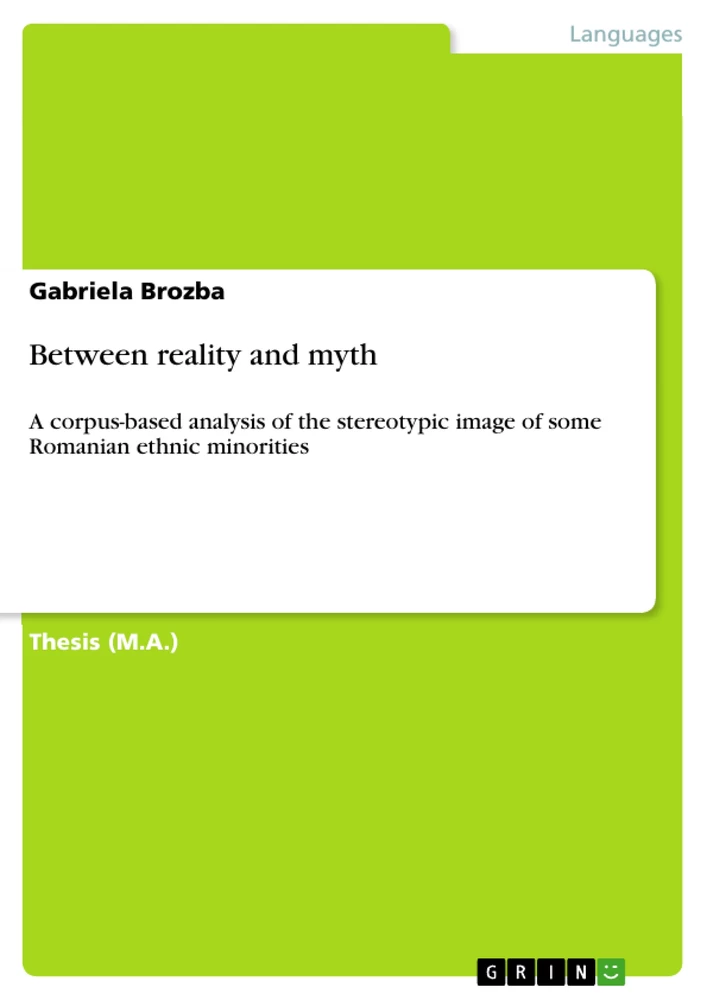
Table of Contents
1 Introduction
2 The Coordinates of Stereotype Thinking
2.1 Lippmann's view
3 The Relation Between the Self and the Group
4 Stereotype formation
4.1 The social origin of stereotypes
4.2 Ethnocentrism
4.3 Phenomena involved in the mechanism of stereotype formation
4.3.1 Illusory correlation
4.3.1.1 Explaining illusory correlations
4.3.1.1.1 Availability Heuristic
4.3.1.1.2 Schema-driven processing
4.3.2 Categorization
4.3.3 Outgroup homogeneity
5 Stereotyping and Language
5.1 The functions of language in intergroup contexts
5.2 The Language of Stereotyping
5.2.1 The foreigner
5.2.2 The stereotype of Rroma
5.2.3 The stereotype of the Jews
5.2.4 The Stereotype of the Turks
5.2.5 The stereotype of the Greeks
5.2.6 The stereotype of the Hungarians
5.2.7 Conclusion
6 Conclusions
7 Bibliography
Research Objectives and Thematic Focus
This study explores the relationship between language and stereotyping as a socio-cognitive process. The central research question examines how linguistic materials—specifically nicknames, forms of address, collocations, expressions, and proverbs—delineate the stereotypical images of ethnic minorities in Romania, including the Rroma, the Jews, the Turks, the Greeks, and the Hungarians.
- The link between language and socio-cognitive processes in stereotyping.
- The role of the "individual self" versus the "collective self" in social identity.
- Mechanisms of stereotype formation, including illusory correlation and categorization.
- Linguistic functions in transmitting, organizing, and maintaining stereotypes.
- A corpus-based analysis of ethnic stereotypes within the Romanian language.
Excerpt from the Book
4.1 The social origin of stereotypes
As already specified, stereotypes are social phenomena that are part of the ideology and ideological practices within any society. But then, how do they arise? One line of reasoning maintains that humans, whenever they lived, formed clans, consisting of several families, which shared some basic interests, the most important of which was to survive. In order to survive it is necessary to have water, food and intercourse, so any group of people should safeguard access to these. In times of shortage, however, the access to food and water was contested by other clans with the same basic interests. Given the human capacity to reflect, to communicate by language, this not only leads to fighting for what one needs and protecting what one has, but also to the development of accompanying tales in which intergroup comparisons are drawn. Stereotypes are formed, reflecting the conflicting interests and power differences between groups. Of course, today's society is far more complex, but the generated stereotypes that are formed basically reflect comparable conflicts of interests.
If stereotypes serve as a guideline within a specific social environment, they must contain perhaps not so much a 'kernel of truth' but cannot either be disseminated as blatantly false. Otherwise formulated, the perceived differences being made must be grounded in the experienced reality of everyday life. We can ascribe lesser intelligence to one group of people just as long as are in a position which prevents them from showing that they are not less intelligent. Thus, as long as stereotypes are not systematically falsified, that is, as long as possible inconsistencies can be resolved, stereotypes can be expected to resist. Although the evaluative meaning of the ascribed characteristics will be frequently negative if an outgroup is concerned, this does not mean that the characteristics do not reflect intergroup differences on a descriptive level.
Summary of Chapters
1 Introduction: Introduces the scope of the paper, focusing on the relation between language and stereotyping as a socio-cognitive process, and outlines the corpus-based methodology used to analyze Romanian ethnic stereotypes.
2 The Coordinates of Stereotype Thinking: Examines the psychological nature of impression formation and the functional necessity of stereotypes for cognitive economy, highlighting Lippmann's foundational view.
3 The Relation Between the Self and the Group: Discusses the distinction between the individual self and the collective self, emphasizing how self-categorization mediates intergroup behavior and perceptions.
4 Stereotype formation: Explores the socio-economic and cognitive origins of stereotypes, including ethnocentrism and mechanisms like illusory correlation and categorization.
5 Stereotyping and Language: Investigates the crucial role of language in transmitting, organizing, and maintaining stereotypes, and presents a detailed corpus-based analysis of ethnic stereotypes in Romanian.
6 Conclusions: Synthesizes the main findings, reiterating that language is a value-laden tool through which social identities and biases are constructed and communicated.
7 Bibliography: Provides a comprehensive list of academic sources and references used throughout the study.
Keywords
Stereotyping, Language, Ethnic Minorities, Socio-cognitive process, Romania, Collective mentality, Social Identity, Ingroup, Outgroup, Illusory correlation, Categorization, Proverbs, Linguistic analysis, Ethnocentrism, Prejudice.
Frequently Asked Questions
What is the core focus of this research?
The work fundamentally explores how language acts as a carrier and creator of stereotypical images regarding specific ethnic groups within the context of Romanian culture.
What are the primary thematic areas covered?
The study covers the psychological foundations of stereotype thinking, the relationship between individual and group identity, and how language functions to encode and reinforce social biases.
What is the central research question?
The primary research question addresses how linguistic materials, such as proverbs and idioms, delineate the stereotypical images of ethnic minorities like the Rroma, Jews, Turks, Greeks, and Hungarians in Romania.
Which scientific methods are employed?
The author uses a corpus-based analysis approach, examining linguistic material collected from the Dictionary of Romanian Language (DLR) and Iuliu Zanne’s collection of Romanian proverbs.
What does the main body of the work address?
The main body reviews the evolution of stereotype theory—from Lippmann’s foundational work to modern social identity theory—and provides a detailed linguistic analysis of ethnic stereotypes in Romanian.
How can this work be characterized by its keywords?
The study is characterized by the intersection of social psychology, linguistics, and cultural studies, specifically focusing on intergroup relations and the mechanisms of prejudice transmission.
How does the author define the "foreigner" in the context of the study?
The author analyzes the figure of the foreigner as a universal construction in group imagery, noting that Romanian terminology for "stranger" reflects specific historical and cultural developments, distinct from the pejorative loading often found in other languages.
What conclusion does the author reach regarding the role of language?
The author concludes that language is not value-free and serves as the essential tool for communicating prejudice interpersonally and across generations, making language analysis an indispensable method for accessing subtle, less controlled stereotyping processes.
Ende der Leseprobe aus 66 Seiten
- nach oben
- Arbeit zitieren
- Teaching Assistant Gabriela Brozba (Autor:in), 2007, Between reality and myth, München, Page::Imprint:: GRINVerlagOHG, https://www.diplomarbeiten24.de/document/157177

neugierig - aktuell - relevant
Entdecken Sie hilfreiche Tipps und Tricks rund ums Studium!

Entdecken Sie hilfreiche Tipps und Tricks rund ums Studium!
Ihre Hausarbeit / Abschlussarbeit:

- - Publikation als E-Book und Buch
- - Hohes Honorar auf die Verkäufe
- - Für Sie komplett kostenlos - mit ISBN
- - Es dauert nur 5 Minuten
- - Jede Arbeit findet Leser

- © GRIN Publishing GmbH.
- Alle Inhalte urheberrechtlich geschützt. Kopieren und verbreiten untersagt.
- info@grin.com
- AGB
- Open Publishing
Der GRIN Verlag hat sich seit 1998 auf die Veröffentlichung akademischer eBooks und Bücher spezialisiert. Der GRIN Verlag steht damit als erstes Unternehmen für User Generated Quality Content. Die Verlagsseiten GRIN.com, Hausarbeiten.de und Diplomarbeiten24 bieten für Hochschullehrer, Absolventen und Studenten die ideale Plattform, wissenschaftliche Texte wie Hausarbeiten, Referate, Bachelorarbeiten, Masterarbeiten, Diplomarbeiten, Dissertationen und wissenschaftliche Aufsätze einem breiten Publikum zu präsentieren.
Kostenfreie Veröffentlichung: Hausarbeit, Bachelorarbeit, Diplomarbeit, Dissertation, Masterarbeit, Interpretation oder Referat jetzt veröffentlichen!
Folgen Sie GRIN auf


- GRIN Verlag GmbH
-
- Nymphenburger Str. 86
- 80636
- Munich, Deutschland
- +49 89-550559-0
- +49 89-550559-10
- info@grin.com
-
