
präsentiert von

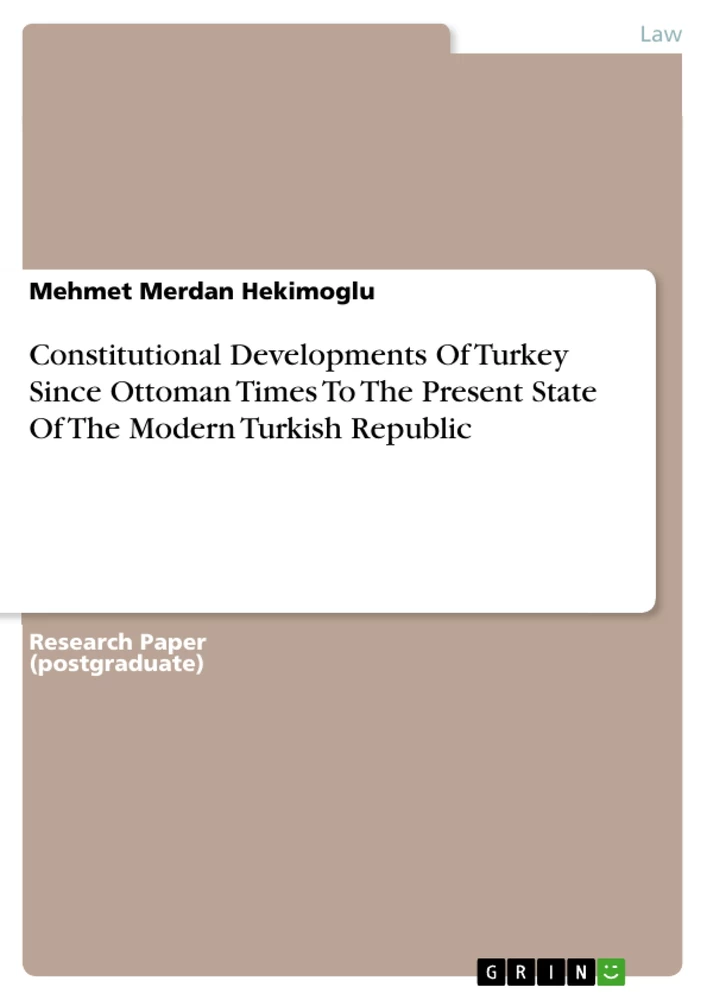
Table of Contents
Chapter 1
CONSTITUTIONAL DEVELOPMENTS IN THE OTTOMAN EMPİRE
I. The Ottoman Empire in General
II. The Legal System of the Ottoman Empire in General
III. Nizam-ı Cedit
IV. Sened-i İttifak
V. Tanzimat Fermanı (Gülhane Hattı Hümayunu)
VI. Islahat Fermanı
VII. Kanun-i Esasi (First Constitutional Monarchy)
VIII. II. Meşrutiyet (Second Constitutional Monarchy)
Chapter 2
CONSTITUTIONAL DEVELOPMENTS IN THE TURKİSH REPUBLİC
I. The start of the Turkish national liberation war period
II. The Constitution of 1921
III. The Constitution of 1924
IV. The Constitution of 1961
V. The Constitution of 1982
Research Objectives and Core Themes
This work aims to provide a comprehensive historical analysis of Turkish constitutional developments, tracing the evolution from the Ottoman Empire to the modern Turkish Republic to demonstrate the Turkish society's rich constitutional experience.
- Historical overview of legal and constitutional transitions from the Ottoman era to the present.
- Comparative analysis of constitutional laws and their alignment with Western legal traditions.
- Examination of the impact of European Union membership aspirations on domestic constitutional amendments.
- Evaluation of the role of internal dynamics versus external pressures in the constitution-making process.
Excerpt from the Book
I. The Ottoman Empire in General
Turkic tribes originated from Central Asia and accepted Muhammadanism around the middle of the 10th century, as a nation of immigrants, migrated to Anatolia in the last decades of the 11th century. They founded primarily the Selçuk (English Seljuk) State in the mid-11th century. The founder of the Selçuk State and its first ruler was Tuğrul Bey, the grandson of Selçuk (therefore “Selçuk” or “Seljuk”) the khan (leader) of a tribe of the Oghuz Turks. The Turk-controlled and ruled Ottoman Empire, which had been for six centuries an effective power in affairs between nations, was founded afterwards by a Turkish Emir Osman I (r. 1281–1326) the son of Ertugrul (for this reason “Osman” or “Ottoman”), attained the position of authority in 1299. As conquering power, the Empire was also affected by Byzantine forms in some ways like Court ceremonial and central administrative practices. Ottoman society was formed varied communities on the basis of differences in religion. The non-Muslim communities were hierarchically under the Islam community. However, other communities, especially in the field of private law were free in their own affairs. The Ottoman law was strictly valid in the field of public law. For example Jizya (Turkish Cizye) was a poll tax or a tribute or a head tax collected only from free non-Muslims adult males.
Summary of Chapters
Chapter 1: CONSTITUTIONAL DEVELOPMENTS IN THE OTTOMAN EMPİRE: Provides an overview of the Ottoman state structure, legal system, and early reform efforts, including the Sened-i İttifak, Tanzimat, and the First and Second Constitutional Monarchies.
Chapter 2: CONSTITUTIONAL DEVELOPMENTS IN THE TURKİSH REPUBLİC: Examines the constitutional evolution of modern Turkey, starting from the national liberation war and moving through the development and amendments of the 1921, 1924, 1961, and 1982 Constitutions.
Keywords
Constitutional Law, Ottoman Empire, Turkish Republic, Sultan, Tanzimat, Sened-i İttifak, Parliament, Secularism, Human Rights, Sovereignty, Constitution of 1921, Constitution of 1924, Constitution of 1961, Constitution of 1982, Legal Reform.
Frequently Asked Questions
What is the primary focus of this research?
The work provides a thorough survey of Turkish constitutional developments, detailing the transition from Ottoman-era legal practices to the modern constitutional framework of the Turkish Republic.
What are the central themes discussed in this book?
Key themes include the shift from absolute monarchic rule to parliamentary systems, the influence of Western law on Turkish reforms, and the historical struggle for a truly democratic and independent constitution.
What is the core objective of the author?
The primary goal is to present the Turkish constitutional experience as an advanced evolutionary process that demonstrates the capacity of the Turkish people to create a new constitution based on internal dynamics.
What methodology does the author employ?
The author uses a historical and comparative legal methodology, analyzing constitutional texts alongside the socio-political contexts of the Ottoman and Republican eras.
What does the main body of the work cover?
The main body is divided into two chapters, exploring the Ottoman legal heritage, constitutional decrees, and the subsequent constitutional documents (1921, 1924, 1961, and 1982) of the Turkish Republic.
How would you characterize the keywords of this work?
The work is characterized by terms reflecting legal history, state identity, and the formal evolution of legislative power in Turkey.
How does the author view the Sened-i İttifak?
The author identifies it as the first constitutional document in Ottoman history, though notes that it was more a reflection of power struggles among feudal elites rather than a broad social movement.
What is the significance of the 1961 Constitution according to the author?
The author considers it a turning point, as it introduced the constitutional court for the first time and established a system of judicial review for legislation.
How does the book address the impact of the European Union?
The book discusses how European standards, specifically the Copenhagen criteria, prompted significant constitutional amendments in 2001, 2004, and 2010 to strengthen human rights and democratic institutions.
What is the author's final conclusion regarding the future of the Turkish constitution?
The author concludes that the time is ripe for a new constitution created by the people themselves, marking a departure from past models driven by elite or external coercion.
Ende der Leseprobe aus 48 Seiten
- nach oben
- Arbeit zitieren
- Mehmet Merdan Hekimoglu (Autor:in), 2010, Constitutional Developments Of Turkey Since Ottoman Times To The Present State Of The Modern Turkish Republic, München, Page::Imprint:: GRINVerlagOHG, https://www.diplomarbeiten24.de/document/158150

neugierig - aktuell - relevant
Entdecken Sie hilfreiche Tipps und Tricks rund ums Studium!

Entdecken Sie hilfreiche Tipps und Tricks rund ums Studium!
Ihre Hausarbeit / Abschlussarbeit:

- - Publikation als E-Book und Buch
- - Hohes Honorar auf die Verkäufe
- - Für Sie komplett kostenlos - mit ISBN
- - Es dauert nur 5 Minuten
- - Jede Arbeit findet Leser

- © GRIN Publishing GmbH.
- Alle Inhalte urheberrechtlich geschützt. Kopieren und verbreiten untersagt.
- info@grin.com
- AGB
- Open Publishing
Der GRIN Verlag hat sich seit 1998 auf die Veröffentlichung akademischer eBooks und Bücher spezialisiert. Der GRIN Verlag steht damit als erstes Unternehmen für User Generated Quality Content. Die Verlagsseiten GRIN.com, Hausarbeiten.de und Diplomarbeiten24 bieten für Hochschullehrer, Absolventen und Studenten die ideale Plattform, wissenschaftliche Texte wie Hausarbeiten, Referate, Bachelorarbeiten, Masterarbeiten, Diplomarbeiten, Dissertationen und wissenschaftliche Aufsätze einem breiten Publikum zu präsentieren.
Kostenfreie Veröffentlichung: Hausarbeit, Bachelorarbeit, Diplomarbeit, Dissertation, Masterarbeit, Interpretation oder Referat jetzt veröffentlichen!
Folgen Sie GRIN auf


- GRIN Verlag GmbH
-
- Nymphenburger Str. 86
- 80636
- Munich, Deutschland
- +49 89-550559-0
- +49 89-550559-10
- info@grin.com
-
