
präsentiert von

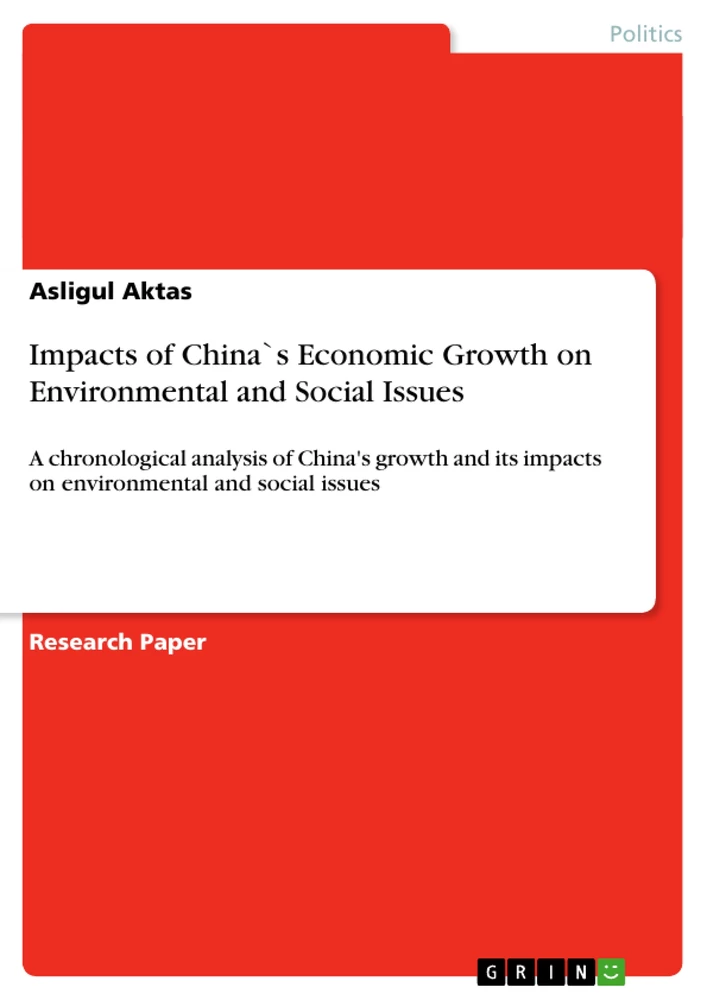
Table of Contents
1. Introduction
2. Status Quo
3. Standing of Government
4. Impacts of Environmental Pollution
Objectives and Research Themes
This paper examines the complex relationship between China's rapid economic development and its deteriorating environmental and social landscape. It seeks to analyze how the prevailing "grow first, clean up later" paradigm has created a vicious cycle of industrial output at the expense of ecological health, health costs, and long-term sustainability.
- Historical context of China's industrialization and economic growth
- Energy consumption patterns and the reliance on coal
- Environmental impacts, including soil erosion and air pollution
- The government's shifting attitude towards environmental regulations and energy efficiency
- Socio-economic trade-offs between productivity and human health
Excerpt from the Book
1. Introduction
When considering the historical background of China`s economic growth, trade-off between environmental protection and sustaining economic growth. Both the opening of free ports during 1978 industrialization process and the impact of 1997 Asian crisis, encouraged the heavy industry and urbanization. “Grow first, clean up later” approach have brought China into a vicious circle: Growth vs. Environmental Damage.
To be able measure the value of environmental loss exactly is almost impossible. The positive impacts of growth should be isolated to calculate the actual loss.
Chapter Summaries
1. Introduction: Outlines the historical context of China's industrialization and introduces the central tension between rapid economic expansion and environmental preservation.
2. Status Quo: Analyzes China's massive increase in energy consumption, specifically focusing on the heavy reliance on coal and its negative effects on the environment and public health.
3. Standing of Government: Explores the evolution of the Chinese government's policy regarding the environment, moving from initial denial and focus on growth to the recognition of necessary changes through energy efficiency plans.
4. Impacts of Environmental Pollution: Evaluates the real costs of pollution, noting that health risks and environmental damage now threaten to offset the gains made by productivity and industrial output.
Keywords
China, Economic Growth, Environmental Pollution, Sustainability, Coal Consumption, Industrialization, Energy Efficiency, GDP, Public Health, Air Pollution, Social Stability, Soil Erosion, Resource Dependency, Environmental Regulation, Productivity
Frequently Asked Questions
What is the core subject of this publication?
The publication examines the dual impact of China's rapid economic growth on its environment and social stability, specifically highlighting the consequences of heavy industrialization.
What are the primary thematic fields covered?
The key themes include energy consumption patterns, environmental degradation, government policy shifts, public health, and the economic sustainability of growth.
What is the central research question?
The study investigates the long-term viability of China's "grow first, clean up later" strategy and how the environmental and social costs weigh against economic productivity gains.
Which methodology is employed in the work?
The work utilizes a descriptive analysis of economic data, energy consumption statistics, and historical policy reviews to evaluate the environmental impacts of growth.
What is discussed in the main body?
The main body focuses on the status quo of energy usage, the political stance of the Chinese government towards environmental regulation, and the measurable impacts of pollution on GDP and public health.
Which keywords best characterize this work?
The work is defined by terms such as Economic Growth, Environmental Pollution, Coal Consumption, Sustainability, and Industrialization.
How has China's energy consumption changed since 2000?
China increased its energy consumption by 70% between 2000 and 2005, significantly driven by its heavy reliance on coal, which accounts for 68% of its energy supply.
What is the government's current stance on environmental pollution?
While the government historically prioritized growth over the environment, it has increasingly recognized the need for change, as evidenced by the introduction of Energy Efficiency Plans and new numerical targets for emission reductions.
What are the health-related costs of pollution in China?
The document highlights that health costs resulting from air pollution amounted to 1.16% of the GDP in 2003, with the real costs of environmental pollution estimated at roughly 10% of the GDP annually.
How does an ageing population affect China's economic outlook?
The ageing population creates a dilemma between consumption and productivity; as the productivity of older citizens is generally lower than their consumption, it poses a challenge to maintaining high-speed economic growth.
Ende der Leseprobe aus 6 Seiten
- nach oben
- Arbeit zitieren
- M.A. Asligul Aktas (Autor:in), 2009, Impacts of China`s Economic Growth on Environmental and Social Issues, München, Page::Imprint:: GRINVerlagOHG, https://www.diplomarbeiten24.de/document/158714

neugierig - aktuell - relevant
Entdecken Sie hilfreiche Tipps und Tricks rund ums Studium!

Entdecken Sie hilfreiche Tipps und Tricks rund ums Studium!
Ihre Hausarbeit / Abschlussarbeit:

- - Publikation als E-Book und Buch
- - Hohes Honorar auf die Verkäufe
- - Für Sie komplett kostenlos - mit ISBN
- - Es dauert nur 5 Minuten
- - Jede Arbeit findet Leser

- © GRIN Publishing GmbH.
- Alle Inhalte urheberrechtlich geschützt. Kopieren und verbreiten untersagt.
- info@grin.com
- AGB
- Open Publishing
Der GRIN Verlag hat sich seit 1998 auf die Veröffentlichung akademischer eBooks und Bücher spezialisiert. Der GRIN Verlag steht damit als erstes Unternehmen für User Generated Quality Content. Die Verlagsseiten GRIN.com, Hausarbeiten.de und Diplomarbeiten24 bieten für Hochschullehrer, Absolventen und Studenten die ideale Plattform, wissenschaftliche Texte wie Hausarbeiten, Referate, Bachelorarbeiten, Masterarbeiten, Diplomarbeiten, Dissertationen und wissenschaftliche Aufsätze einem breiten Publikum zu präsentieren.
Kostenfreie Veröffentlichung: Hausarbeit, Bachelorarbeit, Diplomarbeit, Dissertation, Masterarbeit, Interpretation oder Referat jetzt veröffentlichen!
Folgen Sie GRIN auf


- GRIN Verlag GmbH
-
- Nymphenburger Str. 86
- 80636
- Munich, Deutschland
- +49 89-550559-0
- +49 89-550559-10
- info@grin.com
-
