
präsentiert von

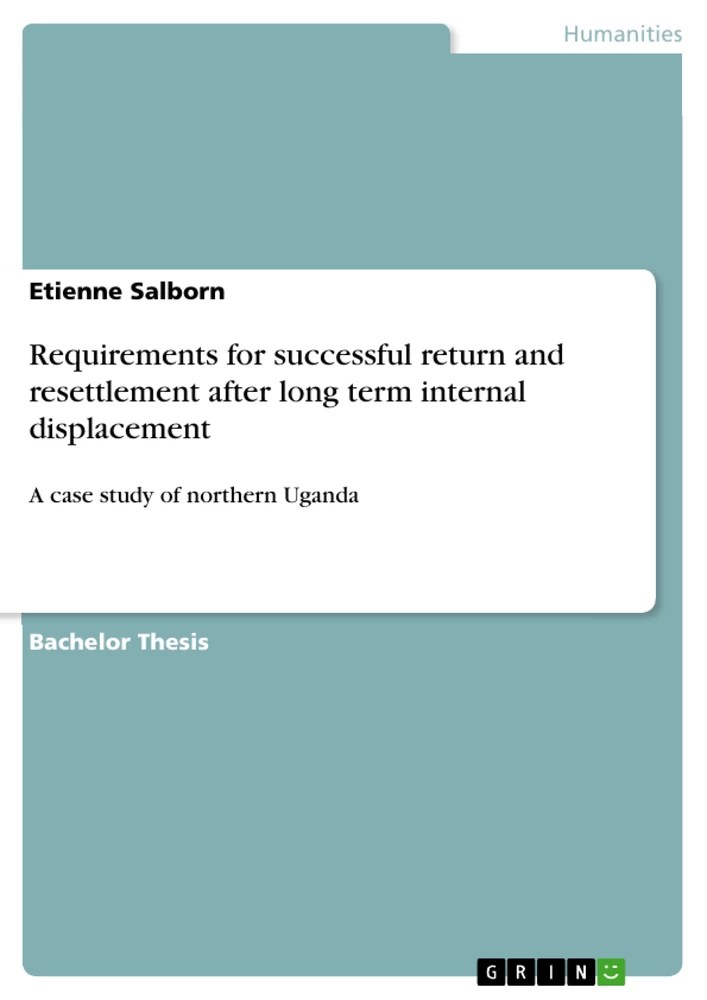
Table of Contents
1. Initial situation and problem definition
2. Background
2.1 Uganda: land and people
2.2 The stardom of the LRA and Joseph Kony
2.3 Legal framework: IDPs and refugees
3. Displacement
3.1 Profile of IDPs in Northern Uganda
4. Peace process
4.1 Peace vs. Justice
4.2 Amnesty for LRA fighters
4.3 The intervention from the International Criminal Court
4.4 Juba Peace Talks
4.5 Where the LRA went and their current actions
5. Return = resettlement = reintegration?
6. Patterns of return in Northern Uganda
6.1 The role of the Government of Uganda
6.1.1 Peace, Recovery and Development Plan for Northern Uganda
6.1.2 Camp phase out guidelines
7. Theoretical approaches
7.1 Lee’s push and pull factors
7.2 Conditions affecting the rate of return in conflict areas
7.2.1 Economic Prospects
7.2.2 Vulnerability
7.2.3 Time
7.2.4 Intensity
8. Requirements, factors and obstacles of return
8.1 Availability of services and infrastructure
8.1.1 Roads
8.1.2 Education
8.1.3 Health
8.1.4 Police
8.1.5 Water
8.2. Monetary funds and income
8.3 Resettlement kits
8.4. Landmines
8.5 Government deadlines
8.5.1 The end of food rations
8.6 Pressure from hosting population
8.7 Shelter
8.8 Assistance
8.9 Unfavourable conditions in the camps
9. Special cases
9.1 Land conflicts
9.2 Formerly abducted persons
9.3 Extremely Vulnerable Individuals (EVIs)
10. Discussion and conclusion
11. Limitation
Research Objectives and Key Topics
This thesis investigates the complex requirements and challenges associated with the return and resettlement of internally displaced persons (IDPs) in Northern Uganda following two decades of civil war. The primary research question addresses the essential circumstances and support structures needed to enable these populations to safely and sustainably transition from displacement camps to their areas of origin or new settlements.
- The impact of long-term displacement on social, economic, and traditional structures.
- Evaluation of governmental resettlement policies, including the Peace, Recovery and Development Plan (PRDP).
- Identification of critical barriers to return, such as land disputes, lack of infrastructure, and psychological trauma.
- Application of theoretical frameworks, specifically Lee’s push and pull factors, to analyze migration decisions.
- Specific needs of vulnerable groups, including formerly abducted persons and Extremely Vulnerable Individuals (EVIs).
Extract from the Book
8.1 Availability of services and infrastructure
The first ones to leave the IDP camps were generally the people who have been affected the least by the armed conflict and displaced for a relatively short period of time. They had the funds and means available once security seemed promising they returned. What they found was abandoned and empty land where almost all infrastructure had collapsed over the previous years. Basic services were unavailable. Reconstruction to a state as it was before displacement is necessary (Martin, Petty, Acidri 2009: 12).
Chapter Summary
1. Initial situation and problem definition: Outlines the historical context of the conflict in Northern Uganda and the resulting mass displacement of 1.8 million people, establishing the central research question.
2. Background: Provides geographical and cultural information about Uganda, details the history of the Lord’s Resistance Army (LRA), and explains the legal status of internally displaced persons.
3. Displacement: Analyzes the causes and conditions of the displacement in Northern Uganda, highlighting the impact on the Acholi population and their living standards in camps.
4. Peace process: Examines the attempts to resolve the conflict, focusing on the tension between amnesty and justice, the role of the ICC, and the impact of the Juba Peace Talks.
5. Return = resettlement = reintegration?: Defines the core terminology of the study and explains why successful return requires more than just physical relocation.
6. Patterns of return in Northern Uganda: Discusses the role of the Ugandan government and the implementation of recovery plans and camp phase-out guidelines.
7. Theoretical approaches: Applies migration theories, specifically Lee’s push and pull factors, to explain the decision-making process of IDPs regarding their return.
8. Requirements, factors and obstacles of return: Identifies and analyzes the practical barriers to sustainable return, including infrastructure, land issues, and financial support.
9. Special cases: Investigates the specific needs of vulnerable populations such as those involved in land conflicts, formerly abducted persons, and Extremely Vulnerable Individuals.
10. Discussion and conclusion: Synthesizes the findings, emphasizing that lasting peace and systemic support are vital for a successful return and the future development of the region.
11. Limitation: Acknowledges that while findings offer insights, conflict situations are unique and generalized solutions must be applied with caution.
Keywords
Northern Uganda, Internally Displaced Persons, IDP, Return and Resettlement, LRA, Lord's Resistance Army, PRDP, Peace Building, Reintegration, Land Conflicts, Humanitarian Assistance, Migration Theory, Acholi, Post-Conflict Reconstruction, Vulnerable Individuals.
Frequently Asked Questions
What is the primary subject of this thesis?
The thesis explores the conditions, requirements, and challenges involved in the return and resettlement of internally displaced persons (IDPs) in Northern Uganda after the cessation of a long-term civil conflict.
What are the central themes discussed in the work?
Key themes include the impact of displacement on livelihood, the effectiveness of governmental recovery plans, the role of infrastructure and basic services in return areas, and the specific needs of socially marginalized groups.
What is the central research question?
The research seeks to identify what circumstances and specific requirements must be met for internally displaced persons in Northern Uganda to successfully leave displacement camps and either return home or resettle elsewhere.
Which scientific methods were used in the research?
The study is primarily based on a comprehensive literature review, drawing on reports from international organizations, governmental documents, and sociological studies regarding migration and post-conflict recovery.
What does the main body of the work cover?
The main part covers the background of the conflict, the process of displacement, the peace negotiations, theoretical frameworks of migration, and a detailed analysis of obstacles to return, such as shelter, water access, and land disputes.
Which keywords characterize the work?
The core keywords include Northern Uganda, IDP, Resettlement, Peace Building, Reintegration, and Land Conflicts.
How does the author define the difference between "return" and "resettlement"?
In this study, "return" refers specifically to moving back to the individual's place of origin, whereas "resettlement" refers to moving to a different location that provides alternative conditions, as return to the original home might not always be viable.
Why is the "Peace, Recovery and Development Plan" (PRDP) criticized in the work?
The PRDP is criticized for significant delays in implementation and the poor quality of distributed materials, which many stakeholders felt failed to adequately address the psychological and long-term recovery needs of the population.
What role do land conflicts play in the resettlement process?
Land conflicts are identified as a major obstacle because land in Northern Uganda was traditionally held through oral customary tenure; as returnees re-evaluate the value of land, disputes have surged, hindering the ability of many to re-establish their farms.
Ende der Leseprobe aus 57 Seiten
- nach oben
- Arbeit zitieren
- Etienne Salborn (Autor:in), 2010, Requirements for successful return and resettlement after long term internal displacement, München, Page::Imprint:: GRINVerlagOHG, https://www.diplomarbeiten24.de/document/163462

neugierig - aktuell - relevant
Entdecken Sie hilfreiche Tipps und Tricks rund ums Studium!

Entdecken Sie hilfreiche Tipps und Tricks rund ums Studium!
Ihre Hausarbeit / Abschlussarbeit:

- - Publikation als E-Book und Buch
- - Hohes Honorar auf die Verkäufe
- - Für Sie komplett kostenlos - mit ISBN
- - Es dauert nur 5 Minuten
- - Jede Arbeit findet Leser

- © GRIN Publishing GmbH.
- Alle Inhalte urheberrechtlich geschützt. Kopieren und verbreiten untersagt.
- info@grin.com
- AGB
- Open Publishing
Der GRIN Verlag hat sich seit 1998 auf die Veröffentlichung akademischer eBooks und Bücher spezialisiert. Der GRIN Verlag steht damit als erstes Unternehmen für User Generated Quality Content. Die Verlagsseiten GRIN.com, Hausarbeiten.de und Diplomarbeiten24 bieten für Hochschullehrer, Absolventen und Studenten die ideale Plattform, wissenschaftliche Texte wie Hausarbeiten, Referate, Bachelorarbeiten, Masterarbeiten, Diplomarbeiten, Dissertationen und wissenschaftliche Aufsätze einem breiten Publikum zu präsentieren.
Kostenfreie Veröffentlichung: Hausarbeit, Bachelorarbeit, Diplomarbeit, Dissertation, Masterarbeit, Interpretation oder Referat jetzt veröffentlichen!
Folgen Sie GRIN auf


- GRIN Verlag GmbH
-
- Nymphenburger Str. 86
- 80636
- Munich, Deutschland
- +49 89-550559-0
- +49 89-550559-10
- info@grin.com
-
