
präsentiert von

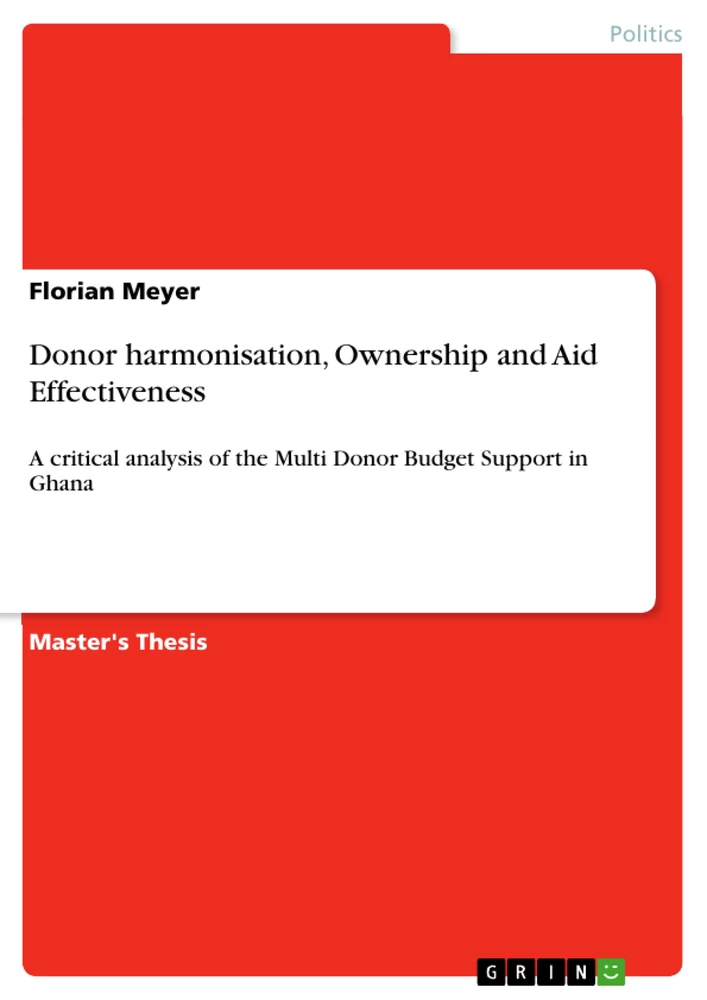
Table of Contents
1. Preface
2. Literature Review
2.1 The international context
2.2 The rise of budget support
2.3 The actual debate
3. The Multi Donor Budget Support in Ghana – An analysis
3.1 Operational structure
3.2 Achievements and challenges
3.2.1 Budget support, project aid and public financial management
3.2.2 Donor harmonisation, bilateral bypassing and the flexibility of the instrument
3.2.3 Conditionality, ownership and domestic accountability
3.2.4 Other challenges and risks
4. Conclusion
Research Objectives and Themes
The primary research objective of this paper is to analyze the effectiveness of Multi Donor Budget Support (MDBS) in Ghana, specifically evaluating its strengths, weaknesses, and potential for implementing international aid principles within a specific country context.
- Evaluation of General Budget Support (GBS) as an aid instrument.
- Analysis of the operational structure of MDBS in Ghana.
- Examination of donor harmonization and its impact on aid effectiveness.
- Assessment of the tension between conditionality and national ownership.
- Investigation of democratic legitimacy and the role of domestic accountability.
Excerpt from the Book
3.2.1 Budget support, project aid and public financial management
The decision to establish the MDBS in Ghana in 2003 was driven by a variety of positive factors and circumstances prevalent in the country. Its functioning liberal democracy and with it the political stability, economic liberalisation and sustainable growth as well as the political will to undergo difficult reforms in order to achieve long term sustainable development were some of the factors in favour for the decision to “take a leap of faith” and provide GBS in Ghana.
“Ghana has been far enough with their structural reforms and we only provide GBS to structurally robust recipients, where GBS can make a difference.”
Furthermore, Ghana has been something like a ‘donor’s darling’ for quite some time and thus it seems logical to provide GBS based on the above mentioned circumstances and the recent positive development of the country.
Another reason was the belief that the use of GBS could achieve better overall results than the provision of project aid alone. In consequence multiple interview partners underlined the advantages of GBS to classic project aid and the positive outcomes of the implementation in Ghana. One donor representative stated:
“Ghana needed fiscal stabilization and thus a lot of money needed to be disbursed quickly but aligned with the Paris Declaration. The instrument is known for improving the macroeconomic stability and strengthening the state structures and the PFM by using country systems, so that we decided to use it in order to tackle the fiscal imbalances of the country.”
Summary of Chapters
Preface: Introduces the shift in development aid strategies since the 1990s, focusing on the Paris Declaration and the emergence of program-based approaches like GBS.
Literature Review: Summarizes the international context of development aid and evaluates the academic debate regarding the strengths and weaknesses of budget support versus project aid.
The Multi Donor Budget Support in Ghana – An analysis: Provides a detailed empirical assessment of the MDBS framework in Ghana, including its operational structure, its performance, and existing challenges such as donor harmonization and domestic accountability.
Conclusion: Synthesizes the findings, confirming that while MDBS in Ghana faces specific challenges, it remains a functional example of implementing effective, country-aligned development aid.
Keywords
Budget support, MDBS, Ghana, Aid Effectiveness, Paris Declaration, Accra Agenda for Action, Donor Harmonization, Ownership, Conditionality, Public Financial Management, Domestic Accountability, Program-based approaches, Development aid, Policy dialogue, Governance.
Frequently Asked Questions
What is the core focus of this dissertation?
The dissertation provides a critical analysis of the Multi Donor Budget Support (MDBS) instrument in Ghana, examining its effectiveness in achieving development goals within the framework of the Paris Declaration.
What are the primary thematic areas covered?
The work covers donor harmonization, the balance between national ownership and conditionality, the role of domestic accountability, and the operational structure of budget support compared to traditional project aid.
What is the central research question?
The primary goal is to determine whether budget support can be an effective aid instrument if inherent problems are addressed and if it is properly adapted to the specific country context.
Which scientific methods were employed?
The author utilized a qualitative and interpretative approach, primarily based on semi-structured field interviews with donors, government officials, and civil society representatives in Accra, supplemented by an analysis of secondary literature and official datasets.
What topics are discussed in the main analysis?
The main part analyzes the operational structure of MDBS in Ghana, the progress assessment framework (PAF), donor behavior, the improvement of public financial management (PFM), and the inclusion of civil society.
How would you characterize this work using keywords?
Key terms include Budget Support, Aid Effectiveness, Donor Harmonization, Ownership, Ghana, and Public Financial Management.
How does the author explain the success of MDBS in Ghana?
The author attributes the success to Ghana's functioning democracy, political stability, and the committed willingness of the government to undergo reforms, alongside a shift toward more inclusive policy dialogues.
What role does the 'Progress Assessment Framework' (PAF) play?
The PAF serves as the central mechanism for monitoring progress, setting performance-based triggers for fund disbursements, and prioritizing policy aims within the development agenda.
How is the issue of 'bilateral bypassing' addressed?
The author identifies bilateral bypassing as a significant risk to donor harmonization, where donors pursue individual interests rather than joint strategies, and emphasizes the need for better multilateral coordination.
Ende der Leseprobe aus 45 Seiten
- nach oben
- Arbeit zitieren
- Florian Meyer (Autor:in), 2010, Donor harmonisation, Ownership and Aid Effectiveness , München, Page::Imprint:: GRINVerlagOHG, https://www.diplomarbeiten24.de/document/163566

neugierig - aktuell - relevant
Entdecken Sie hilfreiche Tipps und Tricks rund ums Studium!

Entdecken Sie hilfreiche Tipps und Tricks rund ums Studium!
Ihre Hausarbeit / Abschlussarbeit:

- - Publikation als E-Book und Buch
- - Hohes Honorar auf die Verkäufe
- - Für Sie komplett kostenlos - mit ISBN
- - Es dauert nur 5 Minuten
- - Jede Arbeit findet Leser

- © GRIN Publishing GmbH.
- Alle Inhalte urheberrechtlich geschützt. Kopieren und verbreiten untersagt.
- info@grin.com
- AGB
- Open Publishing
Der GRIN Verlag hat sich seit 1998 auf die Veröffentlichung akademischer eBooks und Bücher spezialisiert. Der GRIN Verlag steht damit als erstes Unternehmen für User Generated Quality Content. Die Verlagsseiten GRIN.com, Hausarbeiten.de und Diplomarbeiten24 bieten für Hochschullehrer, Absolventen und Studenten die ideale Plattform, wissenschaftliche Texte wie Hausarbeiten, Referate, Bachelorarbeiten, Masterarbeiten, Diplomarbeiten, Dissertationen und wissenschaftliche Aufsätze einem breiten Publikum zu präsentieren.
Kostenfreie Veröffentlichung: Hausarbeit, Bachelorarbeit, Diplomarbeit, Dissertation, Masterarbeit, Interpretation oder Referat jetzt veröffentlichen!
Folgen Sie GRIN auf


- GRIN Verlag GmbH
-
- Nymphenburger Str. 86
- 80636
- Munich, Deutschland
- +49 89-550559-0
- +49 89-550559-10
- info@grin.com
-
