
präsentiert von

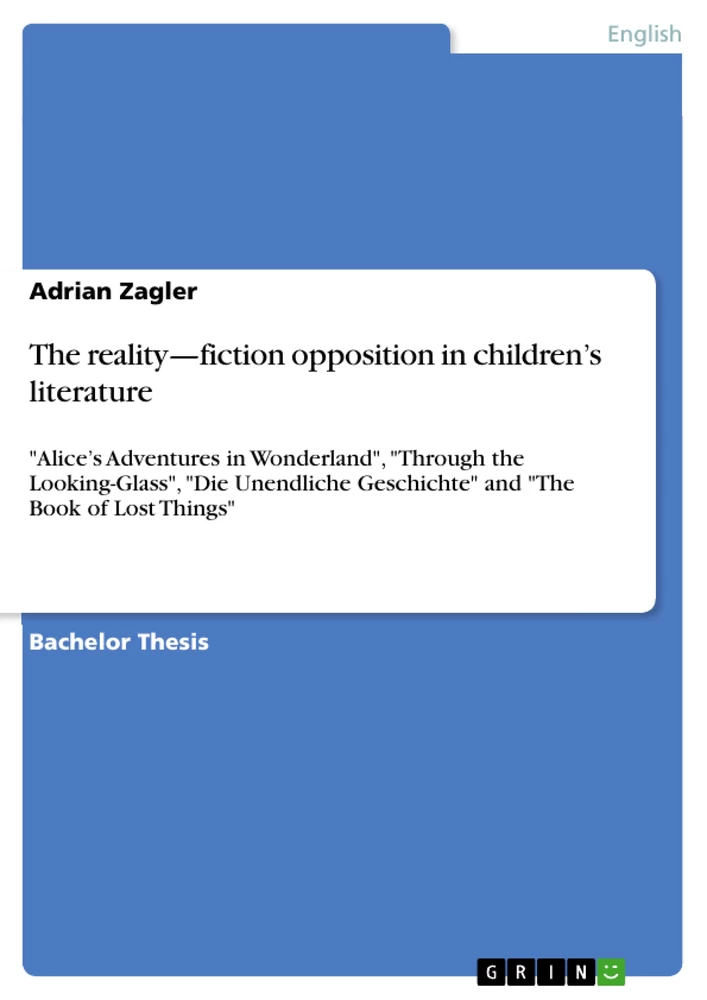
Table of Contents
1 General remarks on children’s literature and metareferentiality
1.1 The elusive nature of children’s literature
1.2 Literary metareference and the reality—fiction opposition
2 The reality—fiction opposition in Lewis Carroll’s Alice-stories
2.1 Introductory remarks and plot summary
2.2 Framing the border-crossing between reality and fiction
2.3 Metalepses and tangled hierarchies between reality and fiction
2.4 Carroll’s use of language in discussing the reality—fiction opposition
2.5 Carroll’s use of identity and illusion in discussing the reality—fiction opposition
2.6 Synopsis
3 The reality—fiction opposition in Michael Ende’s Die Unendliche Geschichte
3.1 Introductory remarks and plot summary
3.2 Framing the border-crossing between reality and fiction
3.3 Metalepses and tangled hierarchies between reality and fiction
3.4 Ende’s use of language in discussing the reality—fiction opposition
3.5 Ende’s use of language in discussing the reality—fiction opposition
3.6 Synopsis
4 The reality—fiction opposition in John Connolly’s The Book of Lost Things
4.1 Introductory remarks and plot summary
4.2 Framing the border-crossing between reality and fiction
4.3 Metalepses and tangled hierarchies between reality and fiction
4.4 Connolly’s use of language in discussing the reality—fiction opposition
4.5 Connolly’s use of identity and illusion in discussing the reality—fiction opposition
4.6 Synopsis
Objectives and Topics
This thesis examines the representation and treatment of the reality—fiction opposition within four classic and contemporary works of children’s literature. By applying theoretical frameworks of metareferentiality and metalepsis, the research explores how these novels navigate the boundaries between the 'real' world and the fictional constructs created by characters and authors.
- The structural depiction and framing of reality and fiction.
- Mechanisms of border-crossing (metalepsis) and their implications.
- The role of language in highlighting or blurring the reality—fiction divide.
- The relationship between truth, lies, identity, and illusion in narrative worlds.
Excerpt from the Book
Metalepses and tangled hierarchies between reality and fiction
Earlier in this paper, I have mentioned the characteristics of metalepsis, namely an intentional yet paradoxical crossing of borders between diegetically and/or ontologically separated worlds. Further, I have pointed out the three different types of metalepsis: rhetorical, epistemological and ontological. For the latter two, there are examples to be found in the Alice-stories.
Epistemological metalepsis happens, when characters in a story become aware of their own status as fictional beings. In Alice’s Adventures in Wonderland it is the heroine herself who uses this knowledge as a means of defence against the threat of the Queen of Hearts to behead her (cf. AW 161). The cards react with aggression towards Alice, who has laid bare their fictionality, and as a consequence, Alice awakes from her dream. In Through the Looking-Glass, on the other hand, the characters seem to be perfectly aware that they are only pieces in a chess game and act according to it.
Summary of Chapters
1 General remarks on children’s literature and metareferentiality: Establishes the theoretical framework by discussing the elusive definition of children's literature and the relevance of metareferentiality in the genre.
2 The reality—fiction opposition in Lewis Carroll’s Alice-stories: Analyzes the subversive nature of Carroll’s dream worlds and how they deconstruct conventional understandings of time, logic, and identity.
3 The reality—fiction opposition in Michael Ende’s Die Unendliche Geschichte: Explores the interconnectedness of reality and fiction through the meta-referential device of the "book within a book" and the power of naming.
4 The reality—fiction opposition in John Connolly’s The Book of Lost Things: Investigates how recent children's fiction utilizes traditional fairytales to address themes of violence, truth, and moral maturity in a dual-world setting.
Keywords
Children's literature, metareferentiality, reality—fiction opposition, Alice-stories, Die Unendliche Geschichte, The Book of Lost Things, metalepsis, mise en abyme, identity, illusion, fiction, narrative levels, reader, language, authorship.
Frequently Asked Questions
What is the fundamental focus of this research?
The work focuses on the intersection of children's literature and metareferentiality, specifically how four selected novels represent and challenge the opposition between reality and fiction.
Which texts serve as the primary focus?
The study examines Lewis Carroll's "Alice's Adventures in Wonderland" and "Through the Looking-Glass", Michael Ende's "Die Unendliche Geschichte", and John Connolly's "The Book of Lost Things".
What is the primary objective of this thesis?
To analyze and compare how these authors utilize structural and linguistic devices to blur the boundaries between reality and the fictional realms presented in their stories.
What academic approach is applied?
The analysis primarily employs the framework of Werner Wolf regarding metareferentiality and concepts of metalepsis to understand the hierarchical relationships between diegetic levels.
What are the core themes explored in the main body?
The main body treats the structural framing of story-worlds, the role of language in creating or destabilizing reality, and the impact of identity-related illusions on both characters and readers.
What keywords define this analysis?
Key terms include children's literature, metareferentiality, metalepsis, mise en abyme, and the reality—fiction opposition.
How do these books handle the "author" figure?
The thesis highlights that all four works employ specific mises en abyme to mirror the author-reader relationship, with varying degrees of authority and existential threat to the characters.
Does the research conclude that fiction is superior to reality?
While the authors take different stances, the thesis concludes that all four works suggest fiction and reality are fundamentally interdependent, with most arguing for a necessary conjunction of both for a holistic human experience.
Ende der Leseprobe aus 74 Seiten
- nach oben
- Arbeit zitieren
- Adrian Zagler (Autor:in), 2010, The reality—fiction opposition in children’s literature, München, Page::Imprint:: GRINVerlagOHG, https://www.diplomarbeiten24.de/document/164235

neugierig - aktuell - relevant
Entdecken Sie hilfreiche Tipps und Tricks rund ums Studium!

Entdecken Sie hilfreiche Tipps und Tricks rund ums Studium!
Ihre Hausarbeit / Abschlussarbeit:

- - Publikation als E-Book und Buch
- - Hohes Honorar auf die Verkäufe
- - Für Sie komplett kostenlos - mit ISBN
- - Es dauert nur 5 Minuten
- - Jede Arbeit findet Leser

- © GRIN Publishing GmbH.
- Alle Inhalte urheberrechtlich geschützt. Kopieren und verbreiten untersagt.
- info@grin.com
- AGB
- Open Publishing
Der GRIN Verlag hat sich seit 1998 auf die Veröffentlichung akademischer eBooks und Bücher spezialisiert. Der GRIN Verlag steht damit als erstes Unternehmen für User Generated Quality Content. Die Verlagsseiten GRIN.com, Hausarbeiten.de und Diplomarbeiten24 bieten für Hochschullehrer, Absolventen und Studenten die ideale Plattform, wissenschaftliche Texte wie Hausarbeiten, Referate, Bachelorarbeiten, Masterarbeiten, Diplomarbeiten, Dissertationen und wissenschaftliche Aufsätze einem breiten Publikum zu präsentieren.
Kostenfreie Veröffentlichung: Hausarbeit, Bachelorarbeit, Diplomarbeit, Dissertation, Masterarbeit, Interpretation oder Referat jetzt veröffentlichen!
Folgen Sie GRIN auf


- GRIN Verlag GmbH
-
- Nymphenburger Str. 86
- 80636
- Munich, Deutschland
- +49 89-550559-0
- +49 89-550559-10
- info@grin.com
-
