
präsentiert von

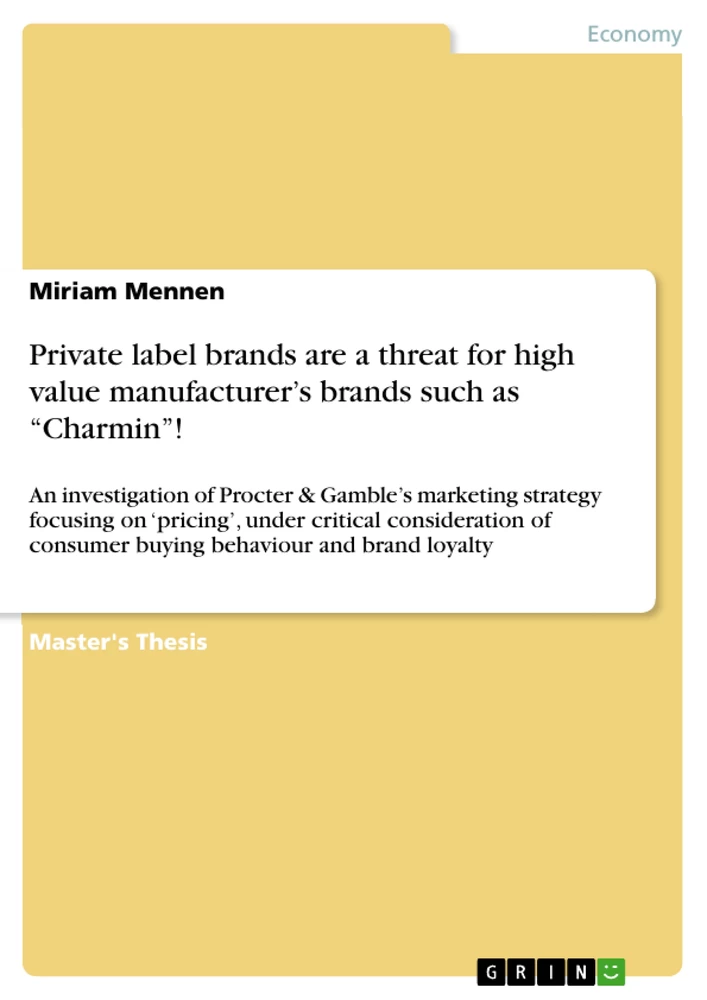
Table of Contents
I INTRODUCTION
1. Nature of Study
1.1 Company Profile – Procter & Gamble
1.1.1 Procter & Gamble - Germany
1.1.2 The brand ‘Charmin’
1.2 The Disposable Paper Industry
2. Aims of Study
3. Structure of Study
II LITERATURE REVIEW
1. Strategic integration of the research topic
1.1 Competitive advantage in an organisational context
1.2 Stakeholder theory relevant to Procter & Gamble
1.3 Decision Making & Value Innovation
2. Operational dimension relevant to Procter & Gamble
2.1 Marketing – A General Introduction
2.2 Branding
2.2.1 Emotional Branding
2.2.2 Private Label Brands
2.2.3 Private Label Brands vs. Manufacturer’s Brands in Germany
2.3 Pricing
2.3.1 Value-based pricing approach
2.3.2 Value-based pricing strategy
3. The role of consumer buyer behaviour
3.1 Market Segmentation
3.2 Buying Decision Process
3.3 German Consumer Buyer Behaviour
3.4 Customer Perceived Value
3.5 The Loyalty Factor
III METHODOLOGY
1 The researcher’s philosophy
2 The approach to the dissertation
3 Justification for research strategy selected
4 Data Collection
4.1 Sampling
4.2 Questionnaires
5 Credibility of research findings
6. Ethical Issues
IV ANALYSIS & DISCUSSION
1. Critically analyse strategic marketing changes and dynamics of the disposable paper industry
2. Analysis of Primary Data
2.1 Discussion of primary and secondary data
3 Conclusions about success or failure of P & G’s marketing strategy
V CONCLUSIN & RECOMMENDATIONS
1 Strategic marketing changes and the dynamics of the disposable paper sector
2. Consumer buying behaviour in the disposable paper sector
3. Success or Failure of P & G’s marketing strategy
4. Test of Hypothesis
5. Recommendations
6. Success of the project
7. Restricting elements and limitations
8. Areas of further study
9. Personal Reflection
Research Objectives and Themes
This research aims to investigate the influence of pricing and branding strategies on consumer buying behaviour within the disposable paper industry, specifically using Procter & Gamble's 'Charmin' brand as a case study to determine how global manufacturers can sustain competitive advantage against the growing threat of private label brands.
- Strategic marketing dynamics in the disposable paper industry
- Impact of 'value pricing' and premium branding on consumer loyalty
- Consumer buying behaviour and segmentation in the German market
- The relationship between retailer power and manufacturer strategies
Excerpt from the Book
1. Nature of study
The business area of strategic decision making in marketing and its interrelation to the achievement of consumer satisfaction has become increasingly important over the last few decades turning marketing activities into a critical success factor. Therefore, consumer buying behaviour around the world becomes very essential for companies in order to increase profitability. Consumer behaviour can be defined as “individuals or groups acquiring, using, and disposing of products, services, ideas, or experiences.” (Arnould et al, 2004, p.9) The researcher wants to investigate the linkage between consumer behaviour and a company’s marketing strategy with particular consideration of the pricing component. It is vital for a company to understand each of the above named stages in a consumption circle in order to achieve the best marketing opportunities.
Emotional benefits in marketing have received more and more attention and discussion because they work beyond the awareness of the customer and influence their buying behaviour. The New York Times states that, “over the last fifty years the economic base has shifted from production to consumption. It has gravitated from the sphere of rationality to the realm of desire: from the objective to the subjective; to the realm of psychology.” (Muschamp, 1999) Amongst others, Arnould et al (2004, p.20) state that “business stay in business not by producing products, building accounting systems, generating dividends for their owners, or managing employees”. Basically, companies continue their business by focusing, attracting and keeping customers, which they achieve through the exchange of resources like information, goods, emotions and money with their customers. This way, both parties receive benefits.
Summary of Chapters
I INTRODUCTION: Provides the background of the research, introduces Procter & Gamble and the disposable paper industry, and defines the research aims.
II LITERATURE REVIEW: Examines strategic management, competitive advantage, marketing theories, pricing strategies, and consumer buyer behaviour in a theoretical context.
III METHODOLOGY: Details the research philosophy, the deductive approach, the multi-method research design, and data collection techniques used.
IV ANALYSIS & DISCUSSION: Presents primary and secondary data analysis concerning industry dynamics, consumer behaviour in Germany, and the effectiveness of P & G’s strategies.
V CONCLUSIN & RECOMMENDATIONS: Summarizes research findings, tests the hypothesis, and provides recommendations for Procter & Gamble regarding future market challenges.
Keywords
Procter & Gamble, Disposable Paper Industry, Value Pricing Strategy, Consumer Buying Behaviour, Brand Loyalty, Private Label Brands, Market Segmentation, Marketing Mix, Competitive Advantage, Emotional Branding, Strategic Management, Retailer Power, Brand Equity, Customer Perceived Value, Market Research
Frequently Asked Questions
What is the core focus of this dissertation?
The research investigates Procter & Gamble’s marketing strategy in the disposable paper industry, with a specific focus on pricing and its influence on consumer buying behaviour and brand loyalty in Germany.
What are the primary themes discussed?
Key themes include competitive advantage, stakeholder theory, strategic decision-making, the impact of private label brands, market segmentation, and consumer behaviour within the Western economic context.
What is the central research hypothesis?
The study tests the hypothesis that private label brands represent a significant threat to high-value manufacturer’s brands, such as 'Charmin'.
Which methodology does the author employ?
The author uses a multi-method, deductive approach characterized by positivism, triangulating qualitative and quantitative data including secondary industry reports and primary survey data from German consumers.
What does the main body of the work cover?
It covers an extensive literature review, detailed analysis of the disposable paper industry, primary research findings through consumer questionnaires, and critical discussions on P & G's strategic performance.
How is the term "consumer behaviour" characterized in this study?
It is defined as the process of acquiring, using, and disposing of products, services, or ideas, which is influenced by cultural, social, personal, and psychological factors.
How does Procter & Gamble approach pricing?
P & G utilizes a 'value pricing strategy' rather than an 'everyday low pricing' (EDLP) model, focusing on superior product quality and emotional branding to justify premium price points.
What were the findings regarding German consumer loyalty?
The research suggests a contradiction where German consumers are highly price-conscious regarding discounter shopping, yet express significant brand loyalty once a product has earned their trust.
What impact does the 'Charmin' bear mascot have on consumers?
The study notes that advertising with the 'Charmin' bears successfully facilitates emotional bonding, helping consumers associate the brand with 'cute' and soft qualities beyond just functional performance.
Ende der Leseprobe aus 97 Seiten
- nach oben
- Arbeit zitieren
- Miriam Mennen (Autor:in), 2007, Private label brands are a threat for high value manufacturer’s brands such as “Charmin”! , München, Page::Imprint:: GRINVerlagOHG, https://www.diplomarbeiten24.de/document/164825

neugierig - aktuell - relevant
Entdecken Sie hilfreiche Tipps und Tricks rund ums Studium!

Entdecken Sie hilfreiche Tipps und Tricks rund ums Studium!
Ihre Hausarbeit / Abschlussarbeit:

- - Publikation als E-Book und Buch
- - Hohes Honorar auf die Verkäufe
- - Für Sie komplett kostenlos - mit ISBN
- - Es dauert nur 5 Minuten
- - Jede Arbeit findet Leser

- © GRIN Publishing GmbH.
- Alle Inhalte urheberrechtlich geschützt. Kopieren und verbreiten untersagt.
- info@grin.com
- AGB
- Open Publishing
Der GRIN Verlag hat sich seit 1998 auf die Veröffentlichung akademischer eBooks und Bücher spezialisiert. Der GRIN Verlag steht damit als erstes Unternehmen für User Generated Quality Content. Die Verlagsseiten GRIN.com, Hausarbeiten.de und Diplomarbeiten24 bieten für Hochschullehrer, Absolventen und Studenten die ideale Plattform, wissenschaftliche Texte wie Hausarbeiten, Referate, Bachelorarbeiten, Masterarbeiten, Diplomarbeiten, Dissertationen und wissenschaftliche Aufsätze einem breiten Publikum zu präsentieren.
Kostenfreie Veröffentlichung: Hausarbeit, Bachelorarbeit, Diplomarbeit, Dissertation, Masterarbeit, Interpretation oder Referat jetzt veröffentlichen!
Folgen Sie GRIN auf


- GRIN Verlag GmbH
-
- Nymphenburger Str. 86
- 80636
- Munich, Deutschland
- +49 89-550559-0
- +49 89-550559-10
- info@grin.com
-
