
präsentiert von

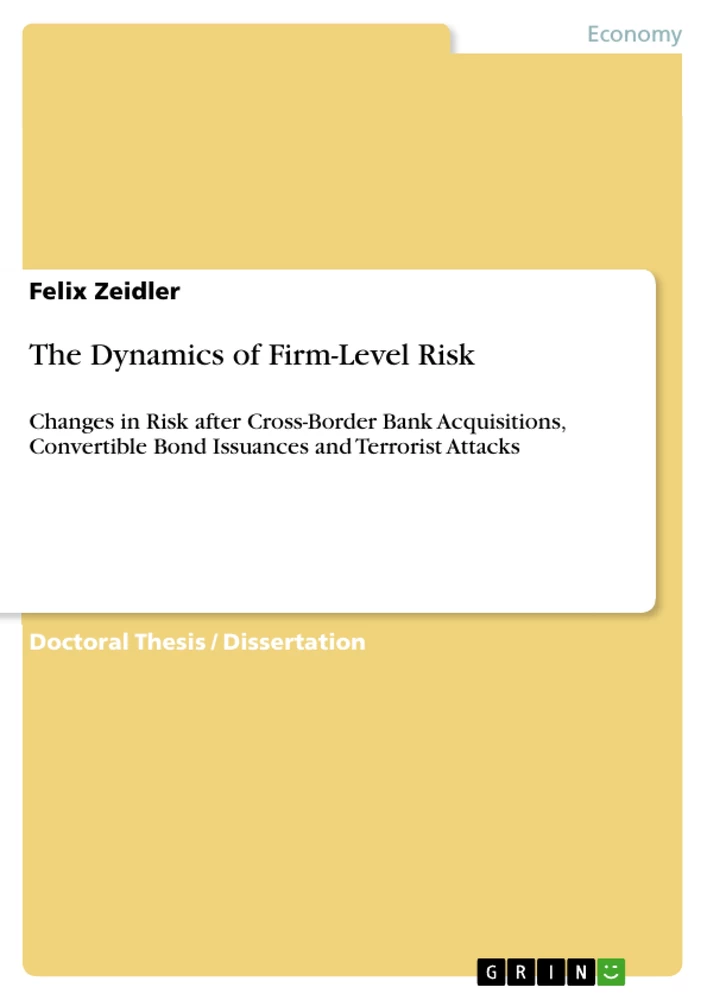
Table of Contents
1 INTRODUCTION
1.1 OVERVIEW AND GENERAL RESEARCH OBJECTIVE
1.2 ESSAY 1: RESEARCH QUESTIONS AND MAIN FINDINGS
1.3 ESSAY 2: RESEARCH QUESTIONS AND MAIN FINDINGS
1.4 ESSAY 3: RESEARCH QUESTIONS AND MAIN FINDINGS
2 CROSS-BORDER BANK ACQUISITIONS AND CHANGES IN BANK RISK
2.1 INTRODUCTION
2.2 RELATED LITERATURE
2.3 DATA AND METHODOLOGY
2.3.1 Sample and data
2.3.2 Measurements of (bank) risk
2.4 RESULTS
2.4.1 Univariate analysis of acquiring bank’s risk
2.4.2 The acquiring bank’s risk, functional diversification, and relative riskiness
2.4.3 Robustness Tests
2.4.3.1 Cross-sectional regression on risk changes after cross-border bank M&A
2.4.3.2 Quantile regression of revenue diversity
2.5 CONCLUSIONS
3 RISK DYNAMICS SURROUNDING THE ISSUANCE OF CONVERTIBLE BONDS
3.1 INTRODUCTION
3.2 RELATED LITERATURE
3.3 SAMPLE AND RESEARCH METHODS
3.3.1 Sample Construction
3.3.2 Matched Firm Selection
3.3.3 Measurements of Risk
3.4 RESULTS
3.4.1 Descriptive Analysis
3.4.2 Analysis of Systematic Risk Dynamics
3.4.2.1 Univariate Analysis of Systematic Risk Dynamics
3.4.2.2 Cross-sectional Analysis of Post-issuance Beta Changes
3.4.3 Systematic Risk and its Effects on Short- and Long-term Studies
3.4.3.1 Effects on Short-term Studies
3.4.3.2 Effects on Long-term Studies
3.5 CONCLUSION
4 TERROR ATTACKS AND THE EFFICIENCY OF RISK ADJUSTMENT
4.1 INTRODUCTION
4.2 RELATED LITERATURE
4.3 SAMPLE AND RESEARCH METHODS
4.3.1 Event Definition and Sample Construction
4.3.2 Measurements of Systematic and Total Risk
4.4 RESULTS
4.4.1 Descriptive Analysis
4.4.2 Analysis of Systematic Risk
4.4.2.1 Univariate Analysis
4.4.2.2 Regression Analysis
4.4.2.3 Implications for Event Study Methodology
4.4.3 Analysis of Total Firm and Systemic Risk
4.5 CONCLUSION
5 CONCLUSION
Objectives and Research Themes
This doctoral thesis investigates the dynamics of firm-level risk following significant corporate events. The central research objective is to examine how different corporate activities—namely cross-border bank acquisitions, the issuance of convertible bonds, and exposure to major terrorist attacks—influence the risk profiles of affected firms and whether these risk adjustments align with the hypothesis of efficient capital markets.
- Analysis of risk changes in the banking sector following cross-border mergers and acquisitions.
- Examination of systematic risk dynamics surrounding the issuance of convertible bonds.
- Evaluation of the efficiency and speed of risk adjustment to exogenous shocks like terrorist attacks.
- Comparison of risk adjustment processes between different firm types and geographic regions.
- Investigation of time-varying risk models (such as SBETA) versus traditional static risk measures.
Excerpt from the Book
1.1 Overview and General Research Objective
The seminal research of Markovitz (1959), Sharpe (1964), Lintner (1965), and Black (1972) marks the birth of modern finance theory which addresses the fundamental question of how the risk of an asset relates to its expected return. The notion that risk-averse investors choose portfolios that are “mean-variance-efficient” led to the field’s first coherent model (Perold (2004)) addressing this question: the Capital Asset Pricing Model (CAPM). It provides a formal framework for the idea that asset prices are affected only by certain risks, i.e. risks that cannot be diminished by diversifying, and states that the risk of an asset should be estimated relative to a “market portfolio.” Unfortunately, though, empirical tests have failed to find evidence to support the CAPM. Research has shown that the variation in expected returns is hardly related to the market beta. Many stock market anomalies have been documented that starkly contradict the theoretical predictions of the CAPM.
The conclusion that the static beta is dead has led to the development of several expansions of the model, for example, the intertemporal capital asset pricing model by Merton (1973) and the three-factor model by Fama and French (1993). Moreover, these developments have sparked a wide discussion regarding the assumption that the relation between risk and return remains constant over time. It is now widely accepted that risk factors, from the perspective of either a single-factor (e.g., CAPM) or a multi-factor model (e.g., the Fama-French model), vary substantially over time.
Summary of Chapters
1 INTRODUCTION: Outlines the fundamental research objective concerning time-varying firm risk and provides an overview of the three core essays within the dissertation.
2 CROSS-BORDER BANK ACQUISITIONS AND CHANGES IN BANK RISK: Investigates how bank acquisitions impact riskiness, finding that functional diversification leads to significant increases in firm-specific and total risk.
3 RISK DYNAMICS SURROUNDING THE ISSUANCE OF CONVERTIBLE BONDS: Analyzes how systematic risk fluctuates around convertible bond offerings, confirming that these dynamics provide a rational explanation for observed share price patterns.
4 TERROR ATTACKS AND THE EFFICIENCY OF RISK ADJUSTMENT: Examines whether risk adjustment to catastrophic information shocks is consistent with efficient capital market assumptions, using three major terror events as case studies.
5 CONCLUSION: Synthesizes the findings across all three essays, highlighting the importance of understanding risk dynamics and the rejection of the assumption that risk remains constant over time.
Keywords
Systematic Risk, Firm-level Risk, Bank Acquisitions, Convertible Bond Issuance, Terrorist Attacks, Risk Dynamics, SBETA Model, Market Efficiency, Volatility, Diversification, Beta, Financial Institutions, Corporate Finance, Capital Markets, Asset Pricing.
Frequently Asked Questions
What is the core focus of this doctoral thesis?
The thesis focuses on understanding how corporate events, such as mergers, financing decisions, and external shocks, affect the risk profiles of firms over time.
What are the central thematic areas?
The work covers three main areas: the impact of cross-border bank acquisitions on risk, the systematic risk dynamics of convertible bond issuers, and the efficiency of risk adjustment to major terrorist attacks.
What is the primary research objective?
The objective is to move beyond the assumption of static risk and analyze how corporate actions lead to time-varying risk dynamics, testing these movements against the efficient market hypothesis.
Which scientific methods are employed in this study?
The author uses empirical finance methodologies, including the SBETA model (a stochastic, mean-reverting beta process) for estimating time-varying systematic risk, GARCH models for volatility, and cross-sectional and quantile regressions.
What does the main body of the work cover?
The main body comprises three detailed essays that analyze specific empirical datasets, ranging from 264 cross-border bank mergers to over 4,000 firms involved in convertible bond or seasoned equity offerings, and 334 financial institutions impacted by terror attacks.
How would you characterize this work with keywords?
The work is defined by terms like systematic risk, time-varying risk, corporate finance, event studies, and market efficiency.
How does functional diversification affect bank risk according to the findings?
The study finds that banks that diversify functionally experience large and persistent increases in firm-specific and total risk, contradicting the general notion that diversification inherently reduces risk.
Does the adjustment of risk support the efficient market hypothesis?
Yes, the author concludes that the adjustment of risk to new information, particularly regarding the events of 9/11, is consistent with the notion of efficient capital markets, where risk levels are repriced rapidly following significant information shocks.
Ende der Leseprobe aus 116 Seiten
- nach oben
- Arbeit zitieren
- Felix Zeidler (Autor:in), 2008, The Dynamics of Firm-Level Risk, München, Page::Imprint:: GRINVerlagOHG, https://www.diplomarbeiten24.de/document/168691

neugierig - aktuell - relevant
Entdecken Sie hilfreiche Tipps und Tricks rund ums Studium!

Entdecken Sie hilfreiche Tipps und Tricks rund ums Studium!
Ihre Hausarbeit / Abschlussarbeit:

- - Publikation als E-Book und Buch
- - Hohes Honorar auf die Verkäufe
- - Für Sie komplett kostenlos - mit ISBN
- - Es dauert nur 5 Minuten
- - Jede Arbeit findet Leser

- © GRIN Publishing GmbH.
- Alle Inhalte urheberrechtlich geschützt. Kopieren und verbreiten untersagt.
- info@grin.com
- AGB
- Open Publishing
Der GRIN Verlag hat sich seit 1998 auf die Veröffentlichung akademischer eBooks und Bücher spezialisiert. Der GRIN Verlag steht damit als erstes Unternehmen für User Generated Quality Content. Die Verlagsseiten GRIN.com, Hausarbeiten.de und Diplomarbeiten24 bieten für Hochschullehrer, Absolventen und Studenten die ideale Plattform, wissenschaftliche Texte wie Hausarbeiten, Referate, Bachelorarbeiten, Masterarbeiten, Diplomarbeiten, Dissertationen und wissenschaftliche Aufsätze einem breiten Publikum zu präsentieren.
Kostenfreie Veröffentlichung: Hausarbeit, Bachelorarbeit, Diplomarbeit, Dissertation, Masterarbeit, Interpretation oder Referat jetzt veröffentlichen!
Folgen Sie GRIN auf


- GRIN Verlag GmbH
-
- Nymphenburger Str. 86
- 80636
- Munich, Deutschland
- +49 89-550559-0
- +49 89-550559-10
- info@grin.com
-
