
präsentiert von

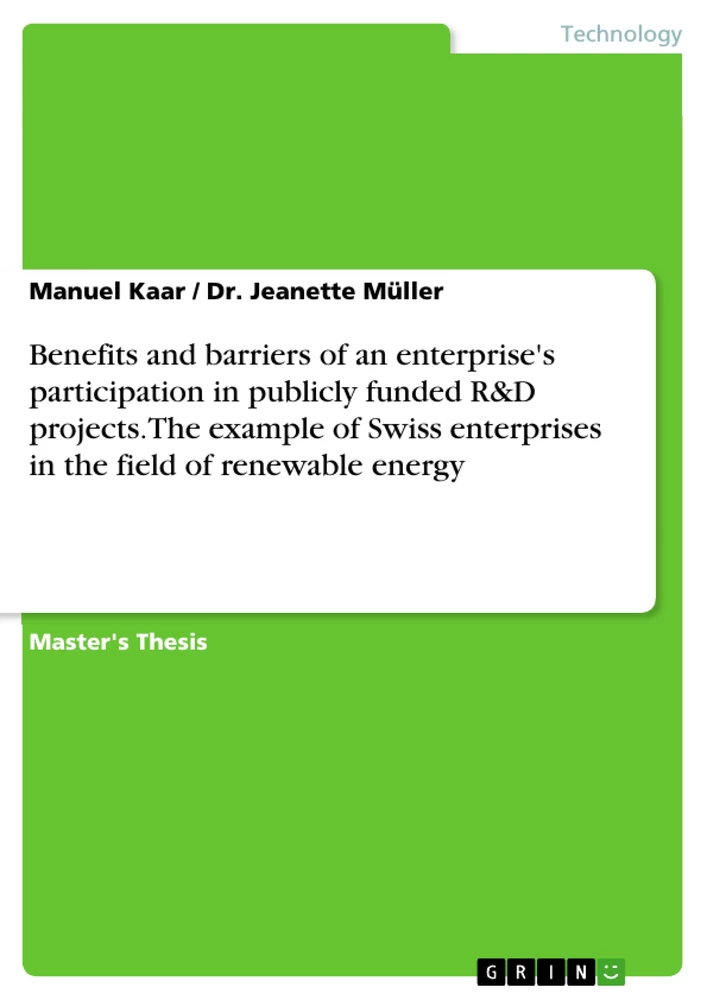
Table of contents
1 Introduction
2 Review of selected theories on firm competitiveness
2.1 General aspects
2.2 Industrial organisation view
2.3 Resource-based view of the firm
2.4 Dynamic capabilities
2.5 Knowledge-based view of the firm
3 R&D funding in Switzerland
3.1 General aspects
3.1.1 Switzerland as a research location
3.1.2 Relevant Swiss research promoting institutions
3.1.3 SME specific issues
3.2 Funding programmes of the SFOE
3.2.1 Hydropower research
3.2.2 Biomass and Wood energy research
3.2.3 Photovoltaics research
3.2.4 Solar heat and heat storage research
3.2.5 Wind energy research
3.2.6 Heat pumping technologies, cogeneration, refrigeration research
3.2.7 Indirect support of geothermal energy
3.3 Funding by the CTI
3.3.1 R&D projects
3.3.2 The CTI "Innovationsscheck"
3.3.3 Feasibility studies
4 R&D funding at the European level
4.1 General aspects
4.1.1 Europe as a research location
4.1.2 Relevant EU research promoting instruments
4.1.3 SME specific issues
4.2 7th Framework Programme for Research and Technological Development
4.2.1 FP7-Cooperation-ENERGY
4.2.2 FP7-Cooperation-ENVIRONMENT
4.2.3 FP7-Capacities-Research for the benefit of SMEs
4.3 EUREKA
4.4 EUREKA Eurostars
5 Potential benefits of and barriers to participation for SMEs
5.1 Benefits
5.1.1 Reduced time-to-market for a product
5.1.2 Outsourcing of R&D
5.1.3 Financing a demonstration or prototype project
5.1.4 Acquiring intellectual property rights
5.1.5 Accessing new technological know-how
5.1.6 Expanding the company network
5.1.7 Enhanced company reputation and visibility
5.1.8 Economic impacts
5.2 Barriers
6 Research methodology
6.1 Research questions and hypotheses
6.2 Quantitative research (company survey)
6.2.1 Sampling approach
6.2.2 Collaboration with external organisations
6.2.3 Questionnaire and survey implementation
6.3 Qualitative research (expert interviews with funding bodies)
6.4 Data analysis
7 Research findings
7.1 Response rate
7.2 Previous participation vs. non-participation
7.3 Companies with previous participation
7.3.1 Funding bodies used
7.3.2 Benefits gained from participation
7.3.3 Companies’ evaluation of their participation
7.4 Companies without previous participation
8 Discussion of research findings
8.1 Companies with previous participation
8.1.1 Funding bodies used
8.1.2 Benefits gained from participation
8.1.3 Companies’ evaluation of their participation
8.2 Companies without previous participation
9 Conclusion and recommendations
Research Objectives and Core Topics
This thesis examines the role of small and medium-sized enterprises (SMEs) in publicly funded research and development (R&D) projects within the renewable energy sector in Switzerland. The primary research goal is to determine how participation in such programs influences an SME's competitiveness, how participating companies evaluate these programs, and why other SMEs choose not to participate.
- Impact of publicly funded R&D projects on SME competitiveness.
- Evaluation of funding programs by SMEs with prior participation experience.
- Identification of barriers preventing SMEs from engaging in R&D funding programs.
- Analysis of national and EU funding landscape for renewable energy.
- Assessment of "system competence" as a prerequisite for project involvement.
Extract from the Book
5.1.2 Outsourcing of R&D
The analysis in the previous chapters revealed that several public funding programmes offer companies the possibility to outsource R&D work to universities or other research institutions within the context of a funded project. This provides firms with the important opportunity to obtain research results without having to finance the full cost of the external institution’s services themselves. For SMEs this option may represent an especially important advantage, as they are frequently not in the position to initiate collaborations with a university without external assistance, whereas larger companies usually possess the necessary capacities to establish such partnerships themselves (Swiss Confederation, 2010). Working with research providers within the scope of a funded project usually also brings the companies together with the leading scientists in their field, which may in turn encourage the SMEs to engage in R&D themselves in the future.
Summary of Chapters
1 Introduction: Provides a background on the energy sector and the importance of SME-driven R&D, while outlining the scope and objectives of the research.
2 Review of selected theories on firm competitiveness: Discusses core management theories, including the industrial organisation view and the resource-based view, to establish a framework for analysis.
3 R&D funding in Switzerland: Details the Swiss research landscape, highlighting specific funding programs from the SFOE and CTI available for SMEs in renewable energy.
4 R&D funding at the European level: Explores European funding instruments like the 7th Framework Programme and EUREKA/Eurostars, focusing on their relevance to SMEs.
5 Potential benefits of and barriers to participation for SMEs: Categorises the strategic advantages of project involvement, such as reduced time-to-market, and identifies common obstacles to participation.
6 Research methodology: Describes the mixed-methods approach, detailing the online company survey design and the structure of expert interviews conducted with funding bodies.
7 Research findings: Presents the empirical data gathered from the survey, providing a breakdown of SME experiences with funding programs.
8 Discussion of research findings: Interprets the empirical data in the context of the theoretical framework, assessing hypotheses regarding SME competitiveness and barriers.
9 Conclusion and recommendations: Summarises the research, provides final insights on the impact of public funding, and offers advice for SMEs and policy makers.
Keywords
SME, R&D, Renewable Energy, Public Funding, Firm Competitiveness, Switzerland, European Union, FP7, SFOE, CTI, Eurostars, Resource-based view, Innovation, Research Funding, Technology Transfer
Frequently Asked Questions
What is the core focus of this Master's Thesis?
The study primarily investigates the participation of small and medium-sized enterprises (SMEs) in publicly funded research and development (R&D) projects, specifically within the Swiss renewable energy sector.
What are the central thematic fields covered in the work?
The work covers theoretical concepts of firm competitiveness, an overview of national (Swiss) and European R&D funding programs, and a practical empirical study on benefits and barriers for SMEs.
What is the primary objective of this research?
The main goal is to determine how participation in publicly funded R&D projects affects the competitiveness of SMEs, how they evaluate their experiences, and what barriers prevent non-participating SMEs from applying.
Which scientific methodology was utilized?
The author employed a mixed-methods approach, combining a quantitative online company survey of Swiss SMEs with qualitative semi-structured expert interviews conducted with representatives of major funding bodies.
What topics are discussed in the main body of the thesis?
The main body treats theoretical foundations (resource-based view, dynamic capabilities), a detailed presentation of SFOE and CTI programs, European instruments (FP7, EUREKA), and a comprehensive analysis of survey findings regarding participant benefits and non-participant barriers.
Which keywords best characterize this research?
Key terms include SME, R&D, Renewable Energy, Public Funding, Firm Competitiveness, Switzerland, European Union, FP7, SFOE, and CTI.
How does the author define the barrier of "system competence"?
The author adopts the term from existing literature, defining it as a firm's capability to recognize, seek out, and successfully access public support opportunities, which is a key requirement for participation.
What were the main conclusions regarding the effectiveness of funding?
The research concludes that public funding is often a crucial prerequisite for innovation projects, as the majority of participants stated their projects would not have been realized without these financial measures.
Ende der Leseprobe aus 124 Seiten
- nach oben
- Arbeit zitieren
- MSc, MA Manuel Kaar (Autor:in), Dr. Jeanette Müller (Autor:in), 2011, Benefits and barriers of an enterprise's participation in publicly funded R&D projects. The example of Swiss enterprises in the field of renewable energy, München, Page::Imprint:: GRINVerlagOHG, https://www.diplomarbeiten24.de/document/169649

neugierig - aktuell - relevant
Entdecken Sie hilfreiche Tipps und Tricks rund ums Studium!

Entdecken Sie hilfreiche Tipps und Tricks rund ums Studium!
Ihre Hausarbeit / Abschlussarbeit:

- - Publikation als E-Book und Buch
- - Hohes Honorar auf die Verkäufe
- - Für Sie komplett kostenlos - mit ISBN
- - Es dauert nur 5 Minuten
- - Jede Arbeit findet Leser

- © GRIN Publishing GmbH.
- Alle Inhalte urheberrechtlich geschützt. Kopieren und verbreiten untersagt.
- info@grin.com
- AGB
- Open Publishing
Der GRIN Verlag hat sich seit 1998 auf die Veröffentlichung akademischer eBooks und Bücher spezialisiert. Der GRIN Verlag steht damit als erstes Unternehmen für User Generated Quality Content. Die Verlagsseiten GRIN.com, Hausarbeiten.de und Diplomarbeiten24 bieten für Hochschullehrer, Absolventen und Studenten die ideale Plattform, wissenschaftliche Texte wie Hausarbeiten, Referate, Bachelorarbeiten, Masterarbeiten, Diplomarbeiten, Dissertationen und wissenschaftliche Aufsätze einem breiten Publikum zu präsentieren.
Kostenfreie Veröffentlichung: Hausarbeit, Bachelorarbeit, Diplomarbeit, Dissertation, Masterarbeit, Interpretation oder Referat jetzt veröffentlichen!
Folgen Sie GRIN auf


- GRIN Verlag GmbH
-
- Nymphenburger Str. 86
- 80636
- Munich, Deutschland
- +49 89-550559-0
- +49 89-550559-10
- info@grin.com
-
