
präsentiert von

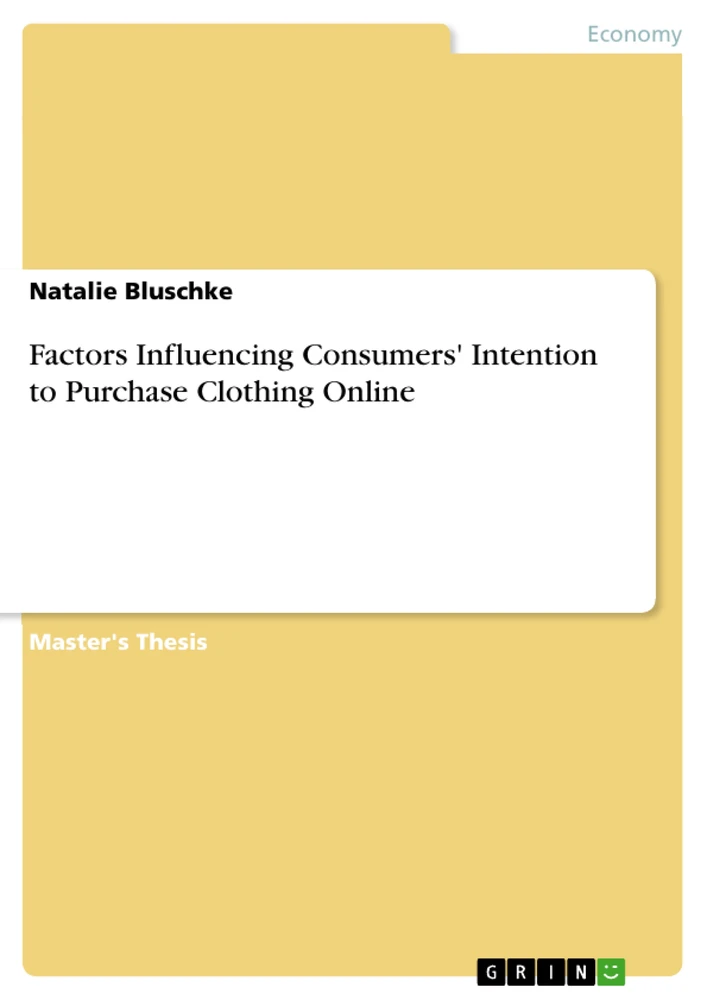
Table of Contents
1. Introduction
2. Literature Review
2.1 Online Shopping
2.2 Motives to online shopping
2.3 Barriers to online shopping
2.3.1 Online shopping experience
2.4 Underlying framework
2.4.1 Technology Acceptance Model
2.5 Product Involvement
3. Methodology
3.1 Research Instrument
3.2 Sampling
3.3 Measurement and questionnaire design
3.4 Validity and Reliability
3.5 Data analysis
4. Findings and Discussion
4.1 Questionnaire results and analyses
4.2 Online behaviour
4.2.1 Internet use
4.2.2 Online clothing purchases
4.2.3 Online purchases
4.3 Influence of gender
4.4 Evaluation of online shopping
4.5 Testing hypotheses
4.6 Summary and Discussion of findings
5. Conclusion and recommendations
6. Bibliography
7. Appendices
7.1 Appendix 1
7.1.1 Theory of Reasoned Action
7.2 Appendix 2
7.2.1 Questionnaire (piloted version)
7.2.2 Questionnaire (final version)
7.3 Appendix 3
7.3.1 SPSS Findings: Descriptive Statistics
Research Objectives and Key Topics
The primary aim of this research is to investigate the factors influencing consumer intention to purchase clothing online, utilizing a quantitative approach based on a modified Technology Acceptance Model (TAM). The study seeks to understand how perceived usefulness, perceived ease of use, perceived risk, and product involvement drive the adoption of online clothing retail among UK students.
- Technology Acceptance Model (TAM) application in e-commerce
- Consumer attitudes toward online clothing shopping
- Impact of perceived risk and product involvement
- Demographic influences, specifically gender differences
- Future intentions regarding online apparel acquisition
Excerpt from the Book
2.3.1 Perceived Risk
As already mentioned before, a significant barrier for many e-commerce transactions is that of perceived risk. Andrew and Boyle (2008) supported the view of Mitchell (1999) on the power of perceived risk, saying that consumers often rather try to avoid mistakes by not taking a risk than to maximise utility when making a purchase. That means that even when consumers believe that they could take a benefit from shopping online like for instance cost-savings, they could yet refuse to use it, if they perceive the Internet to be a risky medium for shopping purposes.
Regarding the uncertain context of online retailers, it is obvious that purchasing online can be perceived as risky. The characteristics of the online environment and the entailed uncertainty of an open infrastructure for transactions have made risk an unavoidable part of e-commerce (Pavlou, 2003). Online transactions are much more anonymous and impersonal, therefore building trust to minimise risk is crucial for online vendors to succeed and to be adopted by consumers. Consumers have to rely on what they see as they have to come to a purchase decision based on the information they get on the website of the online retailer. Thus, the higher the trust a consumer has in a website, the lower the barrier of a consumer to make a purchase (Barnes and Chen, 2007).
Summary of Chapters
1. Introduction: Outlines the rise of online shopping in the UK and the study's goal to understand consumer attitudes and intentions toward purchasing clothing online.
2. Literature Review: Provides a theoretical foundation covering motives, barriers like risk, the Technology Acceptance Model, and the role of product involvement.
3. Methodology: Details the quantitative research approach, specifically the survey design, student population sampling, and the use of SPSS for correlation and chi-square analysis.
4. Findings and Discussion: Presents empirical data on internet usage, shopping habits, and tests five hypotheses regarding the factors affecting purchase intention.
5. Conclusion and recommendations: Summarizes key research findings, acknowledges limitations, and suggests future research directions regarding online consumer behavior.
Keywords
Online shopping, clothing retail, Technology Acceptance Model, TAM, consumer behavior, perceived risk, perceived usefulness, perceived ease of use, product involvement, purchase intention, UK students, e-commerce, quantitative research, statistical analysis, consumer attitude.
Frequently Asked Questions
What is the core focus of this dissertation?
The research focuses on the factors that influence the intention of consumers—specifically university students in the UK—to purchase clothing items online.
What are the primary themes addressed in this study?
The study examines e-commerce adoption, consumer motives and barriers, the impact of risk perceptions, the role of product involvement, and demographic variables like gender.
What is the main research objective?
The objective is to analyze how constructs of the Technology Acceptance Model (TAM), extended by variables like perceived risk and product involvement, affect the intention to buy clothing online.
Which methodology was employed for this research?
The author utilized a quantitative research method, collecting data via an online questionnaire distributed to 94 UK university students and analyzing it using SPSS software.
What key aspects are covered in the main body of the text?
The body covers a comprehensive literature review, the methodological framework, descriptive statistics of the survey results, and a detailed hypothesis testing process.
Which specific keywords define this study?
Key terms include online shopping, clothing retail, Technology Acceptance Model (TAM), consumer behavior, perceived risk, and purchase intention.
Why was the Technology Acceptance Model (TAM) chosen as the foundation?
TAM was chosen because it is an established framework for explaining technology adoption, and it effectively links internal beliefs like usefulness and ease of use to behavioral intentions.
How does perceived risk affect online clothing purchase intentions?
The study found that perceived risk—both regarding financial security and the inability to physically examine the product—has a significant negative impact on purchase intentions.
What was the result of the hypothesis regarding product involvement?
Interestingly, the study found that product involvement did not have a significant positive effect on online purchase intentions, likely because highly involved shoppers still prefer traditional store environments.
Ende der Leseprobe aus 57 Seiten
- nach oben
- Arbeit zitieren
- Natalie Bluschke (Autor:in), 2011, Factors Influencing Consumers' Intention to Purchase Clothing Online, München, Page::Imprint:: GRINVerlagOHG, https://www.diplomarbeiten24.de/document/170011

neugierig - aktuell - relevant
Entdecken Sie hilfreiche Tipps und Tricks rund ums Studium!

Entdecken Sie hilfreiche Tipps und Tricks rund ums Studium!
Ihre Hausarbeit / Abschlussarbeit:

- - Publikation als E-Book und Buch
- - Hohes Honorar auf die Verkäufe
- - Für Sie komplett kostenlos - mit ISBN
- - Es dauert nur 5 Minuten
- - Jede Arbeit findet Leser

- © GRIN Publishing GmbH.
- Alle Inhalte urheberrechtlich geschützt. Kopieren und verbreiten untersagt.
- info@grin.com
- AGB
- Open Publishing
Der GRIN Verlag hat sich seit 1998 auf die Veröffentlichung akademischer eBooks und Bücher spezialisiert. Der GRIN Verlag steht damit als erstes Unternehmen für User Generated Quality Content. Die Verlagsseiten GRIN.com, Hausarbeiten.de und Diplomarbeiten24 bieten für Hochschullehrer, Absolventen und Studenten die ideale Plattform, wissenschaftliche Texte wie Hausarbeiten, Referate, Bachelorarbeiten, Masterarbeiten, Diplomarbeiten, Dissertationen und wissenschaftliche Aufsätze einem breiten Publikum zu präsentieren.
Kostenfreie Veröffentlichung: Hausarbeit, Bachelorarbeit, Diplomarbeit, Dissertation, Masterarbeit, Interpretation oder Referat jetzt veröffentlichen!
Folgen Sie GRIN auf


- GRIN Verlag GmbH
-
- Nymphenburger Str. 86
- 80636
- Munich, Deutschland
- +49 89-550559-0
- +49 89-550559-10
- info@grin.com
-
