
präsentiert von

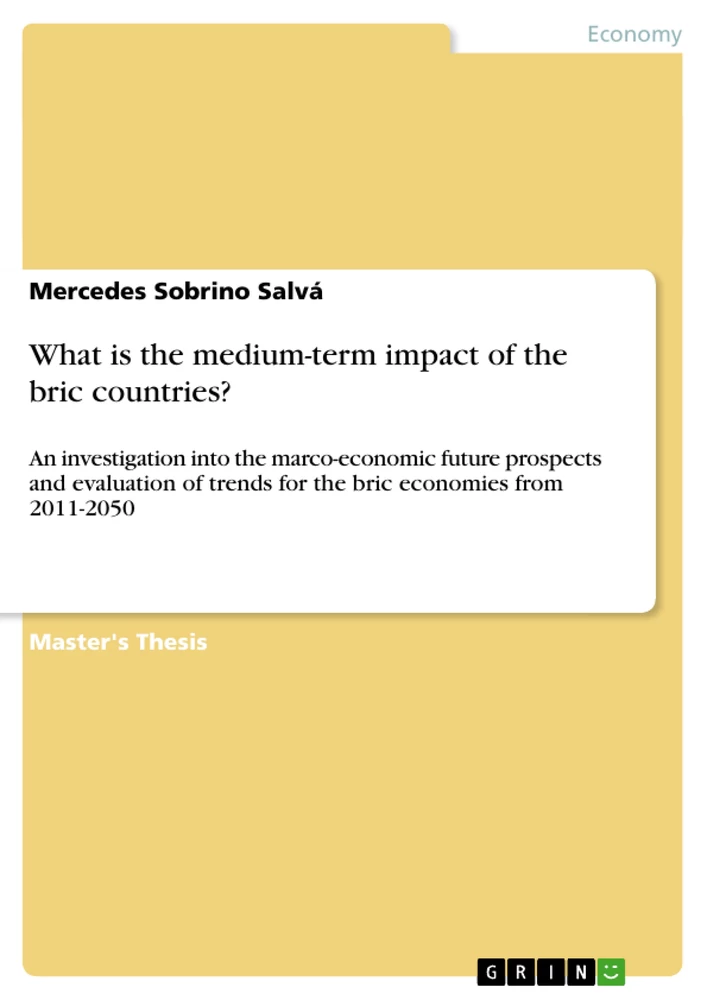
Table of Contents
1. INTRODUCTION
1.1 CHAPTER OVERVIEW
1.2 THE BACKGROUND TO THE STUDY: THE BRIC ECONOMIES
1.3 RESEARCH AIM AND OBJECTIVES
1.4 KEY TERMS
1.5 OUTLINE OF THE DISSERTATION
2. LITERATURE REVIEW
2.1 CHAPTER OVERVIEW
2.2 MACRO ENVIRONMENTAL ANALYSIS
2.2.1 PESTLE framework’s definition
2.2.2 Brief history of PESTLE
2.2.3 Advantages and disadvantages of PESTLE
2.2.4 Discussion
2.3 HOFSTEDE’S STUDY OF CULTURAL DIMENSIONS
2.3.1 Arguments for and against Hofstede’s study
2.3.2 Discussion
2.4 ECONOMIC GROWTH AND FACTORS UNDERPINNING ECONOMIC GROWTH
2.4.1 Actual and potential economic growth
2.4.2 Factors underpinning economic growth
2.5 BUSINESS CYCLES THEORY
2.5.1 Economic growth and business cycles
2.5.2 Discussion
2.6 RELATIONSHIP BETWEEN COMPETITIVENESS AND GROWTH
2.6.1 Determinants of competitiveness
2.6.2 The diamond of competitive advantage
2.6.3 The World Economic Forum’s The Global Competitiveness Report 2010-2011
2.7 GLOBAL RISKS 2011, SIXTH EDITION
2.8 SUMMARY
3. METHODOLOGY
3.1 CHAPTER OVERVIEW
3.2 RESEARCH PHILOSOPHIES
3.3 RESEARCH APPROACHES
3.4 RESEARCH STRATEGIES
3.4.1 Different tactics for pursuing research
3.4.2 Methods of investigation
3.5 RESEARCH CHOICES
3.6 TIME HORIZONS
3.7 DATA COLLECTION METHOD
3.7.1 Primary and secondary data
3.7.2 Quantitative and qualitative techniques
3.7.3 Limitations in the data collection
3.8 ECONOMIC MODEL
3.9 THE CREDIBILITY OF THE FINDINGS
3.9.1 Reliability
3.9.2 Validity
3.9.3 Generalisation
3.10 RESEARCH ETHICS
3.11 LIMITATIONS
4. FINDINGS AND ANALYSIS
4.1 CHAPTER OVERVIEW
4.2 PESTLE ANALYSIS
4.2.1 Brazil
4.2.2 Russia
4.2.3 India
4.2.4 China
4.3 PROJECTED GDP PER CAPITA UNTIL 2050
4.3.1 Initial findings
4.3.2 Analysis
4.3.3 Overall findings
4.3.4 Analysis
5. CONCLUSIONS AND RECOMMENDATIONS
5.1 CHAPTER OVERVIEW
5.2 CONCLUSIONS
5.3 Further research and recommendations
Research Objectives and Topics
This dissertation investigates the macro-economic future prospects and trends of the BRIC (Brazil, Russia, India, China) economies from 2011 to 2050. It examines whether these nations will become the leading economies in terms of GDP per capita, while also identifying socio-economic constraints to their sustainable growth.
- Macro-environmental analysis using the PESTLE framework
- Economic modeling to project future GDP per capita at purchasing power parity
- Evaluation of cultural dimensions using Hofstede's framework
- Assessment of competitiveness factors via Porter's Diamond and WEF reports
Excerpt from the Book
2.2.1 PESTLE framework’s definition
As Johnson, et al. (2008) state, PESTLE is the acronym for Political, Economic, Social, Technological, Environmental and Legal factors. Specifically, it can be highlighted that:
• Politics emphasises the position of governments.
• Economics is linked to macroeconomic factors such as exchange rates, trade cycles and disparity in economic growth rates among countries.
• Social influences are mainly related to changing cultures and demographics.
• Technological influences are related to innovations.
• Legal refers to legislative restrictions.
• Environmental refers to ‘green issues’.
This framework can provide long and complex lists of factors and their interrelations, which need refining and rating in terms of the key drivers for change that are likely to have an impact on the success or failure of a given strategy (ibid). Therefore it needs to be used in the context of a specific objective in order to add value and aid understanding of the dissertation context.
Summary of Chapters
CHAPTER 1: This chapter introduces the rise of BRIC economies, the significance of the study, research objectives, and key terms to set the foundation for the dissertation.
CHAPTER 2: This chapter provides a critical literature review, evaluating the PESTLE framework, Hofstede's cultural dimensions, economic growth theories, business cycles, and competitiveness models.
CHAPTER 3: This chapter details the research methodology, explaining the philosophical approach, research strategies, data collection methods, and the economic model constructed for the study.
CHAPTER 4: This chapter presents the empirical findings and analysis of the BRIC countries using the PESTLE framework and the researcher’s developed economic model for 2050 projections.
CHAPTER 5: This chapter summarizes the research findings, offers conclusions on the growth sustainability of the BRIC nations, and provides recommendations for policy and future research.
Keywords
BRIC, Brazil, Russia, India, China, Macro-economic, PESTLE, Economic Growth, GDP per capita, Competitiveness, Sustainability, Hofstede, Business Cycles, Emerging Markets, Forecasting
Frequently Asked Questions
What is the primary focus of this dissertation?
The dissertation investigates the medium-term and long-term macro-economic prospects of the BRIC countries (Brazil, Russia, India, and China) from 2011 through 2050.
What are the central thematic fields covered?
The study covers macro-environmental factors, socio-cultural dimensions, economic growth drivers, competitiveness, and global risks impacting sustainable growth.
What is the core research objective?
The aim is to evaluate whether the BRIC economies will become the leading world economies in terms of GDP per capita at purchasing power parity by 2050.
Which scientific methods are applied?
The researcher employs a deductive approach, utilizing a mixed-method technique that combines qualitative PESTLE analysis with a quantitative economic model based on business cycle theory.
What does the main body of the research address?
The main body, in Chapter 4, provides detailed PESTLE analyses for each individual BRIC country and presents GDP projections through a self-developed economic model compared against studies by Goldman Sachs and PwC.
Which keywords define this research?
Key terms include BRIC, GDP per capita, PESTLE, sustainable growth, economic modeling, and emerging market competitiveness.
How does the study address the reliability of the findings?
The researcher uses secondary data from reputable sources like the World Bank and applies triangulation to ensure findings are evaluated from multiple perspectives and validated against existing economic theories.
What conclusion does the author reach regarding the BRICs' future?
The author concludes that while the BRICs will continue to grow, they are not expected to become the leading economies in per capita terms by 2050, as their massive populations significantly lower the per capita figures compared to advanced nations.
Ende der Leseprobe aus 131 Seiten
- nach oben
- Arbeit zitieren
- Mercedes Sobrino Salvá (Autor:in), 2011, What is the medium-term impact of the bric countries?, München, Page::Imprint:: GRINVerlagOHG, https://www.diplomarbeiten24.de/document/170736

neugierig - aktuell - relevant
Entdecken Sie hilfreiche Tipps und Tricks rund ums Studium!

Entdecken Sie hilfreiche Tipps und Tricks rund ums Studium!
Ihre Hausarbeit / Abschlussarbeit:

- - Publikation als E-Book und Buch
- - Hohes Honorar auf die Verkäufe
- - Für Sie komplett kostenlos - mit ISBN
- - Es dauert nur 5 Minuten
- - Jede Arbeit findet Leser

- © GRIN Publishing GmbH.
- Alle Inhalte urheberrechtlich geschützt. Kopieren und verbreiten untersagt.
- info@grin.com
- AGB
- Open Publishing
Der GRIN Verlag hat sich seit 1998 auf die Veröffentlichung akademischer eBooks und Bücher spezialisiert. Der GRIN Verlag steht damit als erstes Unternehmen für User Generated Quality Content. Die Verlagsseiten GRIN.com, Hausarbeiten.de und Diplomarbeiten24 bieten für Hochschullehrer, Absolventen und Studenten die ideale Plattform, wissenschaftliche Texte wie Hausarbeiten, Referate, Bachelorarbeiten, Masterarbeiten, Diplomarbeiten, Dissertationen und wissenschaftliche Aufsätze einem breiten Publikum zu präsentieren.
Kostenfreie Veröffentlichung: Hausarbeit, Bachelorarbeit, Diplomarbeit, Dissertation, Masterarbeit, Interpretation oder Referat jetzt veröffentlichen!
Folgen Sie GRIN auf


- GRIN Verlag GmbH
-
- Nymphenburger Str. 86
- 80636
- Munich, Deutschland
- +49 89-550559-0
- +49 89-550559-10
- info@grin.com
-
